For Barcelona families, the strongest Coral Gables acquisition begins with school selection, then aligns the residence, staff plan, design brief, and occupancy model around local rules.

A move from Barcelona to Coral Gables is rarely a simple change of address. For an internationally mobile household, the residence must accommodate the academic year, intercontinental travel, household staff, visiting family, and extended periods when the principals are abroad but the responsibilities of ownership remain.
That makes sequencing decisive. School selection should precede neighborhood selection. Staffing requirements should shape the floor plan before a purchase contract or renovation brief is finalized. Occupancy should reflect genuine residential use, with any future leasing structured within local duration rules. The objective is not simply to find the largest house, but to secure a home that remains coherent in every season.
The best residence is the one that keeps school, staff, and ownership logistics aligned.
Coral Gables and its surroundings offer multiple education options, but no universal admissions timetable or documentation standard applies. Each school may establish its own deadlines, testing, records, guardianship, and visa-related requirements. Families should contact candidate schools directly and create a written admissions schedule for each child.
The initial shortlist may include local schools with an international orientation. International Studies Charter School, at 3930 S. Le Jeune Road, is one Coral Gables option. Its inclusion does not replace direct diligence on eligibility, admissions, commute, and any residency considerations.
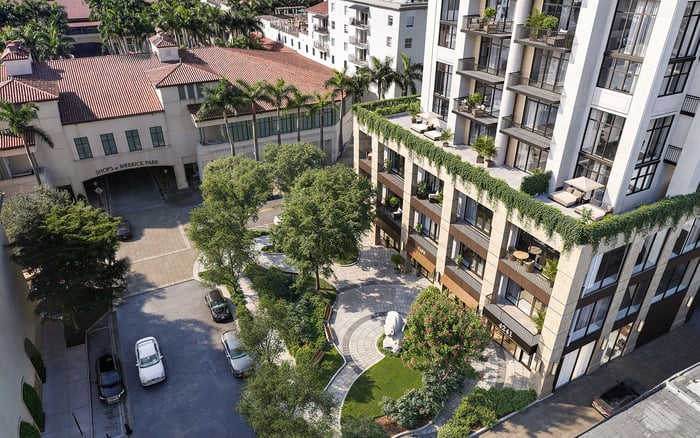
Once the shortlist is credible, map school-day travel from candidate addresses at the relevant hours. This reverses the conventional luxury search process, but prevents an exceptional property from becoming operationally inconvenient. Buyers considering a managed residential format can compare Cora Merrick Park and Ponce Park Coral Gables as part of that location exercise, assessing each against the family’s actual daily routes.
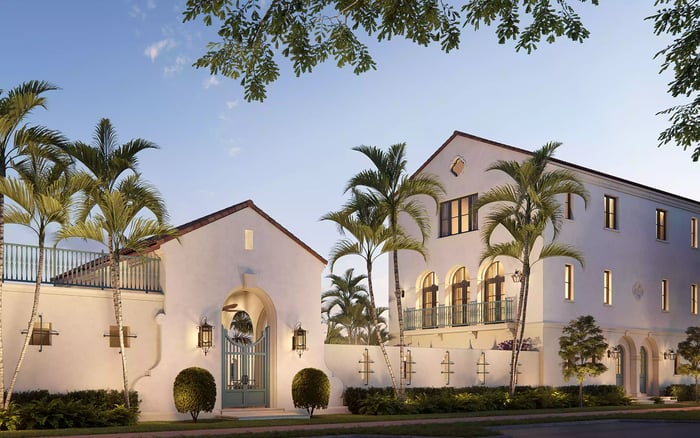
A Barcelona household may instinctively favor a Mediterranean architectural language, yet the visual brief must conform to local planning expectations. Single-family guidance emphasizes a primary facade oriented toward the principal street and compatibility with the surrounding neighborhood character. Barcelona-inspired courtyards, arcades, textured masonry, and shaded outdoor rooms must therefore be adapted to the site rather than imported as a fixed composition.
For a new build or major expansion, coverage is a first-order design constraint. Typical maximum principal-building coverage is 35 percent of the building site. Combined coverage can reach 45 percent when qualifying accessory structures are included, subject to the applicable site and design rules. These figures should be verified for the specific parcel and proposal before design assumptions harden.
Here, design and architecture become operational disciplines. Staff rooms, kitchens, laundry, storage, cabanas, pools, and service access all compete for finite site capacity. Buyers drawn to an established neighborhood composition might also consider The Village at Coral Gables while determining whether a house, townhouse-style setting, or another residential format best suits the household.
Live-in staff accommodation is best resolved within the main residence whenever feasible. Temporary buildings are prohibited in single-family districts, limiting modular or interim structures as staffing solutions. Incorporating bedrooms and supporting service areas into the principal plan also reduces the risk that an accessory space could appear to operate as separate transient lodging.
The practical brief should distinguish sleeping quarters from working zones. Consider discreet access, proximity to laundry and kitchen functions, secure storage, and circulation that allows formal rooms to remain composed during daily service. If drivers, nannies, caregivers, or rotating personnel are contemplated, seek advice from U.S. employment, tax, and immigration counsel. Do not make generalized assumptions about payroll, overtime, workers’ compensation, or work authorization.
For buyers evaluating nearby alternatives, Four Seasons Residences Coconut Grove can form part of a broader Coconut Grove comparison. The purpose is not to expand the search indiscriminately, but to determine whether another residential model better accommodates staffing and maintenance preferences.
Coral Gables is not a conventional short-stay strategy. In affected single-family and multifamily residential areas, stays shorter than six months are not permitted, except for designated historic bed-and-breakfast establishments. Residential rental agreements must run for at least six months, excluding nightly, weekly, and typical seasonal rentals.
Citation and enforcement procedures are established, and alleged short-term accommodation activity has been pursued through code hearings. A family dividing its time between Barcelona and South Florida should therefore treat the property as a retained residence or lease it only for a compliant term of six months or longer.
The six-month rule governs rental use, not ordinary owner travel. Even so, clear records, controlled access, and the absence of transient occupancy are prudent. A second home should have a documented operating protocol covering key custody, staff authority, maintenance visits, mail, security, and arrival preparation. The lifestyle objective is an effortless return, supported by disciplined administration rather than hotel-like turnover.
A Coral Gables search can be benchmarked against Brickell when the family is deciding between a house-led routine and a more urban residential structure. The Residences at 1428 Brickell provides a relevant point of comparison by location and format without altering the central decision criteria.
The investment case should remain subordinate to lawful use and family utility. Rental flexibility, service intensity, school travel, privacy, and staff accommodation vary by residence type. The correct question is not which address appears most prestigious in isolation, but which preserves the household’s standards during school weeks, summer travel, and unoccupied periods.
Begin with school outreach and an admissions calendar. Next, identify realistic daily routes and select target neighborhoods. Then prepare a room-by-room staffing and service brief before evaluating existing houses or renovation potential. For any parcel involving additions or new construction, verify zoning, coverage, accessory structures, facade orientation, and design compatibility with qualified local professionals.
Finally, document the ownership and occupancy plan. Decide who may stay in the home, who holds operational authority, how extended absences will be managed, and whether any future lease would satisfy the minimum term. Legal, tax, immigration, employment, insurance, zoning, and school-admissions advice should be coordinated rather than treated as separate afterthoughts.
For confidential guidance on aligning a South Florida residence with your family’s international life, consult MILLION.
If branded residences are on your mind — as a home or as an allocation — we would be glad to share what we are seeing, privately.
Begin a quiet conversationYes. School location, commute, admissions requirements, and possible residency considerations can materially affect which neighborhood works best.
No universal calendar is supported. Families should confirm deadlines, testing, records, guardianship, and visa-related requirements with each school.
In affected single-family and multifamily residential areas, stays shorter than six months are not permitted, except for designated historic bed-and-breakfast establishments.
No. The rule governs rental use rather than ordinary owner travel, although owners should avoid transient occupancy and keep clear operating records.
Whenever feasible, integrate staff bedrooms and service areas into the main residence rather than relying on temporary structures.
Temporary buildings are prohibited in single-family districts, limiting their use as interim staff accommodation.
Planning materials identify a typical maximum principal-building coverage of 35 percent, subject to the rules applying to the specific site.
Combined coverage can reach 45 percent when qualifying accessory structures are included, subject to applicable site and design rules.
Yes, but it should be adapted to local facade orientation, siting, coverage, and neighborhood-compatibility expectations.
Families should consult U.S. employment, tax, and immigration counsel regarding payroll, overtime, insurance, and work authorization matters.