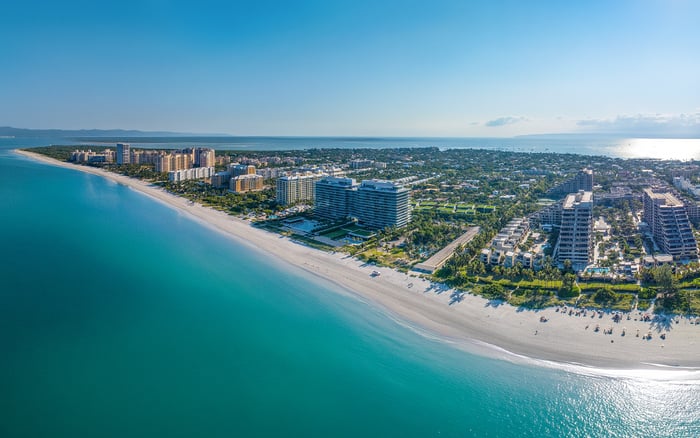
A practical guide for comparing Key Biscayne and Coconut Grove through the lens of lock-and-leave ownership, daily security, package control, and maintenance access.

For buyers choosing between Key Biscayne and Coconut Grove, the lock-and-leave question is rarely whether the home is beautiful enough to return to. It is what happens when the owner is away. Who receives a delivery? Who notices a leaking line? Who admits the air-conditioning technician? Who has eyes on the driveway, lobby, elevator, gate, or service corridor?
Key Biscayne and Coconut Grove both appeal to sophisticated South Florida buyers who prize privacy, water proximity, and a residential rhythm removed from the commercial intensity of Brickell or Miami Beach. Yet the two markets solve absence differently. Key Biscayne often feels more contained, with an island setting that can support a stronger sense of entry, predictability, and neighborhood continuity. Coconut Grove is more varied, with historic streets, bayfront enclaves, boutique condominiums, townhomes, and single-family residences that can differ dramatically from one block to the next.
The buyer shorthand is imperfect: Key Biscayne is not one security profile, and Coconut Grove is not one access model. A second-home owner may need a gated-community protocol, a boutique staffed building, a private estate plan for single-family homes, or a policy for pets, guests, and recurring vendors. The stronger purchase is the one whose daily systems match how the owner actually lives.
Security should be assessed in layers. The first layer is perimeter control: gates, guardhouses, lobby desks, private elevators, camera coverage, lighting, garage access, and visitor screening. The second layer is human judgment: whether staff know residents, whether guest lists are current, whether overnight activity is monitored, and whether a manager can escalate an issue without waiting for an owner to answer from another time zone. The third layer is unit-level discipline: smart locks, leak sensors, alarm monitoring, water shutoff habits, and interior access logs.
Key Biscayne can appeal to buyers who want a more contained environment. For some owners, the act of crossing onto an island carries psychological value as well as practical value. The decision should still be made property by property. A waterfront home with private landscaping may require a different plan than a staffed condominium. A secure entry point does not replace the need for a clear vendor protocol, especially when pool, landscape, housekeeping, and marine-related services are involved.
Coconut Grove rewards more granular diligence. One address may offer a staffed, service-oriented condominium experience, while another may be a private residence that depends on cameras, gates, neighbors, and a trusted property manager. The Grove's charm is its texture, but that texture means buyers should not assume a single standard. In a mature, leafy neighborhood, visibility can be lower, which is excellent for privacy but demands disciplined planning for maintenance and emergency response.
Package handling is a deceptively important test of lock-and-leave quality. Luxury owners receive more than ordinary mail. They may receive wardrobe shipments, wine, art-related materials, medicine, guest supplies, replacement parts, electronics, and time-sensitive documents. A building or home that cannot handle deliveries cleanly can become inconvenient very quickly.
In a staffed condominium, ask how packages are logged, where they are stored, whether refrigerated storage is available, how long items may remain, and how deliveries are released to household staff. The best systems create accountability without turning every delivery into a call to the owner. For buyers who travel often, the goal is not merely receipt. It is chain of custody.
In a single-family setting, the package question is more personal. A gate code sent to too many vendors becomes a liability. A visible doorstep becomes a signal of absence. A lockbox without controls can undermine an otherwise thoughtful security plan. Key Biscayne owners may benefit from neighborhood familiarity, but they still need a written delivery procedure. Coconut Grove owners may need a property manager or household employee empowered to collect, inspect, and place items inside.
The right question is simple: if the owner is away for three weeks and five important packages arrive, what exactly happens? If the answer is vague, the property is not yet truly lock-and-leave.
Maintenance access is where many second-home ownership plans become either elegant or exhausting. South Florida homes need regular attention. Air-conditioning, humidity control, pool systems, landscaping, elevators, generators, pest control, window maintenance, irrigation, and housekeeping are not occasional concerns. They are part of the ownership rhythm.
In Key Biscayne, a buyer should consider how many vendors will require routine access and whether that access is through a main entry, side gate, service entrance, dock area, garage, or staff corridor. A home that is easy to service can be a pleasure to own. A home that requires owner involvement for every appointment can feel demanding, even if it is technically secure.
In Coconut Grove, the range is wider. Some residences are highly private but require active management. Others are designed for service flow, with staff access, building management, and established procedures. The ideal plan separates owner spaces from service routes whenever possible. It also documents permissions: who may enter, when they may enter, whether they require supervision, and how completion is confirmed.
Insurance and liability should not be afterthoughts. Owners should confirm that recurring vendors are properly vetted and that building or community rules do not conflict with the desired service schedule. A refined lock-and-leave experience depends on trust, but it should be trust supported by records, permissions, and repeatable routines.
Choose Key Biscayne if your priority is a quieter, more contained setting where daily movement can feel more legible and island living is part of the appeal. It can suit owners who want a strong residential atmosphere, water proximity, and a sense of separation from the city. The tradeoff is that individual properties still require close review, especially if the home is large, landscaped, waterfront, or dependent on multiple service vendors.
Choose Coconut Grove if you want character, canopy, village energy, and a more varied residential fabric. The Grove can be exceptional for buyers who like privacy without isolation and who appreciate a neighborhood that feels layered rather than uniform. The tradeoff is that every address must be evaluated on its own operational merits. A beautiful home is not automatically an easy home to leave unattended.
For the ultra-premium buyer, the best comparison is a practical walk-through. Arrive as if you were leaving tomorrow. Ask where the luggage goes, who locks up, who checks humidity, who receives wine, who admits the electrician, who sees an alarm notice, and who can act when the owner cannot. The answer will often reveal more than the view.
Is Key Biscayne better for lock-and-leave ownership? It can be, particularly for buyers who value a more contained island setting. The specific building, home, staff, and access procedures matter more than the ZIP code alone.
Is Coconut Grove harder to manage from afar? Not necessarily, but it is more address-specific. Some Grove properties are highly service-oriented, while others require a dedicated property manager.
What is the most important security question to ask? Ask who can act when you are unreachable. A strong protocol includes authority, documentation, and escalation, not just cameras or gates.
Should I prioritize a staffed building over a private home? A staffed building can simplify packages and vendor access. A private home can work beautifully if it has professional management and disciplined entry controls.
How should packages be handled while I am away? There should be a clear chain of custody, secure storage, and a release process for household staff or approved representatives. Vague package procedures are a warning sign.
Do smart locks solve maintenance access? They help, but they are not a complete policy. Access should still be limited, logged, scheduled, and paired with vendor vetting.
What vendors matter most for South Florida ownership? Air-conditioning, humidity control, pool service, landscaping, pest control, housekeeping, and emergency plumbing response are often central. The exact list depends on the property.
How do I compare two similar properties? Simulate a month away and map every delivery, service visit, alarm, and guest arrival. The property with the cleaner operating plan is usually the stronger choice.
Are gated communities always safer? Gates can add an important layer, but they do not replace staff judgment, resident discipline, or unit-level protections. Security is strongest when layers work together.
What should be decided before closing? Confirm package procedures, vendor permissions, emergency contacts, insurance requirements, access technology, and management responsibilities. These details shape the ownership experience from day one.
For a tailored shortlist and next-step guidance, connect with MILLION.
If branded residences are on your mind — as a home or as an allocation — we would be glad to share what we are seeing, privately.
Begin a quiet conversation