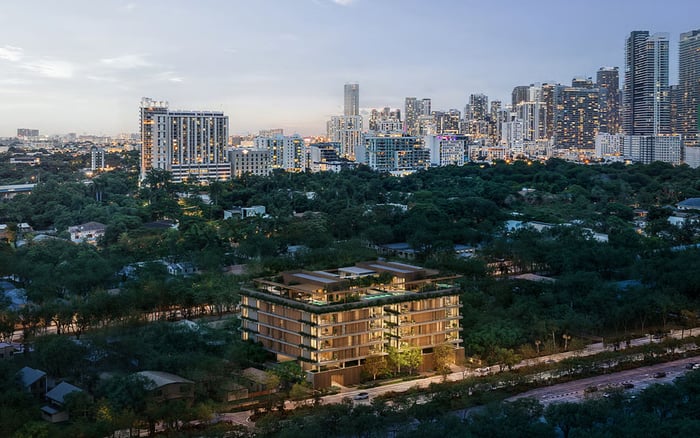
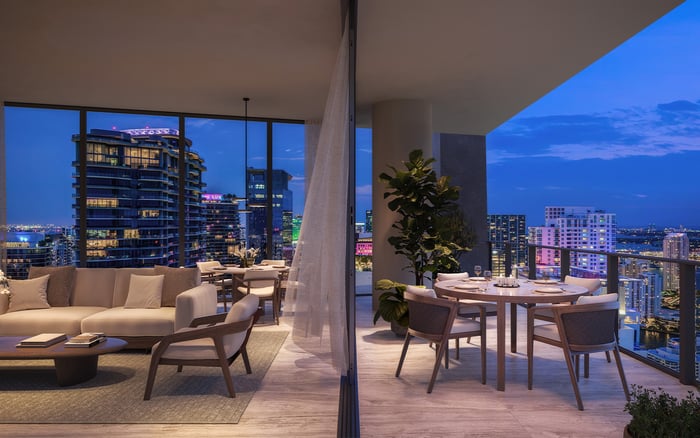
Frida Kahlo Wynwood Residences combines furnished condominium ownership, short-term rental flexibility and selected service benefits. Buyers should assess how those uses will be managed from street arrival to the residence, without assuming private elevators or security protocols are confirmed.
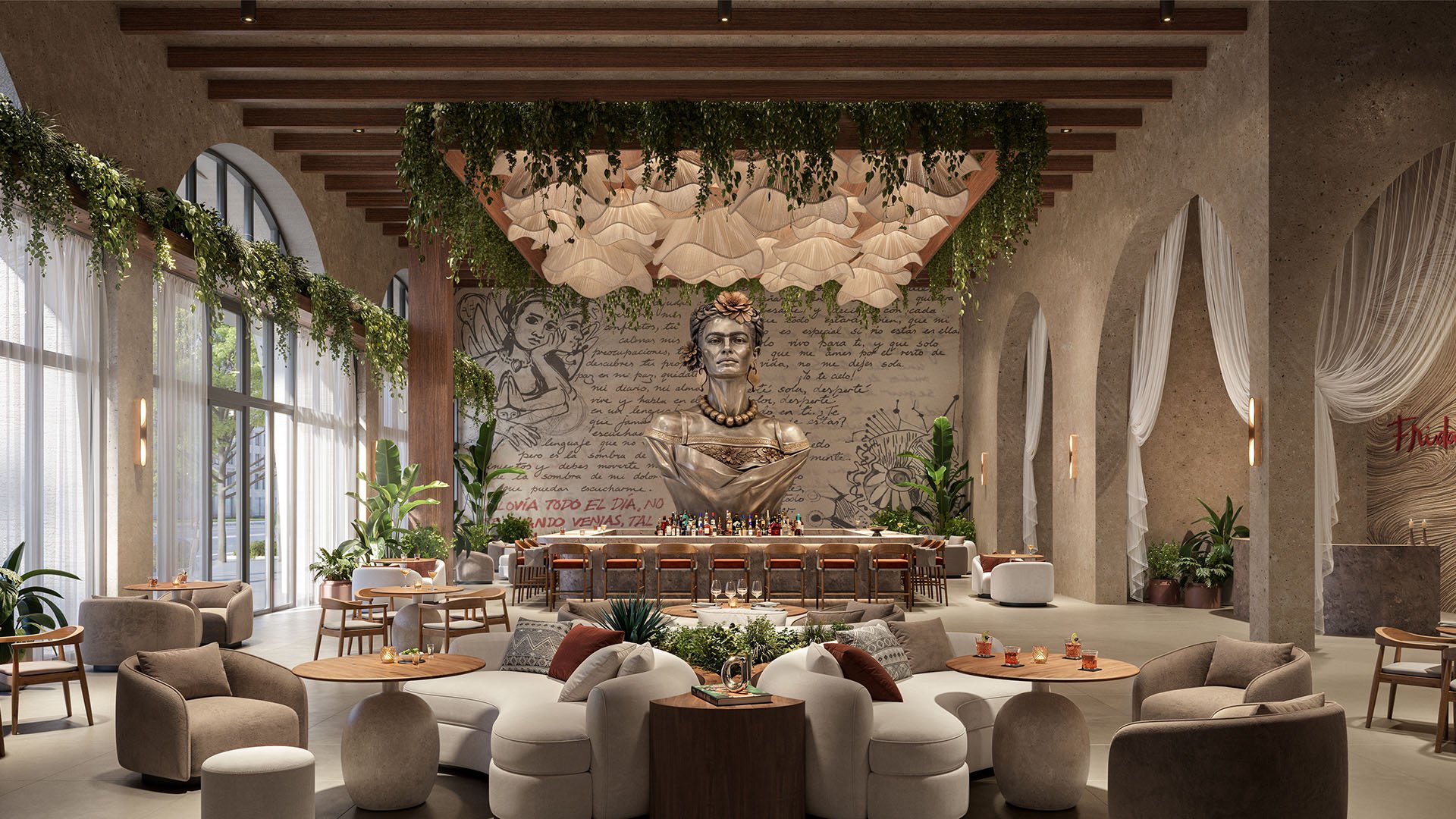
At Frida Kahlo Wynwood Residences, ownership extends beyond a furnished Miami address. The planned 244-unit condominium at 119 NW 29th Street combines homes marketed as short-term rental-friendly, deeded office suites associated with some residences, and a concierge medical membership with an on-site center. For buyers, the central question is how these elements will coexist without compromising residential privacy.
Security should be evaluated as a continuous journey: curb arrival, building admission, movement through shared spaces, elevator authorization and entry into the home. Private-elevator access is not confirmed for this project. It should therefore remain a due-diligence question, not be treated as an established amenity.
The objective is not to assume that flexible occupancy weakens security. It is to establish whether the proposed operating model makes access predictable for owners and sets clear boundaries for everyone else.
Developed by Property Markets Group and LNDMRK Development, the project offers studios through three-bedroom residences marketed as fully finished and furnished. The proposition may appeal to purchasers seeking a second home with fewer furnishing decisions, as well as those considering rental use. Neither the furnishing package nor the rental positioning, however, establishes how the building will be managed.
That distinction matters with deeded office suites. These form part of the offering for some homes, not necessarily every residence. Purchasers should establish precisely what is conveyed with their selected home, how the office may be used, and whether separate rules govern visitors, business activity or access hours. An office deed should not be interpreted as permission for unrestricted client traffic.
The medical benefit also warrants precision. Ownership includes a Baker Health concierge membership, complimentary during the first year of occupancy, followed by discounted rates for the duration of residency. This is not a promise of permanently free medical care. Buyers should request the membership agreement and distinguish membership privileges from the cost of individual services.
Short-term rental-friendly is a positioning statement, not a complete operating agreement. Minimum stays, guest registration requirements and detailed rental rules remain unspecified. Before factoring rental flexibility into an acquisition decision, buyers should obtain the applicable condominium documents and proposed operating policies, then review them with counsel.
The security implications are practical. Ask who will verify a rental guest, who may issue an access credential, when it expires and how an owner can revoke it. Establish whether cleaners, property managers and maintenance personnel would receive separate permissions rather than use a guest's or owner's access.
These are proposed safeguards to investigate, not confirmed project systems. Their value lies in accountability: each authorized person should have a defined reason to enter, an appropriate destination and a clear end to that permission. Purchasers planning occasional rentals should also ask who handles arrival problems when they are unavailable. Flexibility is more useful when responsibility is unambiguous.
Begin with the transition from the street into the property. Request an arrival plan showing pedestrian entry, any vehicle arrival arrangements and the intended locations for deliveries and guest reception. Do not infer a staffed entrance, valet operation or separate service route from an architectural rendering.
Then walk through ordinary scenarios with the sales and management teams. Consider an owner with luggage, a late-arriving rental guest, a food delivery and an office visitor-all arriving at once. Where would each person wait? Who would authorize entry? Could someone proceed toward residential circulation before being identified?
The available project details do not establish guard staffing, camera specifications or visitor-management systems. Buyers should request written descriptions of proposed coverage, after-hours procedures and incident escalation. The goal is not an impressive inventory of equipment, but a coherent explanation of who takes responsibility at each transition. Any promised service should also be reconciled with the proposed operating budget.
The architectural design team comprises Carlos Ott and CUBE 3, with interiors by Cotofana Designs. Those credentials establish design authorship, not the details of access control. To assess privacy, buyers need the selected residence's plan and the relevant circulation drawings.
Distinguish among an elevator serving a shared corridor, a restricted-access landing and direct entry into a residence. These arrangements are not interchangeable. If private-elevator access is represented during a sales discussion, ask which homes receive it and where that commitment appears in the purchase documentation.
For purchasers also considering The Residences at 1428 Brickell, the same discipline applies: compare documented access arrangements rather than treating an address or design identity as evidence of privacy. This is a due-diligence standard, not a claim that the projects share elevator configurations.
At Frida Kahlo Wynwood, request an explanation of floor permissions, visitor escort procedures and service access. Ask how emergency access would be accommodated. An exclusive-looking landing cannot answer those operational questions on its own.
An on-site medical center and deeded office suites raise additional questions about circulation. Neither feature establishes public access or shared residential routes. Buyers should assume neither complete separation nor unrestricted overlap until the plans and operating rules explain the arrangement.
Ask whether office visitors and medical appointments would use residential reception, whether destinations would have distinct permissions, and how waiting areas would be organized. These questions concern discretion as much as security. Owners should understand whether a routine return home could intersect with other building activities.
When comparing the offering with The Well Coconut Grove, focus on each purchase's documented entitlements and access boundaries. A useful comparison distinguishes what the owner receives, what costs extra and how associated visitors would be managed, without assuming equivalent services or operating models.
Completion expectations have included both 2028 and 2029, so buyers should not treat a single delivery year as settled. Prices, plans, architectural interpretations and specifications are subject to change without notice. The distinction between a presentation and a contractual commitment is therefore particularly important.
Before proceeding, assemble the residence plan, any office-suite documentation, rental restrictions, medical membership terms and proposed access policies. Have counsel identify which commitments are binding and which remain subject to revision. Seek written clarification of unresolved security questions rather than relying on verbal assurances.
The strongest ownership proposition is one whose everyday operation is as clear as its design. At Frida Kahlo Wynwood, that means understanding every transition from curb to front door, including any private-elevator arrangement only if expressly confirmed.
For a discreet perspective on South Florida ownership and buyer due diligence, explore MILLION.
If branded residences are on your mind — as a home or as an allocation — we would be glad to share what we are seeing, privately.
Begin a quiet conversationIt is a planned 244-unit condominium development at 119 NW 29th Street in Miami's Wynwood arts district, developed by Property Markets Group and LNDMRK Development.
The offering ranges from studios to three-bedroom homes, marketed as fully finished and furnished.
No. Private-elevator access is not confirmed, so buyers should request residence-specific plans and written contractual clarification before assuming it is included.
No. Minimum stays, guest registration requirements and operating rules remain unspecified and should be reviewed before purchase.
Not necessarily. Deeded office suites are associated with some homes, and buyers should verify the conveyance and permitted uses for their selected residence.
The offering includes concierge membership with an on-site center, complimentary during the first year of occupancy and discounted thereafter for the duration of residency. It should not be understood as permanently free medical care.
The available project details do not establish guard staffing, camera specifications or visitor-management systems. Buyers should request written descriptions of proposed operations.
No. These features do not establish public access or shared residential circulation; plans and operating rules should clarify the intended boundaries.
Completion expectations have included both 2028 and 2029, without a single consistent delivery date. Buyers should review current contractual scheduling provisions.
Request residence and circulation plans, proposed access policies, rental restrictions, any office-suite documentation and medical membership terms. Counsel can help distinguish binding commitments from proposed features.