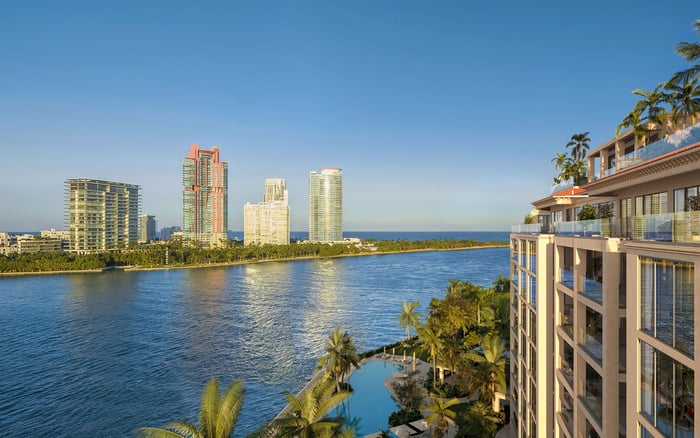
A disciplined South Beach acquisition weighs parcel-level flood exposure, building resilience, association finances, insurance and neighborhood adaptation against future resale appeal.

South Beach waterfront ownership is often framed by outlook, privacy and access. A more durable acquisition thesis begins one level deeper: with how the exact parcel, structure and association respond to water. Compound flooding encompasses sea-level rise, groundwater and storm surge rather than treating each condition in isolation. That distinction matters because a residence can be protected at the unit level while its garage, electrical equipment, pumps, seawall or surrounding streets remain exposed.
The scale of the issue is material. More than 67,000 structures and other assets have been identified as vulnerable to sea-level rise within the city’s 2070 planning horizon. That does not make every asset equivalent. It reinforces the need to compare properties individually, with both building and neighborhood conditions in view.
For buyers considering Apogee South Beach or Continuum on South Beach, the address and waterfront position should begin the analysis, not conclude it. South of Fifth inventory can command attention for its scarcity and setting, but resale strength will increasingly favor assets whose physical preparation and ownership economics are easy for the next buyer to understand.
Confirm the flood-zone classification for the exact parcel. Do not infer it from a building name, a neighboring tower or Miami Beach’s general reputation. Special Flood Hazard Area and Coastal High Hazard Area designations carry distinct disclosure implications, while the latter makes storm-surge exposure a separate diligence question for bayfront and oceanfront property.
Next, request available elevation records and compare them with the applicable Base Flood Elevation. Base Flood Elevation represents the projected floodwater height during a storm with a 1 percent chance of occurring in any year. Miami Beach resilient-construction standards require new construction to sit approximately one to five feet above that elevation, depending on the applicable requirement.
Construction year alone is not enough. Verify the finished-floor elevation, garage entry, loading areas and critical mechanical or electrical equipment. Ask where backup systems are located and which common elements must remain operational after a weather event. A structure below the applicable flood elevation may need to be raised if substantially damaged or substantially improved, potentially changing renovation assumptions and post-storm capital requirements.
When reviewing a contemporary option such as Five Park Miami Beach, treat the design presentation as the opening to a technical conversation. Request documents showing how elevation, materials and critical systems were addressed rather than relying on age or appearance as a proxy for resilience.
Florida residential sellers must provide a completed flood-risk disclosure at or before execution of the sales contract. Sophisticated buyers should make this a pre-contract document, not an item deferred to closing. The form asks whether the seller has filed an insurance claim for flood damage and whether federal assistance for flood damage has been received.
The statutory definition of flooding is broad. It includes the overflow of inland or tidal waters, rapid accumulation of runoff or surface water, and sustained standing water caused by rainfall. The disclosure also warns that homeowners insurance does not cover flood damage and directs purchasers to discuss separate flood insurance with an insurance professional.
Disclosure is a starting point, not a substitute for an independent zone review, elevation verification, inspection or insurance quote. Preserve the signed form alongside flood-zone documents, elevation records, insurance proposals and known claim information. A complete acquisition file can reduce friction when a future lender, insurer or purchaser asks the same questions.
In a condominium, a high-floor residence may have limited direct water exposure while remaining financially connected to vulnerable common elements. Review the association’s insurance program, deductibles, reserves, inspection materials, capital plans and history of storm-related work. Determine who maintains the seawall, pumps, garage systems, generators, elevators and exterior envelope.
Ask for the building’s storm procedures and the expected sequence for restoring access and essential services. Then stress-test potential special assessments against the ownership horizon. The objective is not to eliminate every risk. It is to understand which risks are insured, reserved for, mitigated through design or retained by owners.
A comparison involving The Ritz-Carlton Residences® South Beach should therefore include more than residence pricing and service expectations. Place association obligations, recurring insurance expense and infrastructure protection alongside the lifestyle proposition. This is the practical core of a waterfront buyer’s guide analysis.
Building resilience and neighborhood resilience are distinct layers of value. Review modeled exposure and planned public infrastructure work for the property’s block. The adaptation strategy is intended to guide the protection of infrastructure and neighborhoods as flood exposure increases, using compound-flood modeling within a broader resilience framework.
Public improvements may support long-term confidence, but buyers should verify funding, approval status and completion timing before assigning value. Street access, drainage and nearby utilities can influence usability even when a tower performs well. The relevant question is how private systems and public projects work together over the expected holding period.
The same discipline applies when considering The Perigon Miami Beach. Compare documented building measures with block-level conditions, anticipated ownership costs and the clarity of information available to a future purchaser.
Long-term liquidity depends partly on how readily another buyer can underwrite the property. Organize a permanent file containing the seller disclosure, exact flood-zone confirmation, available elevation materials, inspections, insurance quotes, claim information and association records. Update it after capital work, policy changes or storms.
Compare recurring expenses as carefully as resilience features. Premiums, deductibles, reserves, maintenance and assessments shape the total cost of ownership, which can narrow or broaden the next buyer pool. The most compelling resale narrative is evidence-based: a desirable residence, a prepared building, a transparent association and a neighborhood plan whose status has been verified.
Is a high-floor residence insulated from flood risk? Not entirely. The unit may be elevated, but garages, elevators, electrical systems, pumps and access roads can create association-level exposure.
Should buyers rely on the seller’s flood disclosure? Use it as the required starting point, then conduct independent flood-zone, elevation, inspection and insurance diligence.
When must the flood-risk disclosure be delivered? It must be provided at or before execution of the residential sales contract.
Does homeowners insurance cover flood damage? The mandated disclosure warns that it does not, so buyers should discuss separate flood coverage with an insurance professional.
Why verify the exact parcel’s flood zone? Designations can vary by parcel, and nearby properties or a shared neighborhood name are not reliable substitutes.
What is Base Flood Elevation? It is the projected floodwater height during a storm with a 1 percent chance of occurring in any year.
Which elevations should condominium buyers examine? Review finished floors, garage entries, loading areas and the placement of critical mechanical and electrical equipment.
Can renovation plans trigger added resilience costs? Potentially. A structure below the applicable flood elevation may need elevation work if substantially damaged or substantially improved.
How do public projects affect value? Drainage, street and infrastructure work may support confidence, but funding, approvals and completion timing should be verified.
What documents best support future resale? Retain disclosures, zone confirmations, elevation records, insurance materials, claim information, inspections and association documents.
For a discreet conversation and a curated building-by-building shortlist, connect with MILLION.
If branded residences are on your mind — as a home or as an allocation — we would be glad to share what we are seeing, privately.
Begin a quiet conversation