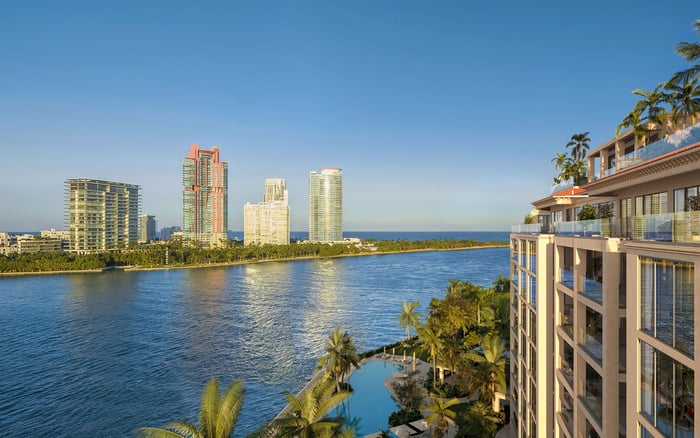
The Perigon’s private condominium model calls for a document-led review of maintenance obligations, water-intrusion records and envelope testing, with La Costa’s predecessor history kept separate from the new construction.

At The Perigon Miami Beach, the appeal of a private oceanfront residence should be matched by an equally precise understanding of ownership. Located at 5333 Collins Avenue in Miami Beach’s Mid-Beach/Millionaires’ Row corridor, the project is positioned as a residential condominium, not a hotel-ownership or condo-hotel product. That distinction frames the purchase. It does not settle who maintains the building envelope or pays for repairs.
For a buyer, the decisive questions lie behind the finishes: how windows, balcony doors and waterproofing are classified; which tests document their installation; and how maintenance, warranties and insurance interact. Private residential positioning is no substitute for reading the condominium declaration.
A history of water intrusion should not be presumed. The available evidence establishes neither a documented Perigon leak incident nor a verified La Costa water-intrusion finding. Nor is there a basis for treating the new development as having a verified, defect-free envelope.
The site previously housed La Costa condominium. Redevelopment followed the acquisition of a majority of its units, termination of its association and demolition of the older building. The Perigon is ground-up construction, not a refurbishment of La Costa’s tower or exterior envelope.
That distinction should govern the document review. Historical La Costa materials belong in a site-context file. Any condition they identify should be evaluated for relevance, not automatically attributed to The Perigon. Neither a predecessor defect nor a predecessor liability should be transferred by assumption.
A separate file should address the new construction: construction-phase water-entry incidents, if any; remediation records; as-built waterproofing details; installation inspections; and applicable field-test results. Ask for each disclosed event to be identified by location, date, affected assembly and documented resolution.
A buyer also considering 57 Ocean Miami Beach should apply the same discipline: evaluate each property’s own records rather than extrapolating envelope performance from a shared coastal setting.
Mast Capital and an affiliate of Starwood Capital Group are developing The Perigon, with Moss Construction identified as contractor. Groundbreaking took place in April 2024. A $390 million construction loan from Eldridge Real Estate Credit was disclosed in January 2025.
These are meaningful development milestones, but none demonstrates successful envelope testing or freedom from leaks. Financial backing and construction credentials do not establish whether installed assemblies met the project’s applicable testing requirements.
January 2025 plans described 73 residences across 17 stories, with completion expected in 2027. Treat those figures as dated planning information, not confirmation of delivery or final specifications. Obtain the current offering documents and delivery schedule rather than relying on conflicting marketing counts.
The residences are described as primarily two- to four-bedroom layouts of approximately 2,100-6,700 square feet, with 10 owner-accessible guest suites also planned. For the suites, confirm legal classification, reservation rights, operating charges and cost allocation. Their presence alone does not establish hotel-style ownership or rental rights.
Start with the declaration and a clear maintenance matrix to understand ongoing responsibility. Ask counsel to identify how the documents treat windows, glazing, frames, balcony doors, balcony surfaces and underlying waterproofing. Do not assume that an element serving one residence is necessarily that owner’s maintenance or replacement obligation.
The review should distinguish routine upkeep, repairs, replacement and consequential interior damage. Ask who arranges access, selects contractors, authorizes emergency work and funds the initial response while responsibility is being determined. Request written clarification wherever the documents leave a material boundary unclear.
For purchasers comparing the ownership experience with Faena House Miami Beach, the useful exercise is to compare the actual allocation of costs and control in each property’s governing documents-not to assume identical obligations.
Ask counsel to reconcile the declaration, maintenance matrix and warranty schedule rather than treating each as a separate assurance. The goal is a usable account of who must act, who may authorize work and who ultimately bears the expense.
References to AAMA 502/503 and ASTM field testing can be relevant to water-infiltration and air-leakage review in hurricane-exposed buildings. They do not establish that The Perigon underwent a particular test, that every relevant assembly was tested or that any test passed.
Request project-specific envelope test records identifying the applicable protocols, tested systems, locations, dates, acceptance criteria and results. An independent envelope specialist should assess which procedures were appropriate and whether the selected locations meaningfully address the proposed residence’s exposure. Exposed windows and balcony doors warrant particular attention.
The record should let the reviewer trace a deficiency through corrective work and, where applicable, retesting and documented closeout. A summary stating that testing occurred is no substitute for the underlying results. Ask the specialist to distinguish completed verification from open items or work still awaiting confirmation.
Review as-built waterproofing details alongside the testing records. The buyer’s objective is not to interpret every technical drawing personally, but to obtain an independent assessment of what the evidence demonstrates and what remains unresolved. Any purchase decision should reflect that distinction.
Request the envelope warranty schedule and complete terms, including coverage, duration, exclusions, maintenance conditions and claim procedures. Have counsel establish who holds each warranty, how claims are pursued and whether relevant transfer or notice requirements apply. Do not assume one warranty covers every component or every form of damage.
Insurance requires a parallel review. Obtain the master policy and ask an insurance adviser to explain deductibles, water-related exclusions and the relationship between association coverage and the proposed owner’s policy. Confirm how any uninsured expense or deductible would be allocated under the governing documents.
Reserves deserve the same attention. Request the available reserve materials and proposed envelope-maintenance provisions, then assess them against the actual allocation of responsibility. No specific reserve balance, coverage level or deductible should be assumed. The financial question is whether the ownership plan addresses future care, not merely initial delivery.
Before closing, confirm the status of the temporary certificate of occupancy, or TCO, versus the final certificate of occupancy. Identify unfinished work and any outstanding envelope items. Ask counsel how unresolved matters interact with the purchase agreement and what written commitments, deadlines or remedies are available.
The strongest review connects three things: documented construction performance, clear maintenance responsibility and a credible financial plan for ongoing care. New construction should begin that inquiry, not end it. For The Perigon, confidence should rest on project-specific evidence rather than assumptions about either its predecessor or its development team.
For a discreet perspective on South Florida residential ownership, explore MILLION.
If branded residences are on your mind — as a home or as an allocation — we would be glad to share what we are seeing, privately.
Begin a quiet conversationThe project is positioned as a private residential condominium rather than a hotel-ownership or condo-hotel product. Specific use and ownership rights should be confirmed in the condominium documents.
The Perigon is at 5333 Collins Avenue, Miami Beach, FL 33140, in the Mid-Beach/Millionaires’ Row corridor.
The available evidence does not establish a documented Perigon leak incident. That does not establish a defect-free envelope or successful project-specific testing.
No. La Costa’s older building was demolished, and The Perigon is a ground-up redevelopment rather than a refurbishment of its tower or envelope.
Mast Capital and an affiliate of Starwood Capital Group are the developers, and Moss Construction is identified as contractor. Those credentials do not establish envelope performance.
Responsibility should be established through the declaration and maintenance matrix. Buyers should not assume an owner or the association bears a particular obligation without reviewing those documents.
Request project-specific records identifying applicable protocols, test locations, acceptance criteria, results, corrective work and closeout. General references to AAMA or ASTM standards do not prove testing occurred.
A specialist can assess test selection, locations, deficiencies and corrective-work documentation. Exposed windows and balcony doors warrant particular attention.
January 2025 plans anticipated completion in 2027. Buyers should obtain the current delivery schedule and confirm occupancy-certificate status rather than treating that expectation as confirmed delivery.
Review envelope warranty terms, claim procedures, master-policy deductibles and water-related exclusions. Confirm how costs are allocated and what reserves address ongoing envelope maintenance.