A buyer-focused guide to judging porte-cochère privacy, operating exposure, and daily comfort in South Florida luxury residences, from sightlines and valet choreography to maintenance obligations and arrival design.
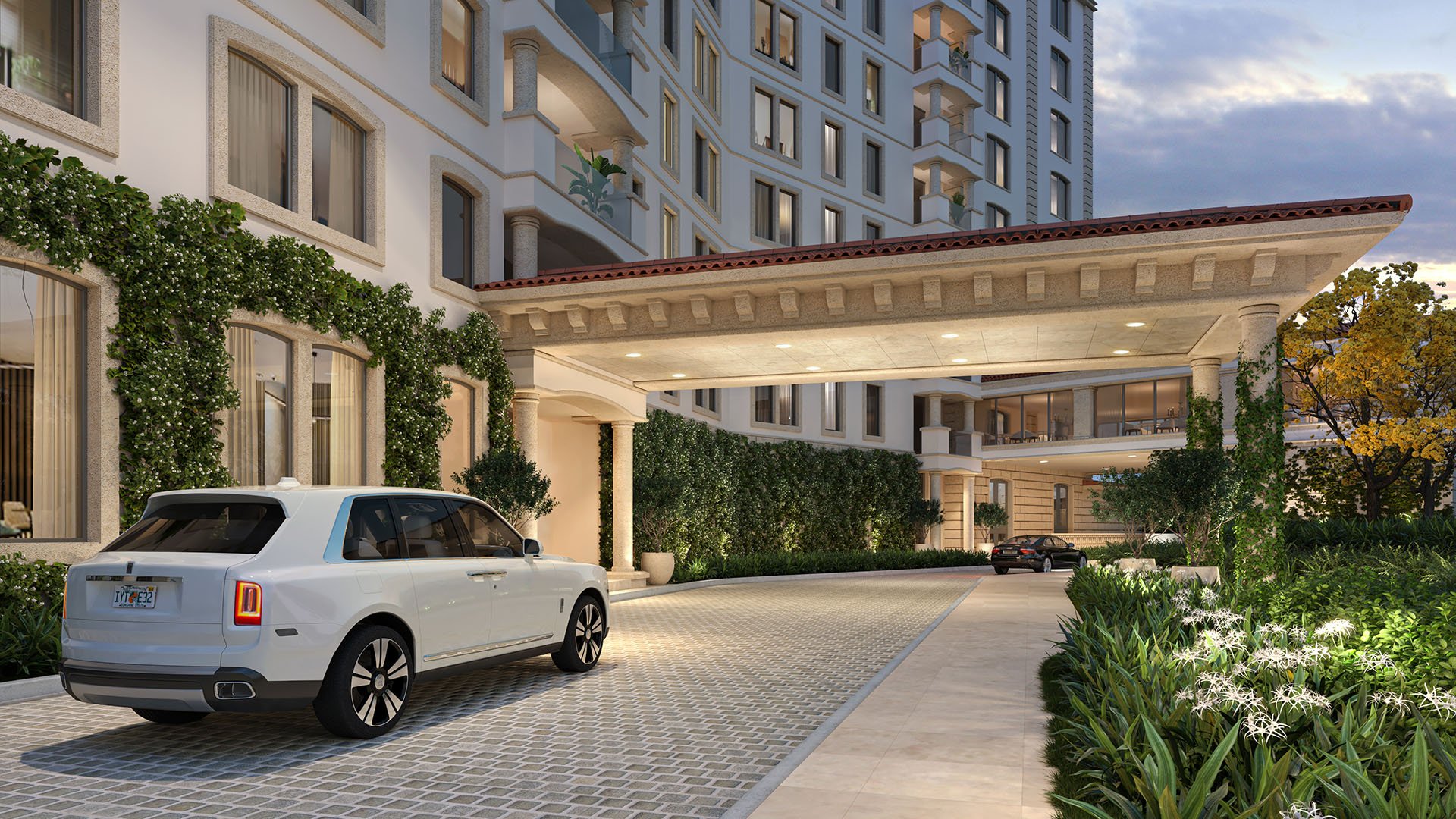
A porte-cochère is often treated as an architectural flourish, but in a luxury residence, it is a working threshold. It is where privacy, service, weather, security, and daily rhythm first intersect. For South Florida buyers, the question is not simply whether the arrival looks impressive. The sharper question is whether it performs gracefully at 8 a.m., during a dinner party, after a flight, or when guests, staff, and family members arrive at once.
The strongest porte-cochère designs feel calm because they remove friction. They create a protected pause between the public realm and the private home. They allow a resident to step out of a car without feeling displayed, hurried, or exposed. They also make the property easier to live in by giving service providers, visitors, drivers, and residents logical paths that do not compromise the main residence.
For discerning buyers, this is a compact space with outsized consequences. Privacy at the arrival court affects how relaxed the home feels. Carrying costs reflect the complexity of maintaining that arrival. Daily comfort depends on whether the space can handle real life, not just photography.
Evaluate privacy from the car, not only from the front door. As you approach, observe whether neighboring windows, street traffic, lobby areas, security desks, amenity terraces, or adjacent driveways have direct views into the vehicle drop-off. A covered arrival can appear secluded while still exposing residents to lateral views from above or across the property.
The best test is to walk the sequence slowly. Sit in the rear passenger seat if possible. Notice what is visible before the door opens, when the door opens, and during the walk from vehicle to entry. A truly private porte-cochère softens each of those moments. Landscape, walls, columns, ceiling depth, lighting placement, and turning geometry should work together, not merely decorate the drive.
For condominium buyers, privacy also depends on shared choreography. If valet, doorman, resident entry, guest check-in, ride service pickup, and delivery activity all converge in one tight zone, visual privacy can erode. A grand canopy does not solve a crowded plan. Ask how residents, guests, vendors, and staff are separated during busy periods, and whether the most private route is available every day or only in theory.
A porte-cochère can influence carrying costs more than many buyers expect. Covered arrivals may involve lighting, drainage, paving, cameras, gates, motors, ceiling materials, fans, landscape maintenance, irrigation, cleaning, pest control, security staffing, and periodic repairs. In a condominium, those obligations may sit within the association budget. In a private estate, the owner carries them directly.
The key is not to avoid complexity. Luxury properties often require it. The key is to understand whether the design is durable, serviceable, and proportionate to the property. Stone surfaces, specialty lighting, integrated audio, concealed cameras, custom gates, and lush planting can create a magnificent sense of arrival, but each element should be accessible and maintainable. A beautiful feature that requires disruptive repair can become a recurring inconvenience.
Ask to review what is included in monthly obligations, what is billed separately, and which parts of the arrival are considered common, limited common, or private. For a single-family residence, inspect the condition of drainage, lighting controls, gate operation, paving settlement, and roof or canopy surfaces. A polished arrival is most valuable when it remains polished without constant intervention.
Daily comfort is where a porte-cochère proves its worth. In South Florida, the covered arrival should make ordinary moments easier: unloading luggage, bringing in groceries, receiving family, transferring children or pets, and stepping out during rain or strong sun. The ceiling height should feel generous without amplifying noise. The turning radius should allow an elegant arrival without awkward reversing. The walking path should be intuitive and protected.
Sound matters. A hard, echoing drive court can make every car door, engine note, suitcase wheel, and conversation feel louder than expected. Materials, ceiling configuration, landscape, and distance from living spaces all shape the experience. If a primary suite, study, or formal living room sits close to the arrival, listen carefully during an active period.
Lighting is another subtle test. Privacy does not mean darkness. The ideal arrival is discreetly illuminated, flattering, and safe, with no harsh glare into car interiors or adjacent rooms. Nighttime evaluation is valuable because a porte-cochère can feel entirely different after sunset. What looks serene by day may reveal unwanted exposure once the lights are on.
Different property types demand different questions. In a tower, the porte-cochère is a shared amenity and an operating system. Its success depends on staffing, valet protocol, guest management, package handling, and how gracefully the building absorbs peak traffic. In an estate, it is more personal. The buyer must evaluate how the motor court relates to the residence, garage, service entry, landscaping, and perimeter privacy.
Buyers often compare this issue across Miami Beach, Brickell, and Sunny Isles, where arrival experiences can vary widely by site planning and building culture. Within a gated community, the entry gate may provide an added layer of separation, but the porte-cochère still determines how private the final arrival feels. New construction can offer contemporary planning advantages, yet buyers should still test the actual sequence. An ultra-modern façade is not a substitute for thoughtful circulation.
The most successful properties avoid making residents perform for the architecture. They allow a quiet return home, a discreet guest arrival, and a service process that stays respectfully in the background. If the arrival feels theatrical but not protective, keep looking more closely.
A serious evaluation should combine observation with direct questions. Who uses the porte-cochère, and at what times? Are ride services allowed to wait there? Where do vendors unload? How are private vehicles separated from guest and service traffic? Are cameras visible or concealed? Who maintains the canopy, paving, lighting, gates, and landscaping? Is there a written protocol for events, storms, or high-volume arrival periods?
Visit at more than one time of day when possible. A quiet midmorning tour may not reveal the same conditions as an evening arrival or weekend shift. If privacy is a priority, ask to experience the route from vehicle to residence exactly as you would use it. The most revealing details are often tactile: the angle of a turn, the time a door remains exposed, the distance to the entry, the sound under the canopy, and the quality of light at night.
For MILLION readers, the porte-cochère should be judged as part of the residence’s living intelligence. It should protect the owner’s privacy, justify its maintenance burden, and make everyday life feel more composed.
Why does porte-cochère privacy matter in a luxury home? It shapes the first and last moments of every arrival. A private sequence allows residents and guests to transition into the home without feeling exposed.
What is the first thing to inspect? Start with sightlines from neighboring properties, streets, lobbies, amenity areas, and upper floors. Privacy can be compromised from angles that are not obvious at the curb.
Can a shared condominium porte-cochère still feel private? Yes, if circulation, staffing, guest handling, and vehicle flow are well organized. The issue is less about sharing and more about choreography.
How can a porte-cochère affect carrying costs? It may require maintenance for lighting, paving, drainage, landscaping, gates, cameras, cleaning, and canopy materials. Review who pays for each component.
Should buyers visit at night? Yes. Night visits reveal glare, visibility into vehicles, lighting quality, security presence, and how active the arrival feels after dark.
What makes an arrival comfortable in daily use? Look for adequate cover, easy turning, quiet acoustics, safe lighting, intuitive access, and enough space for luggage, guests, children, or pets.
Is a larger porte-cochère always better? Not necessarily. Proportion, privacy, drainage, and flow matter more than size alone.
What should estate buyers evaluate differently? Estate buyers should study the relationship between the motor court, garage, service entry, landscaping, and perimeter privacy. Ownership responsibility is usually more direct.
What should condo buyers ask management? Ask about valet protocol, ride service rules, vendor access, event procedures, staffing levels, and maintenance responsibility for arrival components.
Can design beauty and privacy conflict? They can. A dramatic arrival may be visually memorable but still expose residents if sightlines, lighting, or traffic flow are poorly resolved.
To compare the best-fit options with clarity, connect with MILLION.
If branded residences are on your mind — as a home or as an allocation — we would be glad to share what we are seeing, privately.
Begin a quiet conversation