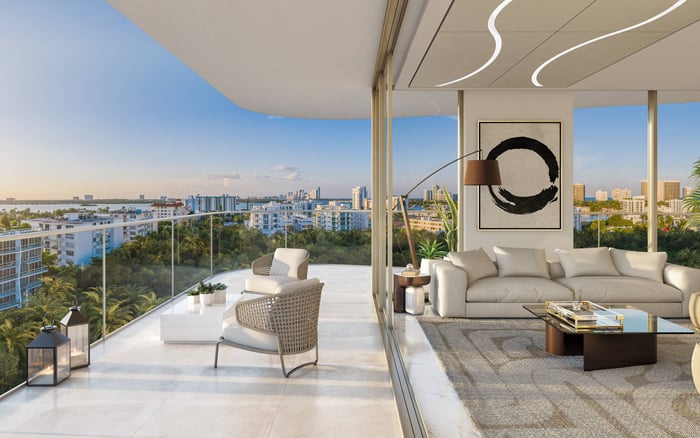
For family collectors, a residence should be evaluated as both a home and a stewardship environment. The most revealing due diligence examines HVAC control, daylight, lighting flexibility, secure storage, service access, and the way children, guests, and staff move through each room.

For a family living with meaningful art, choosing a Bay Harbor Islands residence requires a second layer of judgment. The floor plan must support daily life while providing an environment in which paintings, works on paper, photography, textiles, sculpture, and design objects can be displayed or stored with care.
That evaluation should begin before attention turns to finishes. A polished interior can be altered; infrastructure, glazing, mechanical distribution, storage geometry, and service access may prove more consequential. Treat every viewing as both a residential tour and a collection-management exercise.
This practical buyer’s guide is for the Bay Harbor buyer who values discretion over spectacle. It is especially useful when comparing waterfront residences, where outlook and daylight may shape the initial emotional response to a room.
Begin with a concise collection brief. Record the approximate dimensions, materials, framing requirements, sensitivity, weight, and preferred location of important pieces. Distinguish works intended for permanent display from those rotated seasonally or held in reserve.
Then map those needs onto family life. A fragile floor sculpture may not belong in a primary circulation path. A valuable work on paper may require a different display strategy than a robust object. Children’s rooms, play spaces, entertaining areas, staff routes, and pet zones should all be considered before assigning art walls.
During a visit to Alana Bay Harbor Islands, for example, buyers can bring this brief and evaluate prospective walls, corners, thresholds, and storage areas against actual pieces. Apply the same disciplined approach to every property under consideration.
Do not assume that a comfortable room automatically provides the consistency a collection requires. Ask the owner, developer, or building representative to explain HVAC zoning, thermostat locations, return-air placement, filtration, ventilation, and the controls serving rooms where art may hang.
The objective is not to accept broad assurances, but to understand how the residence operates, what can be adjusted and monitored, and who responds when a system falls outside the owner’s preferred settings. Buyers should also ask where equipment is located, how technicians gain access, and whether maintenance can occur without moving artwork.
At Onda Bay Harbor, a family might use the tour to test these questions room by room rather than discussing the home as a single conditioned volume. Any collection-specific performance standard should be established with a qualified conservator and mechanical professional before closing or beginning interior work.
A bright room can be beautiful, yet the buyer still needs to understand how light behaves throughout the day. Visit at more than one time if possible. Observe direct sun, reflected light, shaded areas, window orientation, overhangs, and the walls receiving the strongest exposure.
Ask what is known about the glazing and whether interior shading can be programmed or operated by zone. Confirm that shades, drapery pockets, sensors, and controls can be integrated without compromising ceiling details. For particularly sensitive works, a conservator can help determine whether a proposed location is appropriate.
When touring La Maré Bay Harbor Islands, photographing empty walls from different viewing angles can help the family’s designer study glare and sightlines later. This turns an impressionistic visit into a more rigorous design and architecture review.
Residential lighting should support several modes: art viewing, entertaining, homework, quiet evenings, cleaning, and nighttime circulation. A single decorative fixture rarely serves them all. Look for the ability to create separate scenes and adjust individual layers without flooding every wall with light.
Before purchase, identify ceiling conditions, likely fixture positions, dimming compatibility, control locations, and the feasibility of future changes. Consider whether lighting can be aimed without creating distracting reflections on glazed frames or screens. A lighting designer should review important works, proposed mounting heights, beam placement, and color quality as part of the interior plan.
The goal is flexibility. Families rotate art, rearrange furniture, and change how rooms are used. A system that can be recalibrated is generally more useful than one designed around a single installation photograph.
Art storage should not be improvised in a crowded household closet. First determine what must be stored vertically, flat, crated, wrapped, or placed on shelving. Then assess clear dimensions, door widths, turning space, floor-loading questions, security, lighting, and proximity to plumbing or other household risks.
A proposed storage area should also suit the family’s operating patterns. Can an art handler reach it without crossing a child’s bedroom? Can inventory be inspected without unpacking the entire room? Is there space for frames, installation hardware, condition records, and temporary staging?
At The Well Bay Harbor Islands, as at any candidate residence, the prudent question is not simply whether storage exists. It is whether the available space can be responsibly adapted for the collection after professional review.
Infrastructure is only half the equation. Establish who may move art, who receives alarms, where keys and records are kept, and how household staff should report condensation, leaks, impacts, or unusual environmental readings. Include instructions for contractors, cleaners, caterers, and guests when activity takes place near important pieces.
Families should also plan for delivery days. Confirm elevator reservations, loading procedures, protective coverings, route dimensions, insurance coordination, and where a piece can safely wait before installation. These operational details may reveal whether a residence suits the collection more clearly than its staging.
Should art considerations come before selecting a floor plan? They should be evaluated alongside family circulation, privacy, and room use, particularly when the collection includes large, fragile, or sensitive works.
Is a standard household thermostat enough for a collection? Not necessarily. Ask a conservator and mechanical professional what monitoring and control are appropriate for the specific works.
How should buyers evaluate daylight during a tour? Observe each prospective art wall from several angles and, where possible, revisit at a different time of day.
What should buyers ask about glazing? Request the available specifications and ask a qualified adviser to interpret them in relation to the collection and proposed display locations.
Are motorized shades sufficient protection for art? They can be one component of a broader plan, but suitability depends on the work, glazing, exposure, controls, and owner behavior.
What makes a useful art-storage area? It needs suitable dimensions, access, organization, security, and an environment reviewed for the materials being stored.
Should art storage be located near household plumbing? Buyers should identify adjacent building services and have the proposed location assessed for avoidable risks before committing to it.
How can families reduce accidental damage? Plan installation heights, circulation routes, furniture placement, staff procedures, and child-aware boundaries before artwork arrives.
When should specialist advisers join the purchase process? Bring them in early enough to inspect a serious candidate and influence negotiations, interior planning, and any proposed alterations.
What records should transfer into the new home? Keep inventories, condition information, installation instructions, contacts, and relevant environmental preferences in a secure, accessible system.
For a discreet conversation and a curated building-by-building shortlist, connect with MILLION.
If branded residences are on your mind — as a home or as an allocation — we would be glad to share what we are seeing, privately.
Begin a quiet conversation