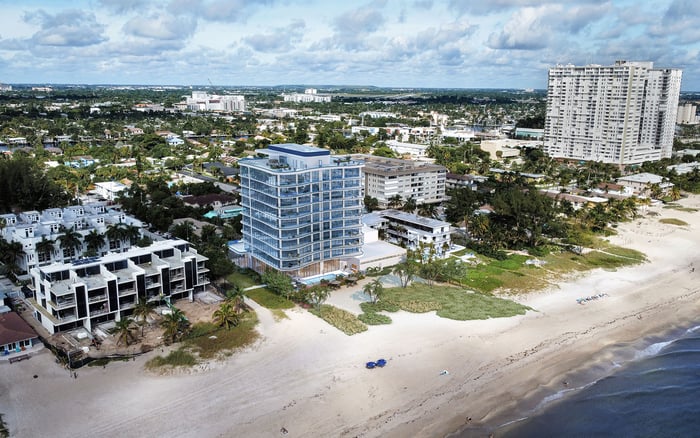
For Hillsboro Beach buyers, a developer’s history and a project’s delivery status can influence more than closing timing. They can shape interim expenses, confidence in the finished residence, privacy expectations, and the practical ease of oceanfront ownership.

In Hillsboro Beach, a polished presentation does not resolve the central questions of a pre-construction purchase. Buyers should identify who is responsible for delivery, what may remain subject to change, and how timing uncertainty could affect the life they intend to lead.
The analysis should extend beyond whether a building is expected to be completed. The more useful inquiry is whether the anticipated schedule, scale, and operating character support the buyer’s financial plan and privacy expectations. Contract documents, applicable records, construction progress, and direct professional advice should carry more weight than marketing alone.
A developer’s name may convey familiarity, but buyers should examine the record at the level relevant to their purchase. Useful areas of review include experience with comparable coastal buildings, approvals, construction, completions, handovers, and consistency between the proposed and delivered programs.
When considering Rosewood Residences Hillsboro Beach, buyers can separate the development story into distinct stages: approvals, construction progress, completion, closing, and operations. No single milestone should substitute for a complete review.
Changes during review may affect a proposal, while visible construction progress can provide context without guaranteeing a closing date. Buyers should assemble these stages into one coherent delivery narrative and confirm the details that matter through the governing documents and appropriate advisers.
Delivery risk becomes tangible when translated into time and obligations. A buyer planning to sell another residence, arrange financing, relocate a household, or occupy seasonally may face additional expenses if closing shifts. Temporary accommodation, storage, travel, overlapping property expenses, and financing arrangements can all be affected by timing.
Consider several schedules rather than relying on one anticipated date. For each scenario, map deposits, financing decisions, existing-home expenses, temporary accommodation, insurance planning, and the intended occupancy period. The relevant exposure depends on the contract and the buyer’s circumstances, so it should be modeled rather than assumed.
Project-related charges also require careful classification. Buyers should distinguish development expenses from recurring ownership costs and ask how any applicable expenses may be allocated. The contract, offering materials, and professional advice should guide that assessment.
Privacy is not established by residence count alone. The lived experience also depends on floor plans, elevator sharing, arrival sequencing, amenity traffic, service access, staffing, guest controls, and neighboring development.
Request circulation information and ask practical questions. Can residents move from vehicle to residence without crossing active social spaces? How are deliveries and household staff handled? Do homes share corridors or elevator landings? Where will pool, beach, fitness, and dining traffic concentrate? A serene view does not by itself define privacy throughout a building.
The same framework can help when comparing coastal alternatives such as Armani Casa Residences Pompano Beach and The Ritz-Carlton Residences® Pompano Beach. The objective is not to compare names alone, but to evaluate how each residence, arrival sequence, and amenity program aligns with the owner’s preferred degree of visibility and service.
Before relying on a zoning rule, fee schedule, permit record, or development proceeding, confirm the jurisdiction that governs the parcel. Address verification and property records can help identify which authority controls permitting, zoning, and development review.
Project-specific records deserve particular attention. Buyers should review the exact site and applicable documents rather than relying on neighborhood-level assumptions.
Waterfront diligence may also include flood and elevation information, formal determinations, available certificates, and records related to seawalls or docks. These materials can inform insurance planning, potential future work, and the intended use of the property. Appropriate legal, insurance, engineering, and inspection professionals can help interpret them.
Delivery and lifestyle should be treated as one decision. Begin with the intended use, whether as a primary residence, seasonal retreat, or long-term holding. Then test the contract schedule, developer record, physical progress, privacy configuration, and coastal documentation against that use.
A buyer who values immediate certainty may place greater weight on construction progress and closing visibility. Another who prioritizes a particular residence, design, or service concept may accept more schedule exposure. The disciplined choice is one in which the risks are identified, financially modeled, and compatible with the owner’s calendar.
Why does developer track record matter in Hillsboro Beach? It can help buyers evaluate whether a team has relevant experience with approvals, construction, completion, and handover in comparable settings.
Is a construction milestone the same as project completion? No. Interior work, inspections, approvals, closings, and operational preparation may remain after a major construction milestone.
How can a delay increase carrying costs? A delay may extend temporary accommodation, storage, travel, financing arrangements, or overlapping ownership expenses, depending on the buyer’s plan.
Should project charges be treated as recurring owner costs? Not without confirmation. Buyers should distinguish development expenses from recurring ownership obligations and review how costs may be allocated.
What does residence count reveal about privacy? It offers one measure of density, but elevator sharing, corridors, access controls, staffing, and amenity traffic also shape the experience.
Why should buyers verify the governing jurisdiction? The applicable jurisdiction controls the relevant permitting, zoning, fees, and review records for the parcel.
What coastal documents deserve attention? Buyers may review flood and elevation information, available certificates, and relevant waterfront permit records with qualified advisers.
Should seawall and dock records be investigated? Yes, when those features are relevant to the property. Available permits, approvals, inspection materials, and as-built records may help clarify their status.
Can a proposed project change before delivery? Plans and programs may change, subject to the governing documents and applicable review. Buyers should distinguish marketing concepts from current approved or contractual materials.
What is a useful delivery-risk exercise? Compare the anticipated schedule with moderate and longer-delay scenarios, then connect each one to financing, housing, and occupancy plans.
For a tailored shortlist and next-step guidance, connect with MILLION.
If branded residences are on your mind — as a home or as an allocation — we would be glad to share what we are seeing, privately.
Begin a quiet conversation