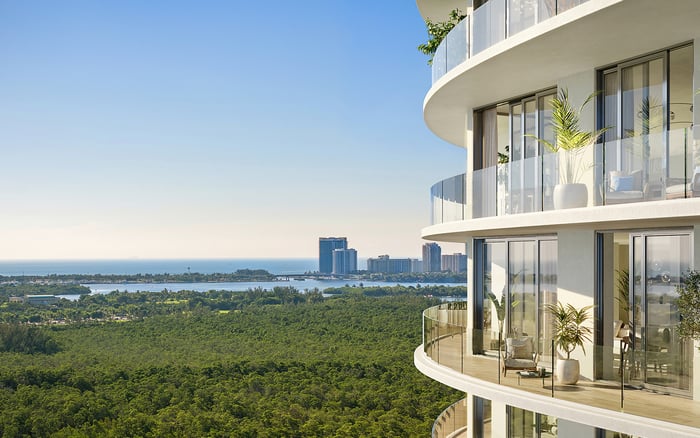
A discreet buyer’s guide to assessing private elevators, controlled arrival sequences, access permissions, service circulation, resilience, and resale relevance in North Miami luxury residences.

In North Miami, the appeal of a private elevator is not simply that the doors open closer to the residence. Its real value lies in the choreography: how a resident enters the property, moves from vehicle to lobby or lift, controls guest access, receives deliveries, and preserves privacy without making daily life feel overmanaged. For a luxury buyer, controlled arrival is part architecture, part operations, and part long-term asset protection.
A private elevator can feel exceptional during a sales tour, when the building is quiet and the route is staged. The more important test is how it performs on an ordinary day. Does the arrival feel calm at peak hours? Is the garage route intuitive? Are guests handled with ease? Can household staff, service providers, and deliveries move without crossing the most private areas of the home? These are the questions that separate a prestige feature from a genuine residential advantage.
Buyers comparing North Miami with Aventura, Bay Harbor, and North Bay Village should treat arrival design as a daily-use amenity. A pool, spa, or club room may be occasional. The route home is constant.
Do not evaluate the elevator in isolation. Begin at the property edge and walk the route exactly as you would live it. Arrive by car, approach the entrance, pass through access control, enter the garage or porte cochere, find the elevator, ride to the residence, and step into the private vestibule or foyer. If the building has multiple arrival paths, repeat the exercise for resident parking, valet, rideshare, visitors, service providers, and package delivery.
A buyer considering One Park Tower by Turnberry North Miami, for example, should ask how the property distinguishes owner arrival from guest arrival, and whether the sequence remains graceful when several residents arrive at once. In a well-considered building, the route should feel protected without feeling theatrical. Security should be present, not intrusive. Staff should be able to assist without becoming the only reason the building functions.
The best private elevator experience has rhythm. The handoff from gate or lobby to elevator should be legible. The access credential should be simple. The elevator landing should feel like an extension of the home, not a leftover corridor. If there is a private vestibule, study its size, lighting, finishes, sight lines, and practical use. Can it hold luggage, flowers, packages, and guests without feeling cramped? Does it create a moment of discretion before the residence opens?
Private elevators are often marketed as a privacy feature, but privacy depends on the entire system. Buyers should review who can call the elevator, who can access the floor, how guest permissions are created, and how those permissions expire. A controlled floor is only meaningful if the building’s daily procedures support it.
Ask whether access is tied to key fobs, mobile credentials, staffed confirmation, elevator programming, or a combination of methods. Consider how the system handles friends, family, household employees, pet care, drivers, chefs, nurses, tutors, and maintenance vendors. The more complex the household, the more important permission management becomes.
Privacy also involves acoustic control. Listen from the residence, the elevator vestibule, and the adjacent corridors. Mechanical sound, door operation, voices from shared landings, and service traffic can all affect the feeling of retreat. A beautiful private elevator loses value if the vestibule becomes a place where building noise collects.
For buyers accustomed to gated-community living, vertical privacy can feel different. A gatehouse controls the perimeter. A private elevator controls proximity. Both can be desirable, but they require different questions.
Luxury buyers should ask what happens when the private elevator is unavailable. Every building needs maintenance, inspections, cleaning, and occasional interruptions. The issue is not whether an elevator can be out of service, but whether the residence remains dignified and convenient when it is.
Ask about secondary elevator access, service elevator routing, stair access, emergency procedures, and staff protocols. If the private elevator is the preferred daily route, what is the alternate path for residents? Is it equally secure? Does it pass through service areas? Does it compromise the privacy of the residence? A strong building gives residents a backup that is practical, not merely technical.
Service circulation deserves particular attention. High-value homes require regular maintenance, deliveries, art handling, wardrobe movement, catering, and vendor access. The ideal controlled arrival plan separates personal arrival from service movement while still allowing the household to function smoothly. A buyer should understand how furniture, large packages, wine storage deliveries, and event setup would be handled before committing.
In new-construction evaluations, request a clear explanation of elevator assignment, operating rules, service hours, and building staffing philosophy. In resale evaluations, observe the building in use and address day-to-day logistics during showings and follow-up visits.
North Miami sits within a broader residential conversation that includes waterfront towers, boutique enclaves, island communities, and urban high-rise living. That makes comparison useful. Nearby Aventura may offer a different rhythm of access and convenience, which is why a buyer looking at Avenia Aventura might compare not only floor plans and views, but also the ease of daily arrival.
Bay Harbor comparisons can be equally instructive. In smaller-scale environments, controlled arrival may feel more residential and less ceremonial. A building such as La Baia North Bay Harbor Islands may prompt buyers to think about how privacy, waterfront calm, and boutique circulation differ from a larger tower experience. The question is not which model is better. The question is which model fits the household.
North Bay Village introduces another lens. At Continuum Club & Residences North Bay Village, a buyer can use the same framework: approach, parking, lobby control, elevator logic, guest arrival, service routing, and the final threshold into the residence. Keeping the evaluation consistent helps prevent an emotional response to finishes alone.
Within North Miami itself, names such as Solana Bay North Miami may enter a buyer’s comparison set. The disciplined approach remains the same: compare the actual arrival experience, not just the promise of exclusivity.
Private elevators can support resale appeal when they solve real problems: privacy, convenience, security, and a more refined threshold between public and private life. They are less persuasive when they add complexity without improving daily living.
A future buyer will likely ask the same questions you should ask now. Is the elevator truly private, semi-private, or simply direct-access? Does it open into a secure vestibule, a shared landing, or directly into the residence? Are access rules easy to understand? Is there a comfortable alternate route? Does the arrangement work for guests and staff? The answers shape not only daily satisfaction, but also the clarity of the resale story.
High floors can make elevator performance more noticeable, especially when travel time, wait time, and guest access are part of daily routines. Waterview residences can command emotional attention during a tour, but the route to that view matters. A perfect outlook reached through an awkward arrival sequence can feel less compelling over time.
Buyers should also review association rules and operating documents with care. The elevator may be private in use, but it remains part of a larger building ecosystem. Maintenance responsibility, access rights, insurance considerations, and emergency procedures should be understood before contract deadlines pass.
Before purchasing, conduct at least one visit at a realistic hour. Arrive as a resident would. Ask the sales team or listing representative to explain each access point without skipping transitions. Ask to see where guests wait, how vendors enter, how packages are handled, and what happens during elevator maintenance.
Stand in the private vestibule and imagine ordinary life. Two suitcases after a flight. A dinner guest arriving early. A florist delivering arrangements. A contractor scheduled for repairs. A family member entering without assistance. A private elevator should make each of these moments easier, not more complicated.
Finally, treat controlled arrival as part of the residence’s architecture. It is not a decorative amenity. It is the sequence that frames every return home.
Is a private elevator always better than a shared elevator? Not always. A private elevator is most valuable when it improves privacy, access control, service flow, and the daily experience of arriving home.
What should I ask first about controlled arrival? Ask who can access the elevator, how permissions are granted, and what path guests or vendors take before reaching the residence.
Should I test the arrival route before making an offer? Yes. Walk the route from the property entrance to the residence as if you already live there, including parking, lobby, elevator, and vestibule.
What is the difference between direct elevator access and a private vestibule? Direct access means the elevator serves the residence or floor. A private vestibule creates an additional threshold that can improve privacy and arrival comfort.
How important is a backup elevator path? Very important. Maintenance and service interruptions are normal, so the alternate route should still feel secure, dignified, and practical.
Should service providers use the same elevator as residents? Ideally, service movement should be planned carefully. The best arrangement protects resident privacy while allowing vendors and deliveries to work efficiently.
Can private elevators affect resale value? They can support resale when they are easy to understand, reliable in daily use, and clearly tied to privacy and convenience.
Are private elevators useful for seasonal owners? Yes, particularly when guest access, staff permissions, luggage handling, and secure lock-and-leave routines are well managed.
What should I review in the building documents? Review access rules, maintenance responsibilities, emergency procedures, elevator use policies, and any limits on service or delivery scheduling.
How should I compare North Miami buildings with nearby markets? Use the same arrival checklist across each property, then decide which building best fits your privacy expectations and household routines.
For a confidential assessment and a building-by-building shortlist, connect with MILLION.
If branded residences are on your mind — as a home or as an allocation — we would be glad to share what we are seeing, privately.
Begin a quiet conversation