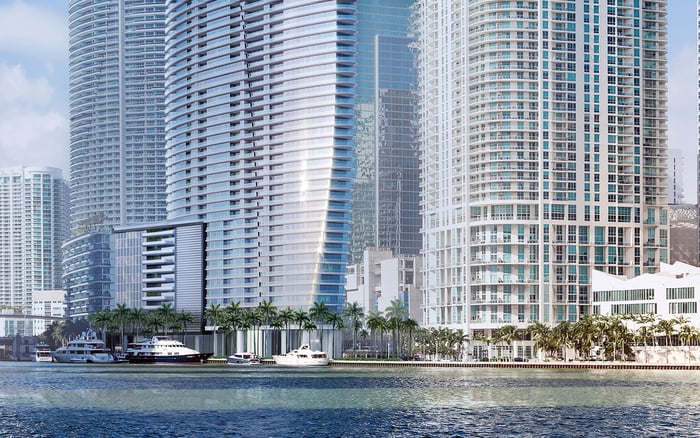
A discreet comparison of Aston Martin Residences Downtown Miami and Faena Residences Miami through the lens of airport access, waterfront luxury, urban energy, curated design, and the buyer who wants connectivity without an airport-adjacent identity.

For a certain South Florida buyer, airport access is essential, but airport proximity is not the aspiration. The goal is not to live near terminals, runways, or the visual language of transit. It is to move efficiently when work, family, or global travel requires it, then return to a residence whose identity is shaped by water, design, privacy, and the city itself.
That is the useful lens for comparing Aston Martin Residences Downtown Miami with Faena Residences Miami Downtown Miami. The question is not simply which address is closest to the airport. For high-net-worth buyers, closeness alone can be too blunt a metric. The more refined question is which building keeps air travel convenient while allowing the residence, not the commute, to set the mood of daily life.
Both properties speak to that tension. Each serves the globally mobile buyer who needs airport access to function well, yet does not want an airport-adjacent identity. Their difference lies in the lifestyle that takes precedence once the car returns from the airport and the door closes behind you.
Aston Martin Residences Downtown Miami is the stronger fit for buyers who want airport access from a highly urban waterfront setting. Its proposition is rooted in Downtown Miami connectivity, but its residential character is not defined by logistics. It is shaped by waterfront living, skyline views, branded luxury design, and the high-rise energy of the city.
For owners who travel frequently, especially those moving between domestic and international commitments, this balance matters. The airport remains accessible as part of a broader mobility pattern, but it does not become the visual or emotional center of the home. The daily environment is still Miami waterfront first: water, towers, light, city movement, and the broader rhythm of Downtown.
That makes Aston Martin Residences Downtown Miami the more urban of the two choices. It suits buyers who want to be near business, dining, culture, and Downtown energy without sacrificing the polished residential experience expected at the top of the market. Airport access is present as a practical advantage, not as the property’s defining story.
Faena Residences Miami offers a different interpretation of the same buyer need. Its appeal is less about urban immediacy and more about a curated residential world where airport access remains a utility. The lifestyle is intended to be shaped by design, culture, privacy, and a more immersive sense of luxury.
For the buyer considering Faena Residences Miami Downtown Miami, the attraction is psychological separation. The airport can be reached when needed, but the property’s identity is not transit-oriented. The atmosphere is more resort-like and art-forward, which can be particularly compelling for owners who want their Miami residence to feel removed from aviation infrastructure, even if their calendar requires regular flights.
This is not the choice for a buyer who wants every decision reduced to pure transfer efficiency. It is for the buyer willing to accept a modest airport transfer in exchange for a more curated lifestyle setting. Faena’s value is in making the airport feel functionally close enough while keeping the home experience culturally and aesthetically dominant.
Among ultra-premium buyers, the airport question often begins with convenience but ends with identity. A residence can be airport-accessible without feeling as though it belongs to an airport corridor. That distinction is especially important in Miami, where the most desirable residential narratives are built around waterfront views, vertical city living, beach culture, design, privacy, and hospitality-level service.
Aston Martin places the emphasis on urban connectivity. It is for the buyer who wants to step into Downtown, maintain a strong city rhythm, and still keep airport access within the practical orbit of ownership. Faena places the emphasis on curated removal. It is for the buyer who wants the airport to do its job quietly in the background while the residence provides a more composed, artful, and private daily world.
The better choice depends on what should dominate the owner’s week. If the answer is meetings, restaurants, cultural activity, and the momentum of Downtown, Aston Martin is the more natural read. If the answer is privacy, immersion, design, and a more resort-like sensibility, Faena carries the stronger emotional case.
Downtown Miami has become one of the clearest places to study this balance because it can absorb transportation needs without surrendering its lifestyle identity. The neighborhood can serve an owner who travels often, yet it remains anchored in water views, skyline drama, and access to Miami’s urban core.
This is why the surrounding luxury context matters. A buyer looking at airport access in Downtown may also encounter Waldorf Astoria Residences Downtown Miami and Casa Bella by B&B Italia Downtown Miami, but the Aston Martin and Faena comparison is especially revealing because each property answers the airport question from a distinct lifestyle angle. One says the city and the waterfront can remain primary. The other says culture and privacy can remain primary.
That is the nuance sophisticated buyers should protect. Airport access is valuable, but it should not flatten the residential decision into a commute calculation. At the upper end of the market, the home must still feel like a destination in its own right.
Aston Martin Residences is best suited to the buyer who is globally mobile but deeply city-oriented. This buyer may fly often, yet still wants a residence embedded in Miami’s luxury waterfront market. The airport is part of the ownership equation, but so are Downtown dining, business access, skyline views, and the pace of a major urban waterfront.
Faena Residences Miami is better suited to the buyer who treats airport access as necessary infrastructure, not a lifestyle preference. This buyer wants to arrive, decompress, and feel absorbed into a curated residential environment. The experience is less about being at the center of urban motion and more about being connected while feeling selectively removed.
Neither choice is about living as close as possible to aviation infrastructure. Both are about refusing that tradeoff. The distinction is whether the buyer wants the energy of Downtown Miami to dominate, or whether a more private, cultural, and design-led residential world should take the lead.
For affluent buyers, the smartest airport-access decision is rarely the most literal one. The best residence is not necessarily the one that makes the airport feel nearest. It is the one that makes travel easy enough while preserving the feeling that life at home is richer than the logistics around it.
Aston Martin Residences Downtown Miami answers that need through urban waterfront connection. Faena Residences Miami answers it through curated lifestyle separation. Both protect the same principle: the airport should be efficient, not dominant.
Is Aston Martin Residences Downtown Miami the more urban option? Yes. It is best framed around Downtown connectivity, waterfront living, skyline views, and access to the city’s dining, business, and cultural rhythm.
Is Faena Residences Miami more lifestyle-driven than transit-driven? Yes. Faena is positioned for buyers who want airport access to remain useful while design, culture, privacy, and curated luxury define daily life.
Should buyers choose only by airport proximity? No. The stronger comparison is which residence keeps travel convenient while allowing the property’s lifestyle identity to dominate.
Does Aston Martin suit frequent flyers? Yes. It serves globally mobile buyers who want efficient airport access without living in an airport-adjacent environment.
Does Faena require accepting some transfer time? Yes. Its appeal is for buyers who accept a modest airport transfer in exchange for a more immersive, art-forward residential setting.
What does waterfront mean in this comparison? It points to the residential experience around water, skyline, and Miami’s luxury high-rise market rather than a lifestyle centered on transit infrastructure.
Why does Downtown matter here? Downtown provides a city-based setting where airport access can remain practical while daily life is shaped by culture, dining, business, and water views.
Which property feels more removed from airport psychology? Faena Residences Miami is the stronger fit for buyers who want to be connected to airports while feeling culturally and aesthetically removed from them.
Which property better fits a business-oriented owner? Aston Martin Residences is the more natural fit for buyers who want airport convenience alongside Downtown business access and urban energy.
Can both properties serve second-home buyers? Yes. Both can work for buyers who travel often and want a Miami base where airport access supports the lifestyle without defining it.
For a confidential assessment and a building-by-building shortlist, connect with MILLION.
If branded residences are on your mind — as a home or as an allocation — we would be glad to share what we are seeing, privately.
Begin a quiet conversation