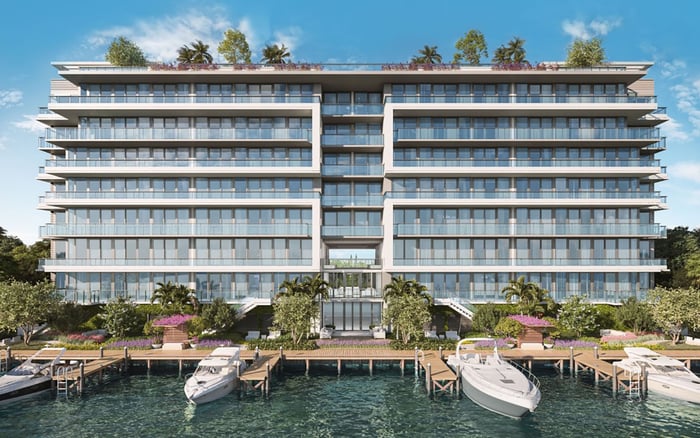
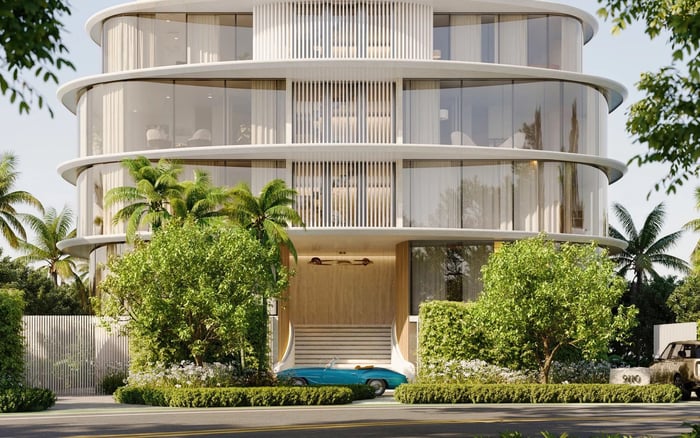
Full-floor living can reduce everyday residential encounters, but genuine privacy at Mila Bay Harbor Islands depends on access, acoustics, sightlines, operations, and governance.

At Mila Bay Harbor Islands, the full-floor proposition should begin the diligence process, not conclude it.
Occupying an entire residential level can eliminate same-floor neighbors and reduce shared walls. It may also give an owner greater command over the home’s internal atmosphere. Yet it does not automatically control the elevator, lobby, service routes, building systems, neighboring views, or future conditions beyond the property line.
The sophisticated question is not simply, “Is this a full-floor residence?” It is, “Which forms of privacy does the design actually deliver, and which remain dependent on shared infrastructure or rules?”
Limited-access elevator service can make arrivals feel residential and discreet, with fewer routine encounters. The meaningful issue is the permission structure behind that experience. Buyers should establish who can call the elevator to the floor, who can enter its lobby, and how guests, contractors, staff, maintenance teams, and emergency personnel are handled.
It is equally important to distinguish exclusive use from exclusive ownership or control. An elevator lobby, corridor, shaft, or service area may function as part of a residence’s private arrival sequence while remaining a common element subject to association access. Architectural plans, access protocols, and condominium documents should align on this point.
When evaluating alternatives such as Alana Bay Harbor Islands, apply the same test rather than comparing privacy language at face value. The objective is to understand daily circulation, not merely the presentation.
A full floor can eliminate lateral residential adjacency, but sound can still travel from above, below, and through elevators or mechanical systems. Privacy-minded buyers should focus on the assemblies and systems separating spaces, including floor and ceiling construction, equipment placement, shafts, and points where sound or vibration could transfer.
If the finished residence is not available for a personal listening test, request acoustic specifications and appropriate technical detail. Qualified advisers can interpret what those materials mean for bedrooms, entertaining areas, service spaces, and the arrival lobby.
Fewer neighbors may improve the odds of quiet living. They are not a substitute for demonstrable sound isolation.
Vertical separation does not ensure visual seclusion. Glazing and outdoor living areas may face neighboring buildings, terraces, waterways, or passing activity. The relationship among height, setback, orientation, and surrounding structures deserves close study.
Review each window wall and terrace from both seated and standing positions. Consider screening, reflected views after dark, and whether principal rooms are exposed to nearby properties. A site visit at different times can reveal conditions that a single rendering cannot.
The same discipline should guide a review of La Maré Bay Harbor Islands or any nearby option. Buyers should compare protected sightlines, not height alone.
Privacy is partly architectural and partly operational. Deliveries, repairs, inspections, emergencies, housekeeping, and contractor visits all introduce circulation that can affect how exclusive a residence feels. Buyers should ask where those movements occur, which entrances and elevators they use, and when access to a residential floor is permitted.
Governance matters after closing. Association rules can shape guest procedures, security practices, contractor access, shared-space conduct, and the handling of common elements. Budgets and reserves also deserve scrutiny because maintaining access-control and building systems supports the privacy experience over time.
A review of Onda Bay Harbor offers another opportunity to ask the same operational questions. Consistent diligence produces a more useful comparison than differing sales vocabularies.
A full-floor premium is most persuasive when it corresponds to identifiable advantages: controlled access, fewer shared walls, effective sound isolation, protected views, and workable service circulation. Without current inventory, closed-sale comparisons, plans, and specifications, assigning a percentage to that premium would be premature.
The preferred approach is evidence-led. Compare Mila with relevant non-full-floor and low-density choices, including The Well Bay Harbor Islands, while controlling as carefully as possible for location, outlook, interior scale, condition, and building quality.
Also investigate nearby development applications. Adjacent construction or redevelopment can alter views, noise, traffic, and visual exposure after purchase. A full-floor owner controls more of the home’s interior plane, but not the neighborhood or shared building systems.
The buyer’s file should include architectural plans, elevator-access protocols, acoustic specifications, condominium documents, association rules, budgets, reserves, and information on nearby development sites. Counsel and technical advisers can then test whether the legal rights, physical design, and operating model tell the same story.
The decisive luxury is not the absence of every interaction. It is predictability: knowing who can approach the home, what can be heard, what can be seen, and which protections are likely to endure. That is the standard against which a full-floor premium should be judged.
Does a full-floor residence guarantee complete privacy? No. It can eliminate same-floor residential neighbors, but access, sound, views, service circulation, and building rules still matter.
What should buyers verify about elevator access? Confirm who can reach the residential floor and lobby, including guests, staff, contractors, maintenance personnel, and emergency teams.
Is the elevator lobby necessarily privately owned? Not necessarily. Exclusive use should be distinguished from ownership or control of common elements such as lobbies, corridors, and shafts.
Can noise reach a full-floor home? Yes. Sound and vibration can travel through ceilings, floors, elevators, mechanical equipment, and other building systems.
Which acoustic documents are most useful? Request construction and acoustic specifications covering separation assemblies, equipment, shafts, and relevant residential spaces.
How should buyers assess visual privacy? Study orientation, setbacks, screening, nearby buildings, and daytime and nighttime exposure from windows and outdoor areas.
Why do condominium rules matter? They can govern guests, contractors, security procedures, staff access, and conduct within shared spaces over the long term.
Can future development reduce privacy? Yes. Nearby redevelopment may change sightlines, construction noise, traffic, and the degree of visual exposure.
How should a full-floor premium be evaluated? Tie it to measurable advantages and compare current inventory and closed sales with suitably similar non-full-floor residences.
What should happen before contract commitment? Review plans, access procedures, acoustic details, association documents, finances, and nearby development activity with qualified advisers.
When you're ready to tour or underwrite the options, connect with MILLION.
If branded residences are on your mind — as a home or as an allocation — we would be glad to share what we are seeing, privately.
Begin a quiet conversation