A discreet operating plan for coordinating MIA arrivals, Brickell stays, Formula 1 transfers, and boat-show movements without treating Miami as a single traffic zone.
For travelers arriving from Westchester County, an elegant Miami event weekend begins before the aircraft leaves New York. An airport pickup, a Formula 1 transfer to Miami Gardens, and a boat-show visit spanning Downtown Miami and Miami Beach are not variations of the same journey. Each has its own direction, congestion pattern, staging strategy, and contingency.
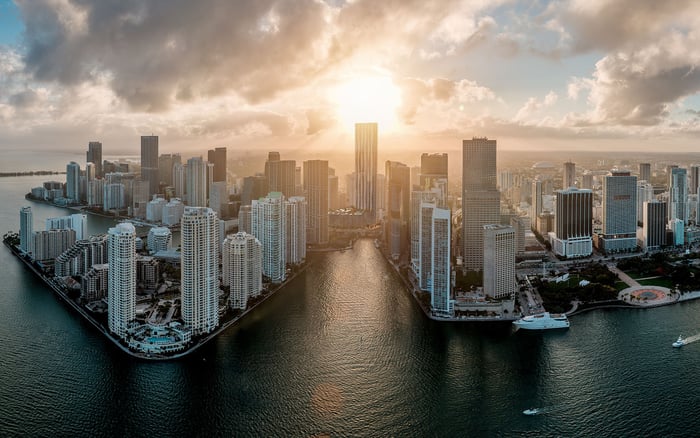
A Brickell residence can serve as a composed central base, but only when the itinerary reflects those distinctions. The objective is not to predict traffic perfectly, but to prevent one delayed assignment from compromising the next. Owners and guests at The Residences at 1428 Brickell, for example, should give household staff and chauffeurs separate instructions for airport, stadium, and waterfront movements rather than rely on a single habitual route.
The most effective event-weekend plan separates Miami by mission, not mileage.
In moderate conditions, a taxi or rideshare between Miami International Airport and Brickell typically takes 20 to 30 minutes, often via SR-836 toward Downtown. At rush hour, the drive can reach 35 minutes or more as the Dolphin Expressway and I-95 approaches become congested. These figures are planning baselines, not promised journey times.
The key advantage is geographic. Formula 1 road restrictions are concentrated north of the airport around Hard Rock Stadium, leaving a direct Brickell-to-MIA assignment less exposed than a journey through the Turnpike and Golden Glades area. That advantage disappears if the assigned driver starts in Aventura, Sunny Isles, Miami Gardens, or another North Dade location and is delayed before reaching the terminal.
For an international arrival, add a ground-transport margin beyond the household’s ordinary airport schedule. Before departure, confirm the driver’s starting location, terminal meeting instructions, luggage capacity, and holding plan. If the roads become unreliable, the Orange Line from MIA to Government Center, followed by Metromover toward Brickell, provides a traffic-independent alternative of approximately 35 to 45 minutes. It may not be the first choice for a luxury arrival, but it remains a credible operational backup.
The F1 traffic problem centers on Hard Rock Stadium, particularly Florida’s Turnpike Exit 2X, NW 199th Street, and NW 27th Avenue. During the 2024 Miami Grand Prix, the northbound and southbound Exit 2X ramps and stadium access ramps remained closed from Thursday morning through Sunday night. Restrictions also included complete closures along a section of NW 199th Street and a northbound section of NW 27th Avenue.
Those historical arrangements should inform the planning discipline, not replace the current year’s official closure plan. Schedules can vary by day and extend into evening race or entertainment periods. A chauffeur should receive the current bulletin, assigned vehicle access point, and a preselected approach from the east or south. Exit 2X should never be treated as a dependable stadium arrival route.
Driver staging matters as much as routing. A vehicle waiting in Brickell or central Miami has less initial exposure to race congestion than one stationed in North Dade. For residents of Bentley Residences Sunny Isles, geographic proximity to Miami Gardens should not be mistaken for a faster or more predictable pickup. The final access roads may be the most constrained part of the journey.
Set two decision times: one for departure, another for abandoning the preferred route. Share the stadium access credential, passenger contact, and post-event meeting point with both driver and principal. A precise rendezvous beyond the most restricted perimeter may prove more dependable than curbside collection amid changing controls.
The Discover Boating Miami International Boat Show has occupied several venues across Miami Beach and Downtown Miami, including the Miami Beach Convention Center, Herald Plaza, Maurice Gibb Park, and Museum Park Marina/FEC Docks. A car-only plan can create needless exposure to constrained Beach parking and bridge traffic.
From Brickell, consider a Downtown transfer followed by the show’s water taxi, trolley, or complimentary shuttle network. Water-taxi loops have connected the Convention Center, Herald Plaza, Maurice Gibb Park, and Museum Park Marina/FEC Docks. Service is scheduled to begin about one hour before the show opens and continue until about one hour after closing. Recent plans have included a $10 day pass, with children younger than 12 riding free, while Miami Beach has also operated a free citywide trolley from 8 a.m. to 11 p.m.
Reconfirm all routes, fares, docks, and hours for the relevant year. Historical water-taxi points have included the W Miami at 485 Brickell Avenue, the Hyatt Regency Miami, Bayfront Park, and the former AmericanAirlines Arena, but docking plans can change. The scale can be significant: one earlier show moved nearly 53,000 people by water taxi against an initial projection of 25,000.
For owners at Aston Martin Residences Downtown Miami, a waterfront-oriented transfer can reduce reliance on the full road journey to the Beach. Guests staying near The Perigon Miami Beach should still identify the nearest current shuttle, trolley, or water connection rather than assume a private vehicle can wait beside every venue. Marina access is valuable only when the operating map is current.
When a household must move among MIA, Brickell, the boat show, and Hard Rock Stadium at the same time, assign one vehicle to city and airport work and another to stadium service. This prevents the fragile scenario in which a chauffeur trapped near Miami Gardens is also responsible for an airport collection or dinner transfer.
The city vehicle should remain south of the principal F1 disruption whenever possible. Its brief should encompass MIA, Brickell, Downtown, and planned transfer points. The stadium vehicle should carry the current closure map, access instructions, water, charging capability, and a clearly defined post-event rendezvous. If only one chauffeur is available, do not interlock assignments. Protect each movement with sufficient recovery time to absorb a route change.
A principal’s office can maintain a one-page movement sheet covering flight timing, passenger contacts, vehicle assignments, luggage needs, venue entrances, backup meeting points, and decision deadlines. Avoid vague instructions such as “usual stadium route” or “pickup at the show.” Event controls can render both unusable.
For frequent event travelers, luxury real estate is also an exercise in operational geography. Brickell provides a practical center for MIA transfers and Downtown connections. Miami Beach places owners closer to show venues but increases exposure to local road and parking constraints. North Dade can be convenient for certain destinations, yet race-weekend staging there carries greater congestion risk.
This is a lifestyle consideration with measurable consequences: where the car begins-not merely where the guest sleeps-can determine whether the day remains composed. The strongest plan pairs the residence with independent airport, waterfront, and stadium protocols, then validates every event-specific route shortly before travel.
For discreet guidance on South Florida residences that complement an exacting travel schedule, connect with MILLION.
If branded residences are on your mind — as a home or as an allocation — we would be glad to share what we are seeing, privately.
Begin a quiet conversationThe drive is commonly estimated at 20 to 30 minutes in moderate traffic and 35 minutes or more during rush hour. Add an event-weekend buffer rather than treating either figure as guaranteed.
The principal F1 closures occur north of MIA around Hard Rock Stadium. A driver coming from North Dade can still be delayed before reaching an airport pickup.
Planning should focus on Florida’s Turnpike Exit 2X, NW 199th Street, and NW 27th Avenue. Current official closure instructions should replace any habitual stadium route.
No. Brickell-based travelers should preselect an alternative stadium approach from the east or south and verify it against the current closure plan.
A stadium vehicle can become trapped in North Dade congestion and miss an MIA or city assignment. Separate vehicles reduce cross-scheduling risk.
The Orange Line to Government Center followed by Metromover toward Brickell takes approximately 35 to 45 minutes and is independent of road congestion.
They can transfer through Downtown and use current water-taxi, trolley, or show-shuttle services. Routes and operating details should be confirmed each year.
Published routes are scheduled to begin about one hour before the show opens and continue until approximately one hour after closing.
No. Recent plans have offered a $10 day pass with children younger than 12 riding free, but fares, docks, routes, and hours can change annually.
Include flight timing, passenger contacts, vehicle assignments, luggage needs, venue entrances, backup meeting points, and decision deadlines. Add the current event access and closure instructions.