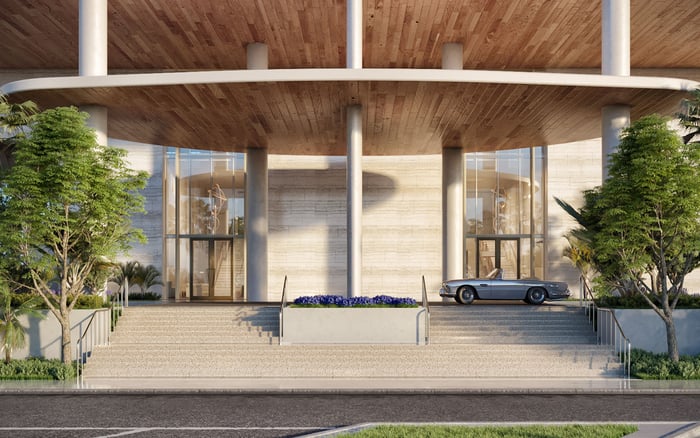
A discreet buyer guide to evaluating generator coverage at Four Seasons Hotel & Private Residences Fort Lauderdale, with a focus on post-storm habitability, load priority, fuel logistics, and resilience diligence.

At the top of the Fort Lauderdale market, resilience is now part of the luxury conversation. For buyers evaluating Four Seasons Hotel & Private Residences Fort Lauderdale, generator coverage belongs in due diligence, not in the amenity checklist. The sharper question is straightforward: what does the generator power, for how long, and under what operating conditions?
That distinction matters because this is a combined hotel and private-residences offering. In a hybrid luxury property, backup power may serve several constituencies at once: hotel operations, residential common areas, life-safety systems, and potentially selected comfort-related functions. Buyers should not assume that emergency power translates into full residential habitability after a utility outage.
In internal buyer shorthand, the file may read Fort Lauderdale, Broward, oceanfront, condo-hotel, but the underwriting question is far more precise. Sophisticated purchasers want to know whether the building can remain functional, secure, and livable when the surrounding grid is interrupted.
The first distinction is life-safety backup power versus comfort or lifestyle backup power. Life-safety systems are the baseline: emergency lighting, fire and alarm systems, essential elevator service, and other functions designed to protect occupants and support evacuation or controlled building operation. Comfort power is different. It may include cooling, selected residential outlets, communications, access systems beyond the minimum, and other services that determine whether an owner can comfortably remain in residence.
This is where language can become imprecise. “Generator equipped” sounds reassuring, but it is not the same as “residential units remain air conditioned and operational.” Buyers should request the emergency power load schedule and understand which systems are designated essential, which are optional, and which are not backed up at all.
The same discipline applies when comparing other Fort Lauderdale addresses. A purchaser considering Auberge Beach Residences & Spa Fort Lauderdale or St. Regis® Residences Bahia Mar Fort Lauderdale should ask the same fundamental questions rather than rely on branding, lobby presentation, or broad resilience language.
In a coastal high-rise, post-storm livability is an ecosystem. Elevators, water pumps, corridor and stair lighting, garage access, security systems, communications equipment, and cooling strategies may all depend on backup power. If any one of those systems is unavailable, the practical experience of ownership can change quickly.
Elevator coverage deserves particular scrutiny. Buyers should determine how many elevators can operate on generator power, whether service extends to all residential levels, and whether hotel operations affect allocation during an outage. Domestic water pumps deserve the same attention. A residence with beautiful finishes is not truly usable if water service is compromised once municipal pressure or building pumping capacity is affected.
Access is another understated issue. Garage gates, fob systems, elevators, and lobby controls all shape movement through the property. For owners who use a residence seasonally, or who may not be present when a storm event occurs, communications and access systems can become as consequential as finishes and views.
Four Seasons Hotel & Private Residences Fort Lauderdale sits in a category where hospitality and residential interests coexist. That makes load priority a central buyer question. During an outage, does the operating plan prioritize hotel functions, residential common areas, life-safety systems, mechanical systems, or some combination of these?
The issue is not whether one use is more important than another. It is whether the hierarchy is documented and understood before a buyer commits capital. A private-residence owner should know if hotel back-of-house operations, guest services, elevators, kitchens, cooling, or other loads are treated differently from residential areas when generator capacity is finite.
The same question can arise across the broader luxury set, including Riva Residenze Fort Lauderdale and branded coastal projects beyond Fort Lauderdale. Prestige does not replace documentation. For 2026 buyers, the most valuable answers are found in building-level materials, not in general descriptions.
Generator value depends heavily on runtime. Fuel capacity, refueling logistics, access after a storm, maintenance discipline, and testing protocols all determine whether backup power remains meaningful during an extended outage. A system that performs for a short window may satisfy a narrow emergency purpose, but it may not support the continuity many luxury buyers envision.
Buyers should request generator specifications, fuel-storage details, maintenance and testing logs, electrical riser diagrams, condo documents, and any post-storm operating plan. These materials help clarify whether the building is designed only to meet essential requirements or whether it offers a broader habitability strategy.
A useful question is: if the utility grid is down for more than a brief period, what exactly happens on day one, day two, and beyond? The answer should address systems, staffing, fuel, access, communications, and resident instructions. If the response remains vague, diligence is not yet complete.
Generator coverage is one part of a larger South Florida resilience review. Hurricane exposure, storm surge risk, insurance scrutiny, building-code requirements, elevation, glazing, mechanical placement, drainage, and association governance all belong in the conversation. Backup power matters precisely because it connects to those other elements.
A buyer comparing Four Seasons Hotel & Private Residences Fort Lauderdale with The Ritz-Carlton Residences® Fort Lauderdale should avoid treating resilience as a single feature. The more refined approach is to evaluate how the building is expected to function when conditions are strained.
The best buyer test is direct: identify the loads, confirm the runtime assumptions, understand the priority sequence, and review the operating plan. In 2026, generator diligence is not pessimism. It is part of owning well on the South Florida coast.
Does a generator mean every residence has full backup power? Not necessarily. Buyers should confirm whether backup power reaches private units or only essential building systems.
What is the first document a buyer should request? The emergency power load schedule is a strong starting point because it identifies which systems are supported.
Why does hotel-residential use make diligence more complex? A hybrid property may allocate generator capacity across hotel operations, residential areas, and life-safety systems.
Should buyers ask about elevators specifically? Yes. Elevator coverage affects practical high-rise habitability, especially after a storm or extended outage.
Do water pumps matter in generator review? Yes. Domestic water service can depend on powered pumps, making this a key habitability question.
Is fuel capacity as important as generator size? Yes. Runtime depends on fuel storage, refueling logistics, access, and the building’s operating plan.
Can cooling be assumed during an outage? No. Buyers should confirm whether any cooling systems are backed up and under what conditions.
How should buyers evaluate access systems? They should ask whether garage gates, fobs, doors, and communications remain functional on backup power.
Is generator diligence only for primary residents? No. Seasonal owners also need to understand building access, security, and remote communications after storms.
What is the simplest buyer test for 2026? Ask what is powered, how long it can run, who gets priority, and where those answers are documented.
To compare the best-fit options with clarity, connect with MILLION.
If branded residences are on your mind — as a home or as an allocation — we would be glad to share what we are seeing, privately.
Begin a quiet conversation