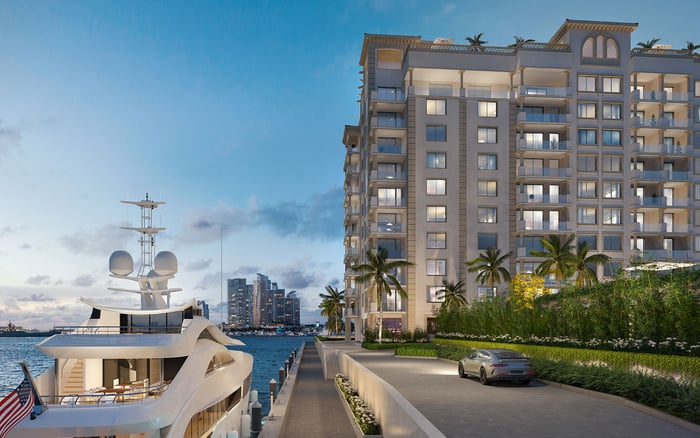
A buyer-focused framework for creating a Miami Beach home office that can maintain power, connectivity, cooling, and remote oversight through routine interruptions and storm conditions.

For a Milan family moving to Miami Beach, a home office may need to support European morning calls, confidential documents, market-sensitive work, schooling, and household management. Resilience begins with a continuity brief, not a shopping list. Define what must remain operational through a short utility interruption, a prolonged outage, and the loss of the primary internet connection.
This is both a Buyer's Guides question and a Design & Architecture decision. The office, network rack, uninterruptible power supplies, generator, cooling zones, and service entrances should function as one coordinated system. Families weighing a Second-home against a primary residence should also determine who will inspect, test, and reset that system while the property is unoccupied.
The principle applies across property types. A condominium search involving 57 Ocean Miami Beach raises questions about building infrastructure, while Estates & Single-Family ownership gives the design team more direct control but introduces parcel-level considerations involving placement, fuel, setbacks, and permits.
Before sizing emergency power, identify the circuits that truly matter. The first tier will often include office computers, displays, network equipment, refrigeration, essential lighting, security, and limited air conditioning. This avoids the costly assumption that every appliance and comfort load must operate at once.
Ask the electrical contractor to translate that list into starting loads, running loads, circuit priorities, and required duration. Separate the office network from nonessential audiovisual and leisure systems. Provide properly sized battery backup for the modem, router, switches, access points, and core computer equipment so brief interruptions do not force a complete restart while the generator starts.
Cooling requires explicit consideration. Maintaining the entire residence at its usual temperature may be unnecessary, but an occupied office, communications equipment, and selected family spaces may require limited air conditioning. In New-construction planning, this can be resolved before electrical panels, mechanical zones, millwork, and equipment closets are fixed.
Address-level verification is indispensable. Miami Beach can offer fiber, cable-based service, DSL, and 5G home internet, but availability varies by property. Reported fiber coverage is approximately 98 percent for AT&T, 89 percent for Xfinity, 60 percent for Hotwire, and 51 percent for Breezeline. In covered areas, reported symmetrical fiber speeds reach up to 5 Gbps for AT&T and 8 Gbps for Hotwire. Neither citywide coverage nor maximum speed, however, confirms service to a particular residence.
A robust brief can specify primary fiber, a secondary wired connection from another provider, and 5G failover through a separate carrier. Request written confirmation that the two wired services use diverse building entrances or upstream infrastructure. Different provider names do not necessarily indicate different physical routes.
For buyers considering The Perigon Miami Beach or The Ritz-Carlton Residences® Miami Beach, the inquiry should extend beyond in-unit speed. Ask how service enters the building, whether residents may choose providers or use a bulk arrangement, and whether telecom rooms, fiber equipment, routers, and common-area network infrastructure remain powered during an outage. An in-unit battery cannot preserve internet access if the building's upstream equipment loses power.
A permanently installed outdoor generator requires a building permit; connecting it to the residence's electrical system requires an electrical permit. Applications for permanent equipment require plans that are signed, sealed, and dated by a design professional. The site plan must identify the generator and permanent fuel tanks, along with their distances from buildings and property lines.
Placement can be difficult on dense lots. The applicable checklist requires generator exhaust termination to be at least 10 feet from property lines, 3 feet from exterior walls or roofs, and 10 feet from operable building openings. Exhaust must also remain clear of doors, windows, vents, and air intakes to reduce carbon-monoxide exposure. Terraces, pools, neighboring structures, and architectural sightlines can further narrow the practical options.
A portable generator generally does not require a building permit when it directly powers only a few appliances and lights. Connecting one to household circuits changes the permitting analysis and should be managed by a licensed electrical contractor. Never treat portability as permission for an improvised connection.
Before purchase, have the architect and electrical contractor confirm the proposed location, fuel arrangement, setbacks, flood considerations, and division of permitting responsibility for the exact parcel. Additional Miami Beach zoning, flood-zone, historic-district, condominium, or HOA restrictions may apply.
In a condominium, emergency power is partly a collective system. Buyers evaluating Apogee South Beach or another Miami Beach residence should obtain precise written answers about which common systems receive generator power and for how long. Power for elevators and life-safety functions does not automatically extend to residential internet infrastructure, in-unit cooling, or every receptacle.
Request the residence's electrical scope, the building's outage protocol, its generator-testing practices, and any restrictions on in-unit batteries or communications equipment. Then ask a network specialist to confirm whether two wired services can actually be installed in the unit. The elegant result is invisible redundancy, but the diligence behind it must be exacting.
Resilience is an ongoing operating discipline. A private household can voluntarily adopt the rigor used for essential and life-safety facilities, including automatic-start readiness, fuel planning, monthly load testing, and annual full-load testing. Qualified professionals should establish the appropriate program for the specific home.
For a remotely managed residence, incorporate generator status, fuel level, battery condition, and internet uptime into the property dashboard. Monitoring does not replace scheduled inspections. Conduct a storm drill by disconnecting primary power and primary internet, then observe generator transfer, battery behavior, router failover, cooling, remote access, and alerts. Document who responds if any stage fails.
When should connectivity be checked? Verify service at the exact address before purchase, lease signing, or office construction.
Is one fiber connection sufficient? It is fast, but resilience is stronger with a second wired provider and separate-carrier 5G failover where available.
Do two internet providers guarantee route diversity? No. Request written confirmation of diverse building entrances or upstream infrastructure.
What should emergency power cover first? Prioritize office equipment, networking, refrigeration, essential lighting, security, and limited air conditioning.
Does a permanent outdoor generator require permits? Yes. Building and electrical permits are required for permanent installation and connection to the residence.
Can a portable generator connect directly to household circuits? That changes the permitting requirements and should be coordinated by a licensed electrical contractor.
Why must generator placement be studied early? Exhaust clearances, openings, property lines, flood considerations, terraces, and neighboring structures can constrain the site.
Will an in-unit battery keep condominium internet working? Not if unpowered building telecom rooms or upstream network equipment fail.
What should remote monitoring include? Track generator status, fuel level, battery condition, and ISP uptime, supported by scheduled inspections.
How often should the resilience plan be tested? Follow a professional maintenance schedule and rehearse the complete power and internet failover sequence before storm season.
For a confidential assessment and a building-by-building shortlist, connect with MILLION.
If branded residences are on your mind — as a home or as an allocation — we would be glad to share what we are seeing, privately.
Begin a quiet conversation