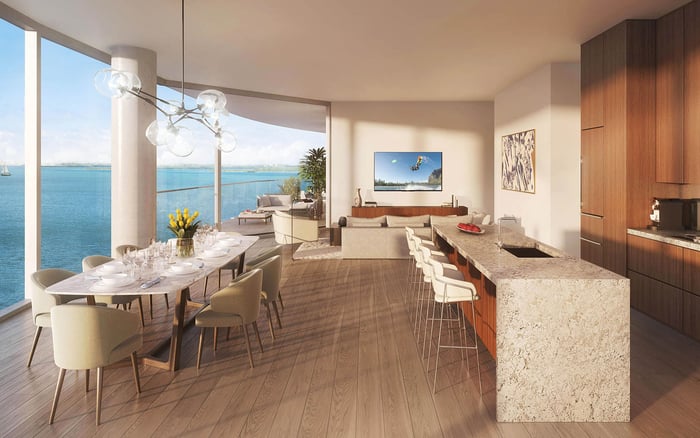
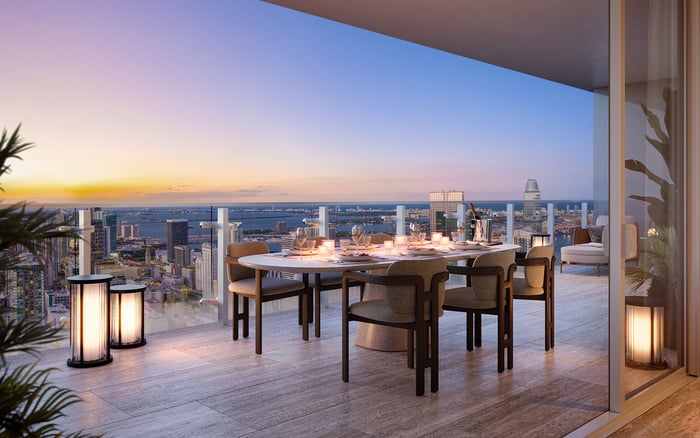
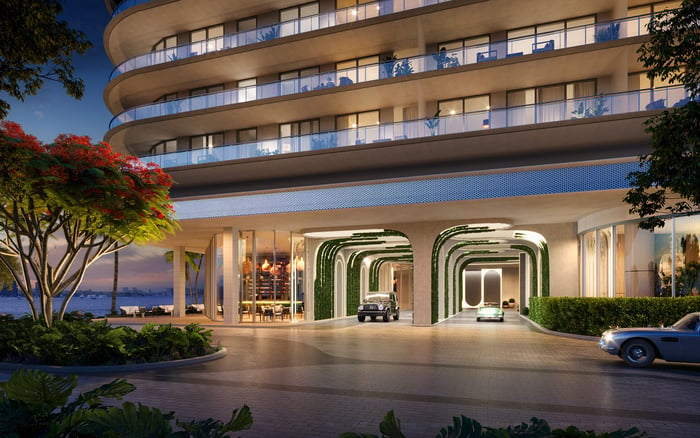
A discreet buyer's framework for assessing privacy, service economics, delivery terms, and enduring ownership value at 619 Residences in Brickell.
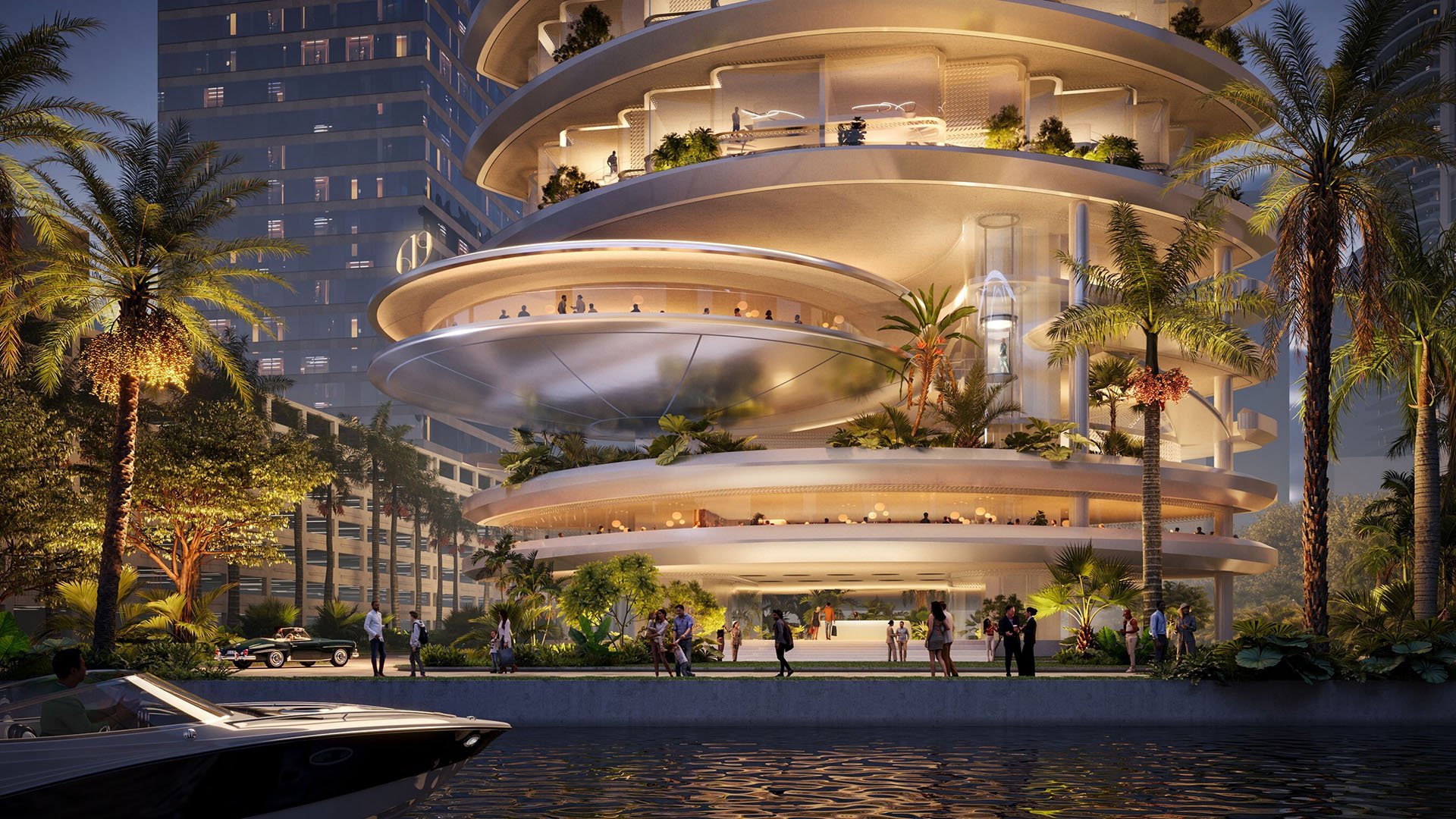
For a London-based buyer, 619 Residences by Foster + Partners + Nobu Hospitality presents a polished proposition: architecture by Foster + Partners paired with Nobu Hospitality's dining, wellness, and lifestyle programming. Planned for 619 Brickell Avenue, the 75-story waterfront tower is designed as a fully residential building, with 306 residences and no hotel component.
That distinction matters. A residence without an attached hotel should avoid some transient guest activity, but it does not guarantee domestic calm. A waterfront Nobu restaurant, Nobu Café, private dining, in-residence dining, and a substantial service operation introduce different users, schedules, and access requirements. The decisive question is not whether hospitality exists, but how precisely it is separated from private life.
The project sits within the expanding field of Branded Residences, although its residential-only structure gives buyers a specific basis for diligence. Pricing extends from approximately $3 million to as much as $60 million. Current availability, pricing, deposits, and specifications should be confirmed in the latest sales and contractual documents.
Privacy should be assessed as an operational system. Buyers should request plans identifying resident and restaurant entrances, visitor reception, loading access, service corridors, lifts, amenity admission points, and routes used by housekeeping, private chefs, childcare providers, and estate staff.
The no-hotel model may reduce hotel-guest traffic, but restaurant patrons, invited guests, vendors, and employees could still share parts of the arrival or back-of-house sequence. Ask whether resident lifts are credentialed, how guests are screened, where deliveries are held, and whether restaurant visitors can reach residential amenity levels. Rules governing staff entry into homes, key custody, notice, logging, and emergency access warrant equal scrutiny.
A private showing by appointment is the right moment to inspect these adjacencies rather than focus solely on finishes. Within Design & Architecture, the most consequential luxury is often invisible: a plan that allows residents, visitors, dining guests, and staff to move efficiently without compromising one another.
The service menu is extensive. It includes butler support, a chauffeur and house car, a dedicated lifestyle manager, housekeeping, valet, pet care, personal shopping, grocery stocking, childcare, travel or aviation assistance, climate-controlled storage, move-in coordination, estate staffing, and doorman or porter assistance.
The appeal for an overseas owner is clear, but the financial architecture requires precision. Ask which services are included in regular common charges, which carry a per-use fee, and which depend on third-party availability. Determine whether staffing levels and hours are contractual commitments or operating intentions. House-car access, private-chef availability, housekeeping frequency, storage allocation, gratuities, cancellation policies, and guest usage can materially shape the lived experience.
Wellness warrants the same scrutiny. Japanese-inspired treatments, recovery therapies, Zen gardens, a sunset pool, longevity facilities, and spa concierge support form part of the positioning. Buyers should distinguish access to facilities from separately billed treatments or services, then consider how those expenses may evolve with wages, insurance, maintenance, and reserve needs.
A second home becomes valuable when it remains effortless during an owner's absence. London buyers should establish who checks the residence, accepts deliveries, coordinates repairs, stocks the kitchen, prepares for arrival, supervises outside contractors, and responds while the owner is several time zones away. Breadth of service matters less than clear accountability.
Ownership considerations also extend beyond the project itself. Independent advisers should address Florida closing procedures, tax exposure, insurance, ownership structure, estate considerations, and remote property management. These questions are particularly important during Pre-Construction, when buyers commit before they can experience the completed building and its operating culture.
The advertised unit mix is not fully consistent, ranging from one bedroom plus den through five-bedroom sky villas and penthouses in one description and from one to six bedrooms in another. The latest developer packet and executed contract should govern decisions concerning layout, designation, rights, and delivery.
A disciplined comparison is not about finding an identical tower. It is about determining which combination of privacy, location, service, design, and carrying cost best suits the buyer's routines. In Brickell, Baccarat Residences Brickell and Cipriani Residences Brickell can frame conversations around branded living, while The Residences at 1428 Brickell provides another relevant point of comparison for buyers assessing the district.
For readers who rely on Buyer's Guides, the useful exercise is to compare documents rather than names. Place proposed budgets, included services, per-use charges, staffing assumptions, guest policies, reserves, completion provisions, and management terms side by side. A recognizable hospitality identity may enhance daily life, but it should never substitute for clear owner protections.
With completion anticipated in the late 2020s, the contractual delivery date, permitted extensions, cancellation rights, deposit protections, and remedies become central diligence points. Buyers should also confirm the current residence count and unit mix in the operative documents rather than rely on preliminary descriptions.
Long-term fit depends on association budgets, service charges, reserves, staffing commitments, and brand-management terms. Counsel should examine the operator's duties, the term and renewal mechanics of management arrangements, performance standards, and owners' rights if the operator or brand changes. The best outcome is not simply hotel-level attention within a permanent home. It is a durable governance structure capable of preserving privacy, service quality, and financial discipline through different market cycles.
Is 619 Brickell planned to include a hotel? No. It is planned as a fully residential tower with no hotel component.
How many residences are planned? The plan calls for 306 residences within a 75-story tower.
Does no hotel guarantee complete privacy? No. Buyers should still examine restaurant, visitor, resident, vendor, and staff circulation.
What dining is planned for residents? Plans include a waterfront Nobu restaurant, Nobu Café, in-residence dining, private-chef services, and private dining access.
Which services require closer cost review? Buyers should clarify charges for housekeeping, chefs, childcare, pet care, transport, storage, shopping, and wellness support.
Are all marketed services guaranteed? That should be verified. Offering documents and management terms should distinguish binding commitments from intended programming.
What residence sizes are advertised? Advertised configurations range from one bedroom plus den through five-bedroom offerings, with a separate range extending from one to six bedrooms.
When is completion anticipated? Completion is anticipated in the late 2020s, but the contract's delivery date and extension provisions should govern.
What should an overseas owner prioritize? Clear remote-management responsibility, access controls, emergency procedures, transparent charges, and independent Florida advice are essential.
What determines long-term fit? Privacy design, service economics, reserves, staffing, governance, management terms, and operator-change protections matter alongside the brand.
For a tailored shortlist and next-step guidance, connect with MILLION.
If branded residences are on your mind — as a home or as an allocation — we would be glad to share what we are seeing, privately.
Begin a quiet conversation