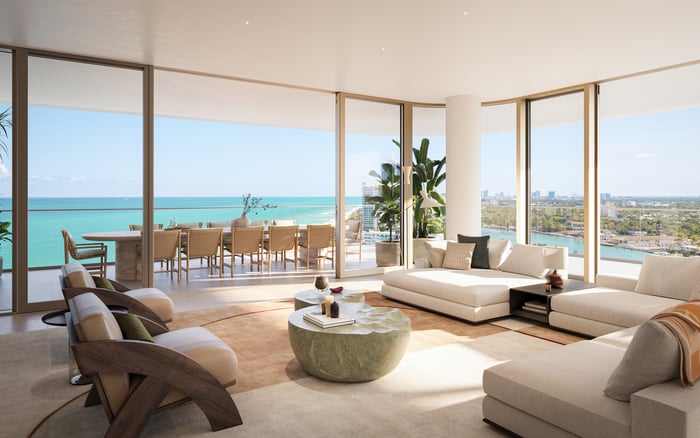
A residence-first framework for comparing Faena House Miami Beach and Delano Residences & Hotel Miami through wellness priorities, privacy, service, and due diligence.

For a luxury buyer, wellness can be evaluated as a practical relationship between the home, the building, and everyday life. Natural light, privacy, outdoor access, movement, quiet, service, and ease of circulation may matter more than the length of an amenity list.
That framework keeps a comparison of Faena House Miami Beach and Delano Residences & Hotel Miami focused on residential use. Rather than assuming that either name guarantees a particular experience, buyers can test how each option supports their preferred schedule, level of privacy, and service expectations.
The first review should address the individual home. Buyers can examine orientation, light, outdoor areas, room flow, storage, acoustic separation, arrival experience, and the transition between private and shared spaces.
A useful exercise is to map an ordinary week. Consider where mornings begin, how frequently shared amenities would be used, whether entertaining feels effortless, and how the residence functions during quiet periods. This turns wellness from an abstract theme into a set of repeatable routines.
Residence-specific review is essential because two homes in the same building can support different priorities. Floor plan, exposure, proximity to elevators or amenity areas, and the relationship between interior and exterior space should be assessed individually through current project materials.
A hospitality association may shape buyer expectations, but the residential framework deserves separate analysis. Buyers should identify which services are included, which may carry additional charges, how requests are handled, and whether any offering depends on an operator or third party.
Privacy also requires close attention. Arrival paths, elevator controls, guest procedures, staffing, and the division between resident and shared areas can influence daily comfort. These details should be confirmed in current plans, disclosures, rules, and service descriptions rather than inferred from branding.
The same discipline applies to amenities. Buyers can ask who may use each space, when it is available, how it is managed, and whether reservations or fees apply. The relevant question is not how many amenities appear in a presentation, but how reliably the most important ones fit the intended lifestyle.
Faena House Miami Beach and Delano Residences & Hotel Miami should each be evaluated through available residence-specific and project-specific materials. Buyers can compare physical design, private-space boundaries, service commitments, recurring obligations, and operating rules without assuming that similarly presented features work in the same way.
Current documentation should guide the analysis. Plans, agreements, budgets, fee schedules, rules, service descriptions, and usage provisions can clarify what is included and what remains conditional. Qualified legal, tax, and financial advisers can help buyers interpret those materials in relation to personal circumstances.
A residence-first approach is especially important when hotel and residential functions may intersect. The buyer should understand the practical boundaries between ownership, hospitality, guests, and shared operations before assigning value to a branded experience.
Buyers who want to test different wellness narratives may also review The Well Bay Harbor Islands and House of Wellness Brickell. These options can broaden the comparison, but their names and positioning should not replace a review of the individual residence and governing documents.
A focused shortlist is more useful than a long catalog. Compare only the factors that will affect ownership: the home, privacy, access, service, recurring costs, usage terms, and the surrounding routine. This makes differences easier to identify without relying on promotional labels.
Begin by ranking nonnegotiable requirements. These might include quiet, outdoor space, discreet arrival, dependable service, access to preferred activities, or flexibility for seasonal use. Then score each residence using verified information rather than general impressions.
Next, separate contractual elements from features that may change. Confirm which services, spaces, and operating terms are documented, and review the expenses connected with them. Where information is incomplete, treat the issue as an open due-diligence item instead of filling the gap with an assumption.
Finally, revisit the weekly-routine exercise after reviewing the documents. The stronger choice is the residence whose physical setting and operating framework continue to support the buyer's priorities after the initial appeal of the brand or amenity presentation has faded.
How should buyers define wellness for this comparison? Define it through repeatable daily needs such as privacy, movement, quiet, light, outdoor access, and dependable service.
Should amenity counts determine the choice? No. Accessibility, operating terms, privacy, cost, and likely frequency of use are more informative than the total count.
Why review the individual residence instead of only the building? Floor plan, orientation, circulation, outdoor space, and proximity to shared areas can change how a home supports daily life.
How should buyers assess a hospitality connection? Confirm how residential and hospitality functions interact, which services are documented, and whether additional charges or third-party terms apply.
What privacy details deserve attention? Review arrival routes, elevator access, guest procedures, staffing, and the boundaries between private and shared areas.
Which documents should buyers examine? Review current plans, agreements, disclosures, budgets, fee schedules, rules, usage provisions, and service descriptions with qualified advisers.
Why map an ordinary week? It reveals whether the residence and its shared features are likely to support actual routines rather than occasional aspirations.
How should recurring costs be evaluated? Compare each obligation with the service or operational function it supports and confirm the terms in current documentation.
Can other South Florida projects improve the comparison? A selective comparison set can clarify priorities, provided each option receives the same residence-level and document-level review.
What is the most useful final test? Choose the residence whose verified physical and operating framework best fits the buyer's long-term priorities.
If you'd like a private walkthrough and a curated shortlist, connect with MILLION.
If branded residences are on your mind — as a home or as an allocation — we would be glad to share what we are seeing, privately.
Begin a quiet conversation