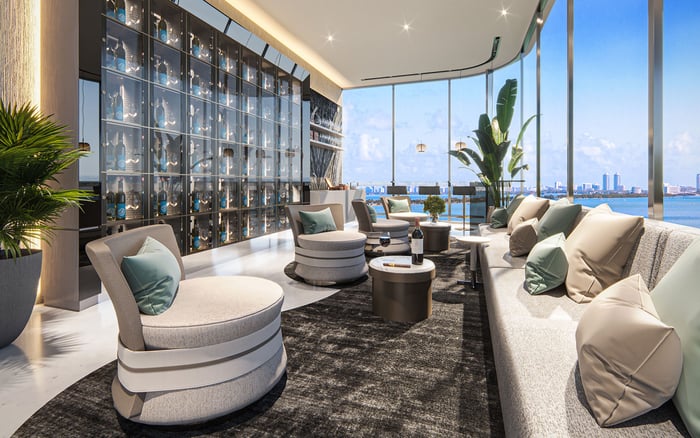
Villa Miami’s waterfront offering calls for a precise distinction between boat arrivals, long-term dockage, and yacht-club membership. Buyers should establish the right being purchased, its full carrying cost, and whether it can pass to a future owner before assigning it value.

For a yacht owner, arriving home by water and keeping a vessel at home are distinct privileges. At Villa Miami, that distinction warrants attention before a buyer assigns financial or practical value to the waterfront offering.
The condominium project at 710 NE 29th Street in Edgewater overlooks Biscayne Bay and is being developed by Terra, One Thousand Group, and Major Food Group. Its setting makes water access an appealing part of the residential proposition. But the purchase question is not simply whether a dock is advertised. It is what enforceable right a particular residence receives, at what cost, and for how long.
The waterfront offering is described inconsistently: as “private boat slips on the Biscayne Bay” and as a pickup-and-drop-off dock rather than a marina with resident slips. Neither interpretation should be treated as a settled entitlement without the governing documents.
The distinction matters. A place to board a tender may suit an owner whose yacht is berthed elsewhere. It does not, by itself, establish permission to leave a vessel overnight, reserve an exclusive berth, or keep a boat there throughout the season.
The arrival-only arrangement is described as concierge-coordinated access for residents and registered guests, rather than long-term boat storage, with the dock subject to permits. Those details must be reconciled in writing with the advertised private slips. Buyers should not assume that one description supersedes the other.
Ask the seller to identify exactly what accompanies the residence: an ownership interest, an assigned-use right, a lease, a license, or access to a shared arrival facility. These are possibilities to investigate, not established Villa Miami arrangements. Request the document granting the right and have counsel review its duration, exclusivity, termination provisions, and relationship to the condominium purchase.
An advertised slip does not establish a deeded berth attached to a particular residence. Until that connection is documented, keep residential value separate from assumed dockage value.
No verified Villa Miami marina-dues schedule, slip price, or membership-transfer agreement establishes the cost of the waterfront offering here. That uncertainty does not mean use is free. Nor does it establish that a separately charged marina exists.
Start with the right being offered, then request every associated charge. Are dock operating expenses included in condominium assessments? Would an assigned berth carry a separate payment? Are there reservation, service, utility, insurance, or maintenance charges? Which entity sets those amounts, and what authority would it have to change them?
If yacht-club membership is part of the proposal, request a separate written breakdown of any initiation fee, recurring dues, minimum spending requirements, and transfer charges. These are diligence questions, not disclosed Villa Miami fees.
For a buyer also considering Aria Reserve Miami, the comparison should rest on documentation: establish each residence’s carrying costs, then add only the boating expenses relevant to the intended ownership plan. Shared geography does not establish equivalent water-access rights.
A yacht club is among Villa Miami’s advertised amenities. It remains unestablished whether the club is on-site or off-site, included with a residence, optional, or operated by a third party. Initiation fees, recurring dues, and membership-transfer rules are also unresolved.
Buyers should separate three questions: what the condominium provides, what any dock arrangement provides, and what a club membership provides. An affirmative answer to one does not answer all three.
Request the club’s identity and operating agreement, if applicable. Ask whether membership attaches to the residence or the individual, whether acceptance requires approval, and whether membership includes a berthing entitlement. Clarify access for family, guests, captains, and crew rather than assuming a resident privilege extends to everyone aboard.
The objective is a usable boating arrangement, not simply an amenity name. A membership offering social access may serve a different purpose from a documented right to keep a yacht nearby.
Even a clearly documented right must fit the owner’s boat and routine. Request written confirmation of vessel-length and beam limits, water depth and draft suitability, permitted stay duration, reservation procedures, tender access, and charter restrictions. None of those operating rules is established here.
Have the captain assess the proposed arrangement against the actual vessel. Would a typical return from the bay require advance coordination? Could the tender remain while guests dine ashore? Is an overnight stay permitted? What happens when access is unavailable? The party responsible for operating the facility should answer these questions.
If the final arrangement permits only arrivals and departures, plan separately for storage and maintenance at an appropriate marina, yacht club, or private dockage. Treat that as a distinct availability and budgeting exercise, not an incidental expense presumed to be covered by the residence.
A right that works for the first buyer may not automatically work for the next. Before assigning a separate resale premium to a slip or membership, determine whether the right survives a sale and what the successor must do to obtain it.
Ask whether transfer requires consent, a new application, another initiation payment, or a replacement agreement. Would an assigned berth remain attached to the residence, return to a shared allocation pool, or terminate? If ownership is held through an entity, would a change in that entity’s ownership affect access? These questions require contractual answers, not sales assurances.
The same discipline applies when evaluating Una Residences Brickell alongside an Edgewater purchase. Compare documented rights rather than assuming different residential offerings deliver interchangeable boating privileges.
For Villa Miami, the prudent position is straightforward: do not value an “included slip” or transferable membership as a separate asset until its existence, scope, and transferability are established.
Before committing, request a consolidated written explanation of the waterfront right, the document granting it, applicable permit conditions, operating rules, all charges, and resale treatment. Ask counsel to reconcile that explanation with the purchase agreement and applicable condominium, dock, or club documents.
The right arrangement need not be the most extensive. A well-defined arrival dock could suit an owner who prefers a separate full-service berth. Another buyer may require dependable long-term dockage. The essential luxury is knowing that the residence supports the way its owner actually uses the water.
For a considered approach to South Florida waterfront ownership, explore MILLION.
If branded residences are on your mind — as a home or as an allocation — we would be glad to share what we are seeing, privately.
Begin a quiet conversationVilla Miami is a waterfront condominium project at 710 NE 29th Street in Miami’s Edgewater neighborhood, overlooking Biscayne Bay.
The developers are Terra, One Thousand Group, and Major Food Group.
Public descriptions conflict between private boat slips and an arrival-only dock without resident slips. Buyers should obtain written clarification in the governing documents before relying on either arrangement.
The advertised private slips do not establish a deeded berth attached to a particular residence. A buyer should request the document granting any claimed slip right.
A verified marina-dues schedule is not established here. Request written confirmation of all applicable charges and do not assume that undisclosed fees mean free access.
Overnight permission and long-term berthing rights are not established. The arrival-only description would not support an assumption that a yacht may remain overnight.
A yacht club is advertised, but its inclusion, location, operator, and membership terms are not established. Obtain the applicable agreement before treating membership as a purchase benefit.
Guaranteed transferability is not established. Buyers should confirm consent requirements, successor eligibility, potential fees, and whether any assigned berth survives resale.
Request written vessel-length and beam limits, water depth, draft suitability, stay duration, reservation procedures, tender rules, and charter restrictions. These operating terms are not established here.
Not before the right and its transferability are documented. Keep assumed dockage or membership value separate from the residential valuation until those terms are clear.