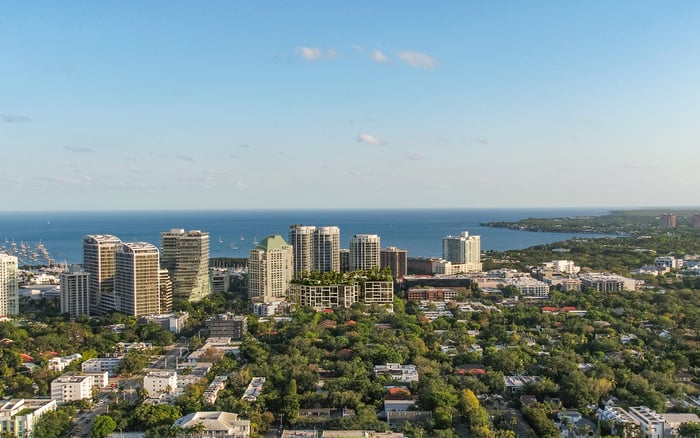
Buyers considering The Well Coconut Grove should model maintenance, working-capital funds, capital contributions, taxes, insurance and closing costs as separate components of first-year liquidity, then verify each amount in the controlling project and closing documents.

For a buyer evaluating The Well Coconut Grove, the purchase price does not provide a complete picture of acquisition-period liquidity. A useful first-year estimate also considers purchase closing costs, association charges, property taxes and unit-owner insurance.
The available information does not establish the project's exact maintenance rate or contribution formulas. Buyers should therefore avoid treating a market convention, preliminary estimate or another condominium's structure as a confirmed term for this transaction.
A clear first-year model separates recurring ownership expenses from one-time association funding due at closing.
This distinction is especially useful when evaluating a new residence because the closing ledger may contain several association-related entries. Similar labels do not necessarily mean that the funds have the same purpose, receive the same accounting treatment or reduce future monthly obligations.
A buyer's worksheet should distinguish regular maintenance from any working-capital payment, capital contribution or other disclosed association amount. Rather than grouping these entries under a single broad heading, record the name, amount, payee, timing and stated purpose of each charge.
The documents should explain whether a payment supports current association liquidity, is allocated to a reserve account or has another disclosed purpose. They should also clarify whether the amount is refundable, credited against future maintenance or retained independently of future monthly payments.
These questions matter because a contribution due at closing can increase the immediate cash requirement without reducing the recurring obligations that follow. The safest approach is to obtain written confirmation instead of inferring the treatment from the label alone.
Begin with the cash required to complete the purchase. Then add every association amount shown as due at closing. Finally, project the recurring expenses expected during the first year, taking care not to count any payment twice.
A practical worksheet can use the following categories:
Purchase-related closing costs;
Initial maintenance shown on the closing estimate;
Any separately disclosed working-capital amount;
Any separately disclosed capital or reserve contribution;
Recurring maintenance during the first year;
Property taxes; and
Unit-owner insurance.
The worksheet should identify which figures are confirmed and which remain preliminary. When a number has not been established by the controlling documents or final closing statement, use a clearly labeled range rather than presenting a single figure as certain.
Buyers may compare The Well Coconut Grove with other Coconut Grove residences, including Four Seasons Residences Coconut Grove, Opus Coconut Grove and Ziggurat Coconut Grove. Design, services and lifestyle may shape the shortlist, but the financial comparison should use consistent categories.
For each property, separate recurring maintenance from one-time closing contributions. A lower recurring figure should not be compared directly with another property's total that includes initial funding, and a closing estimate should not be treated as an annual operating budget.
This normalized approach helps buyers understand whether a difference arises from timing, accounting classification or an actual variation in recurring ownership costs. It also keeps the analysis focused on each project's own documents rather than assumptions drawn from a neighboring property.
Request the proposed condominium budget, maintenance schedule, declaration, bylaws, offering documents and an itemized estimate of cash due at closing. For every association-related entry, ask:
What document authorizes the charge?
Who receives the payment?
When is it due?
What is its stated purpose?
Is it refundable?
Is it credited against future maintenance?
Is it a one-time amount or a recurring obligation?
Could the figure change before closing?
Buyers should have appropriate legal and financial advisers review the answers in the context of the specific transaction. The goal is not merely to identify the total due at closing, but to understand what each amount represents and how it affects liquidity after the purchase is completed.
A first-year cash plan is most useful when it distinguishes confirmed obligations from unresolved items. The base case can contain documented amounts, while a separate liquidity cushion can account for figures that remain subject to final documentation.
Update the worksheet whenever a revised budget, maintenance schedule or closing estimate becomes available. Reconcile the final statement against the model, confirm that the first maintenance payment has not been counted twice and retain a record of how every contribution was treated.
For a private review of The Well Coconut Grove and its acquisition framework, connect with MILLION.
If branded residences are on your mind — as a home or as an allocation — we would be glad to share what we are seeing, privately.
Begin a quiet conversationInclude purchase closing costs, association amounts due at closing, recurring maintenance, property taxes and unit-owner insurance. Keep one-time and recurring items in separate categories.
Separate entries make it easier to verify each payment's purpose, timing and accounting treatment. The controlling documents should explain how each amount is handled.
No. Buyers should obtain the current maintenance schedule, proposed budget and transaction-specific closing estimate.
No assumption should be made without written confirmation. The project and closing documents should state whether a payment receives any credit against future obligations.
Request the proposed budget, maintenance schedule, declaration, bylaws, offering documents and an itemized closing estimate. Review the current versions applicable to the transaction.
Label preliminary figures clearly and keep them separate from confirmed obligations. Use a reasonable planning range until final documents establish the amount.
Identify any maintenance payment already included at closing, then reconcile it with the first-year schedule. Update the worksheet when the final closing statement is available.
Confirm the amount, payee, due date, stated purpose, document authority and whether the charge is refundable or recurring. Obtain the answers in writing when possible.
Use the same expense categories for every property and separate recurring costs from one-time funding. Base each comparison on that project's own documents.
Some figures may remain preliminary until final documents are issued. A range avoids presenting unresolved amounts as certain and supports more flexible cash planning.