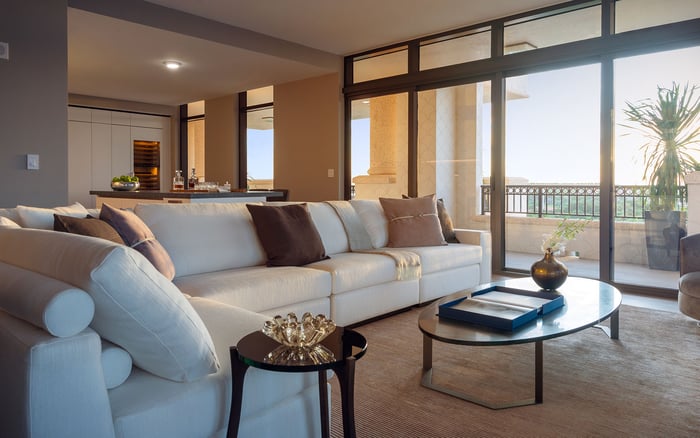
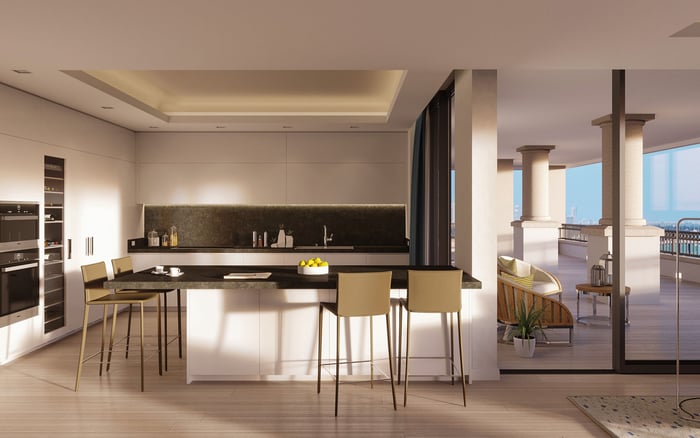
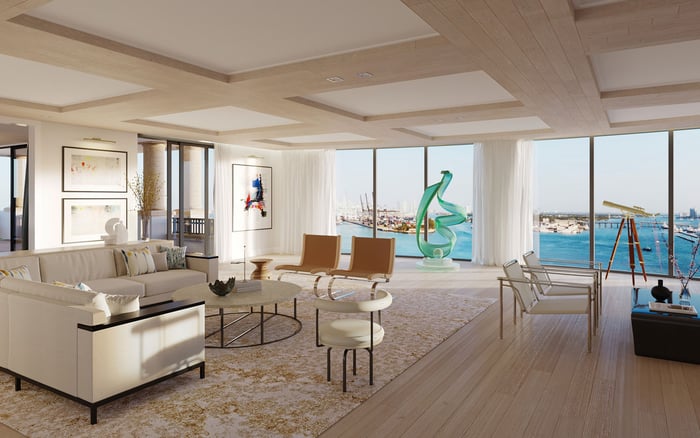
Palazzo della Luna offers several qualities that may support long-term ownership, including private elevator entry, backup elevator power and expansive residences. Yet a sound aging-in-place plan depends on verifying unit dimensions, staff access protocols, service circulation and the full journey between the residence and mainland care.
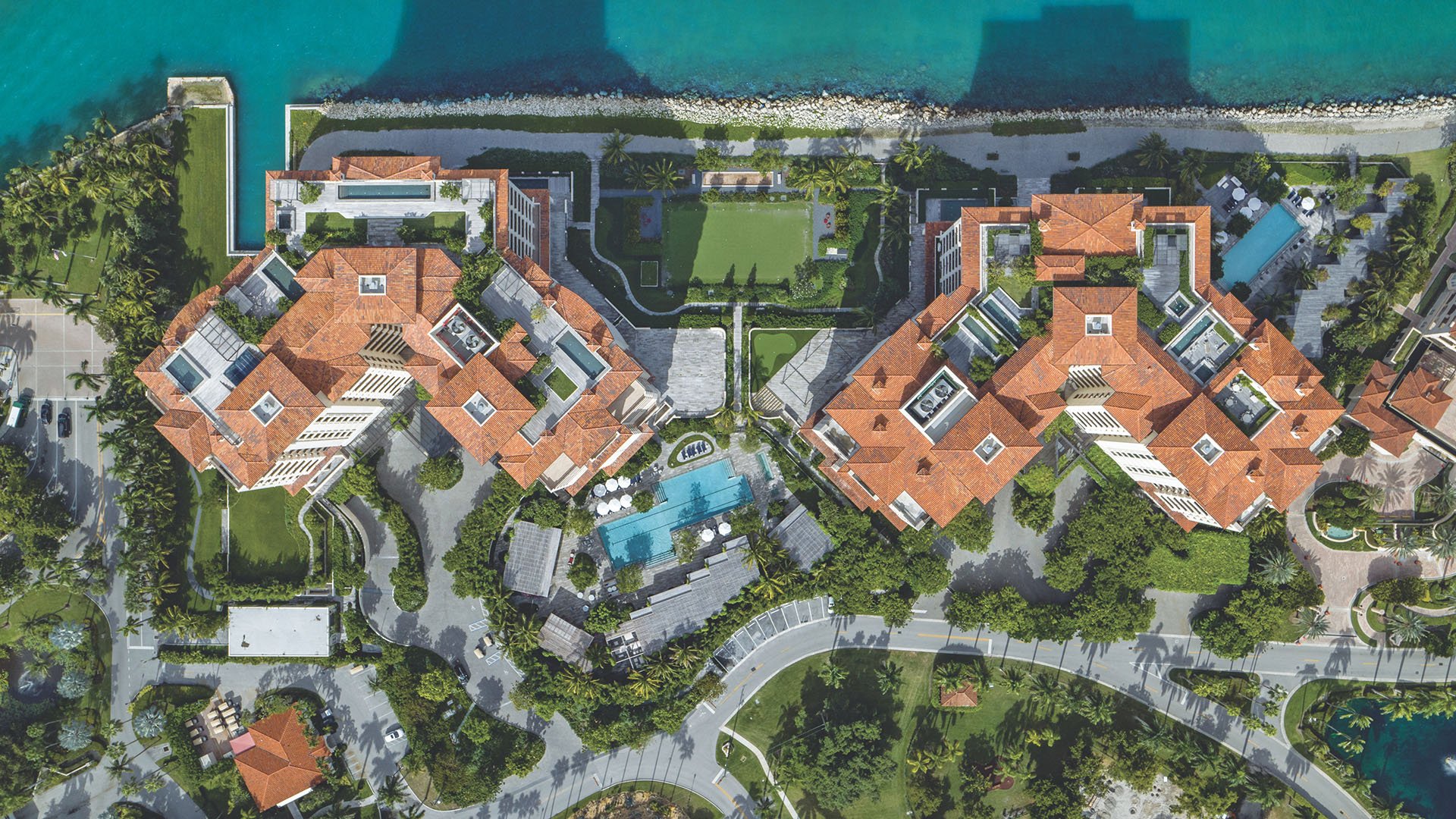
At Palazzo della Luna, privacy is integral to the residential experience. The 10-story, 50-residence waterfront condominium at 6000-6095 Fisher Island Drive combines expansive homes, deep terraces, private elevator entry, valet service, garage parking, and access to the ocean and marina.
Those qualities are compelling, but long-term usability depends on more than scale and finish. For a buyer planning to age in place, accommodate a family member with limited mobility, or retain rotating caregivers, the decisive questions involve routes, permissions, handoffs, and contingencies. The right residence must function smoothly on an ordinary afternoon and remain manageable during an overnight shift change, power interruption, or urgent mainland appointment.
In an island residence, accessibility is a complete journey rather than a single doorway.
Private elevator entry can make arrivals discreet and direct. It also means caregivers, nurses, therapists, household employees, and substitute agency personnel need dependable credentials. Buyers should request written procedures for recurring visitor registration, after-hours access, shift changes, temporary replacements, and credential revocation.
The elevator itself warrants a physical review. Confirm the cab dimensions, door opening, control height, landing clearance, and route from the garage or valet arrival to the unit. Ask whether emergency personnel can reach a private-elevator residence without delay and how management overrides access controls when necessary. These practical checks matter as much as the elegance of a private foyer.
The building has an on-site emergency generator serving elevators and life-safety systems. That is a meaningful mobility safeguard, although buyers should still verify generator runtime, which elevators remain operational, and the procedures followed during extended outages or hurricanes.
The building’s features emphasize private residential elevators but do not clearly establish whether Palazzo della Luna has a separate service elevator or dedicated back-of-house staff corridor. This lack of clarity does not establish that either is absent; it makes written confirmation essential.
A buyer should map how groceries, mobility equipment, medical supplies, luggage, housekeeping carts, and maintenance teams move through the property. Determine whether staff share the resident elevator, whether deliveries require scheduling, and where caregivers wait during access approval. Confirm stretcher dimensions and the route used by fire-rescue or ambulance teams from island arrival through the lobby and into the home.
This operational review is equally useful when comparing nearby options such as Palazzo del Sol or The Residences at Six Fisher Island. The objective is not to assume equivalent procedures, but to ask each property the same detailed questions.
Palazzo della Luna offers broad floor-through plans and deep terraces, including large three- and four-bedroom residences. That scale can create space for an overnight caregiver, private nurse, or dedicated staff room without compromising the principal suite or entertaining areas. Non-penthouse ceilings are approximately 10 to 11 feet, while penthouse ceilings are about 18 feet, contributing to a generous sense of volume.
Scale alone does not establish accessibility. Doorway widths, wheelchair turning clearances, roll-in showers, threshold heights, and other detailed ADA features are not specified. An accessibility specialist should measure the elevator cab, entry sequence, interior doors, bathrooms, kitchen clearances, terrace transitions, and circulation around beds and furnishings.
Penthouses and lanai residences may include private pools. For some households, that brings outdoor recreation close at hand. For others, it introduces fall, supervision, and water-safety considerations that should be integrated into staffing and landscape plans.
First-floor studios range from 514 to 681 square feet and may appear attractive as separate accommodation for staff or caregivers. Buyers should not assume such use is permitted. Association rules, occupancy requirements, access rights, and any limitations on live-in employees require confirmation before a staffing plan relies on a studio.
The same diligence applies when allocating a bedroom within the main residence. Review overnight employee policies, caregiver parking, vehicle registration, package handling, key custody, and amenity access. If an agency provides care, ask how last-minute substitutions are processed when the incoming caregiver has not previously been registered.
Buyers evaluating estate-style alternatives such as The Links Estates at Fisher Island should apply the same discipline. More private space does not eliminate the need to coordinate staffing, transportation, emergency entry, and household circulation.
Fisher Island is reached from the mainland by private yacht or the private passenger-and-vehicle ferry. The ferry crossing takes about seven minutes and generally operates every 10 to 15 minutes, while the island’s Transportation Department operates 24 hours a day throughout the year.
The short crossing is only one component of a medical or caregiver journey. Time the route from the prospective unit through elevator arrival, lobby processing, valet or garage retrieval, transport to the ferry, queueing, crossing, and mainland driving. Repeat the exercise during the hours when caregivers would begin and end their shifts.
Golf carts and low-speed electric vehicles are standard for on-island movement, so the plan should identify who arranges transport between the ferry landing and the residence. Brokers or concierges can arrange carts and island itineraries, but a household requiring continuous care should establish a repeatable protocol rather than depend on improvised transfers.
The lifestyle advantage is that numerous needs can be met on-site. Amenities include a fitness center, theater, beauty salon, massage-treatment rooms, children’s playroom, pools, cabanas, spa, yoga lawn, and landscaped gathering areas. These offerings may reduce routine trips, though they do not replace contingency planning for off-island appointments or emergencies.
For Palazzo della Luna Fisher Island buyers, the strongest long-term plan combines architectural measurements with written operating rules. Before closing, conduct a route test with any mobility aid likely to be used, review staff credentials with management, and document backup transport arrangements for ferry interruptions or severe weather.
Private elevators, backup elevator power, large residences, valet parking, and round-the-clock island transportation can support aging in place. Their value becomes fully practical only when access permissions, service routes, caregiver accommodation, emergency response, and marine transportation are coordinated as one system.
Within MILLION’s Buyer's Guides, this is the central principle: enduring luxury is a residence that remains private, graceful, and workable as household needs evolve.
For discreet guidance on evaluating South Florida residences for long-term use, connect with MILLION.
If branded residences are on your mind — as a home or as an allocation — we would be glad to share what we are seeing, privately.
Begin a quiet conversationIts private elevators, backup elevator power, large residences, valet parking, and round-the-clock island transportation may support aging in place when access and transport contingencies are planned.
Public materials do not specify detailed ADA features. Buyers should have an accessibility specialist measure doors, bathrooms, thresholds, terraces, turning areas, and elevator cabs.
Building management should confirm credentialing, visitor registration, after-hours entry, shift changes, and procedures for substitute agency personnel.
Public feature descriptions do not clearly document a separate service elevator or back-of-house corridor. Buyers should obtain written confirmation from management.
An on-site emergency generator serves elevators and life-safety systems. Buyers should verify runtime, elevator availability, and extended-outage procedures.
Large three- and four-bedroom plans may provide space for an overnight caregiver, but association rules governing live-in employees should be confirmed.
Studios range from 514 to 681 square feet, but buyers must confirm whether association and occupancy rules permit caregiver or staff use.
The crossing takes about seven minutes and generally operates every 10 to 15 minutes. Total door-to-door travel is longer once transfers, queues, and mainland driving are included.
Test the full route from the unit to the mainland, including elevators, lobby access, on-island transport, ferry queueing, the crossing, and onward driving.
Pools in some penthouse and lanai residences can make outdoor recreation convenient, but they also introduce fall, supervision, and water-safety considerations.