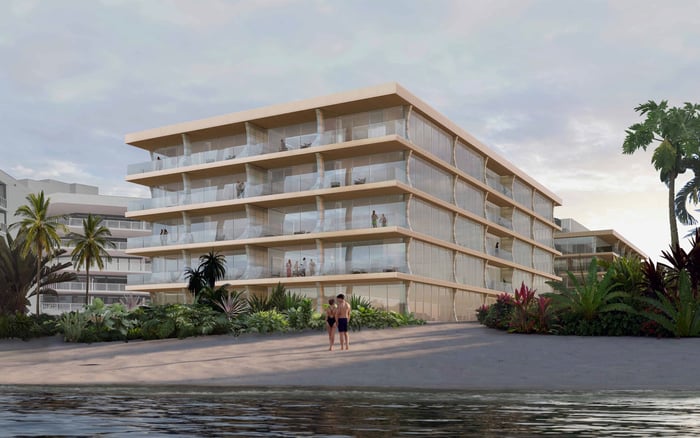
A buyer-focused framework for testing Mr. C Residences West Palm Beach’s estimated HOA against insurance volatility, staffing costs, utility inflation, and reserve funding, without confusing illustrative scenarios with a project forecast.

For buyers considering Mr. C Residences West Palm Beach, the HOA deserves the same scrutiny as the floor plan. The question is not simply whether today’s assessment feels comfortable, but whether the residence remains comfortable to own as the costs behind that assessment change.
The preconstruction estimate used here is approximately $2.19 per square foot monthly; confirm the current figure in the project’s documentation. For an illustrative 2,000-square-foot residence, that translates to $4,380 a month, or $52,560 annually, before property taxes and personal insurance. These are planning figures-not a guaranteed operating assessment or a unit-specific quote.
A useful stress test separates the cost of delivering the lifestyle from the funds set aside for future obligations. Insurance, payroll, utilities, other operating expenses, and reserve contributions each need a separate line. A single inflation assumption can test affordability, but it cannot identify where the pressure originates.
Request the latest assessment for the specific residence, along with the detailed operating budget and its effective date. Confirm the unit’s allocation rather than assuming a square-foot estimate precisely matches its contractual obligation.
When reviewing any “all-inclusive” description, verify how the budget accounts for administration, staffing, utilities, insurance, maintenance, third-party vendor contracts, and reserves. The label alone does not establish that every in-unit utility, optional service, personal policy, or special assessment is included.
Ask for a written inclusions schedule. Distinguish common-area utilities from residence-level consumption, core staffing from separately charged services, and association coverage from the owner’s insurance responsibilities. Reconcile those answers with the budget.
If Alba West Palm Beach is also on the shortlist, request the same documents there. A comparison becomes meaningful only when the expenses inside and outside each quoted assessment are aligned. A lower headline fee alone establishes little.
Build the insurance stress test around the property’s documented premium allocation. An insurance percentage expressed as a share of the operating budget is not automatically a percentage of the total assessment when that assessment also funds reserves.
For illustration only, assume insurance represents 30% of the entire $4,380 monthly assessment. The insurance component would be $1,314. Holding all other expenses unchanged produces these results:
| Illustrative insurance scenario | Added monthly cost | Total monthly assessment | | --- | ---: | ---: | | No premium increase | $0 | $4,380 | | 50% Premium increase | $657 | $5,037 | | 100% Premium increase | $1,314 | $5,694 |
These allocations do not establish Mr. C’s actual budget. Replace the hypothetical insurance component with the unit’s documented share before using the results to inform a purchase decision.
Request insurance quotes, coverage limits, deductibles, and renewal assumptions. Model a cumulative premium increase of 50-100% over three to five years as a stress scenario, not an annual growth rate. Consider deductible exposure separately from recurring premiums so the monthly model does not imply that every potential cash requirement is funded.
Payroll and utilities call for different questions than insurance. For staffing, request the assumed headcount, service hours, benefits, overtime, and outsourced labor arrangements. Identify where vendor-supplied staffing appears in the budget so the same expense is not counted under both payroll and contracts.
Test annual payroll growth of 5-8%. Apply that assumption to the documented payroll allocation, not the full HOA. Ask whether the starting budget reflects the staffing level intended for normal operations or whether any service assumptions remain subject to change.
For utilities, identify what the association pays, what the residence pays directly, and the consumption assumptions supporting the estimate. Test annual growth of 5-10% on the association-funded utility line. These ranges are suggested sensitivities, not predictions about Mr. C’s expenses.
A buyer also evaluating Forté on Flagler West Palm Beach should use the same categories. The objective is not to presume equivalent service or operating costs, but to compare the financial assumptions behind ownership at each property.
Test reserve contributions against the applicable reserve study and funding schedule. Establish Mr. C’s particular reserve allocation and any applicable legal timetable through project documentation and professional review.
Request the proposed contribution, the obligations it addresses, and the scheduled changes over the holding period. Have counsel and an appropriate reserve professional assess the applicable requirements and assumptions.
Do not treat reserves as the balancing figure that makes an otherwise expensive budget appear manageable. Nor is a low initial contribution evidence of low long-term costs. The central question is whether scheduled funding supports the obligations identified for the property.
For a shortlist that includes Shorecrest Flagler Drive West Palm Beach, request the same reserve documentation rather than assuming new-construction budgets share a funding approach.
Build the model from the bottom up: projected insurance, payroll, utilities, and other operating expenses, plus the scheduled reserve contribution. Keep every line on the same monthly, unit-level basis. Assign other operating expenses an explicit assumption rather than silently holding them flat.
Do not add component increases to a total HOA that has already been inflated; that double-counts growth. Maintain a separate whole-assessment affordability check: compounding $4,380 at an assumed 6% annually produces approximately $5,861 monthly after five years. This is a calculation, not a project forecast.
Place property taxes, personally purchased coverage, excluded services, and a separate allowance for potential assessments alongside the HOA model. Obtain a residence-specific insurance quote rather than relying on a generic condominium policy estimate.
Before choosing the residence, establish the annual carrying cost and extraordinary cash call you would comfortably accept. The strongest purchase decision is not the one supported by the lowest estimate, but the one that remains persuasive when its assumptions are tested.
For a discreet conversation about your West Palm Beach shortlist and ownership priorities, connect with MILLION.
If branded residences are on your mind — as a home or as an allocation — we would be glad to share what we are seeing, privately.
Begin a quiet conversationThe preconstruction estimate used here is approximately $2.19 per square foot monthly. It is not a guaranteed operating assessment, so request the latest unit-specific figure.
The illustrative assessment is $4,380 monthly, or $52,560 annually. Property taxes and personal insurance are additional.
Request written confirmation of how administration, staffing, utilities, insurance, maintenance, vendor contracts, and reserves are funded. Confirm exclusions, particularly in-unit utilities, optional services, and personal coverage.
No, the 30% allocation is hypothetical. Insurance’s share of an operating budget should not be treated automatically as its share of an assessment that includes reserves.
If insurance hypothetically accounts for 30% of a $4,380 assessment, a 50% premium increase adds $657 monthly. The total becomes $5,037 with every other cost unchanged.
Under the same hypothetical allocation, the monthly assessment rises to $5,694 with other costs unchanged. This is a stress scenario, not a prediction for the project.
Suggested sensitivities are 5–8% annual payroll growth and 5–10% annual utility growth. Apply each rate only to its documented expense component.
Compare proposed contributions with the applicable reserve study and funding schedule. The project’s actual reserve allocation and legal timetable must be established through its documentation and professional review.
A $4,380 monthly baseline compounded at an assumed 6% annually reaches approximately $5,861 after five years. Keep this separate from the component model to avoid double-counting growth.
Request the unit-specific assessment, detailed operating budget, staffing assumptions, insurance quotes and deductibles, utility inclusions, and reserve study and funding schedule. Obtain a separate residence-specific personal insurance quote.