Tula Residences offers a relatively concise staged-deposit structure, but foreign buyers should examine more than the headline percentages. With 70% reportedly due at closing, the largest currency exposure arrives at the end of the construction period. Careful scenario planning can clarify the home-currency cost, liquidity needs, and operational timing of each transfer.
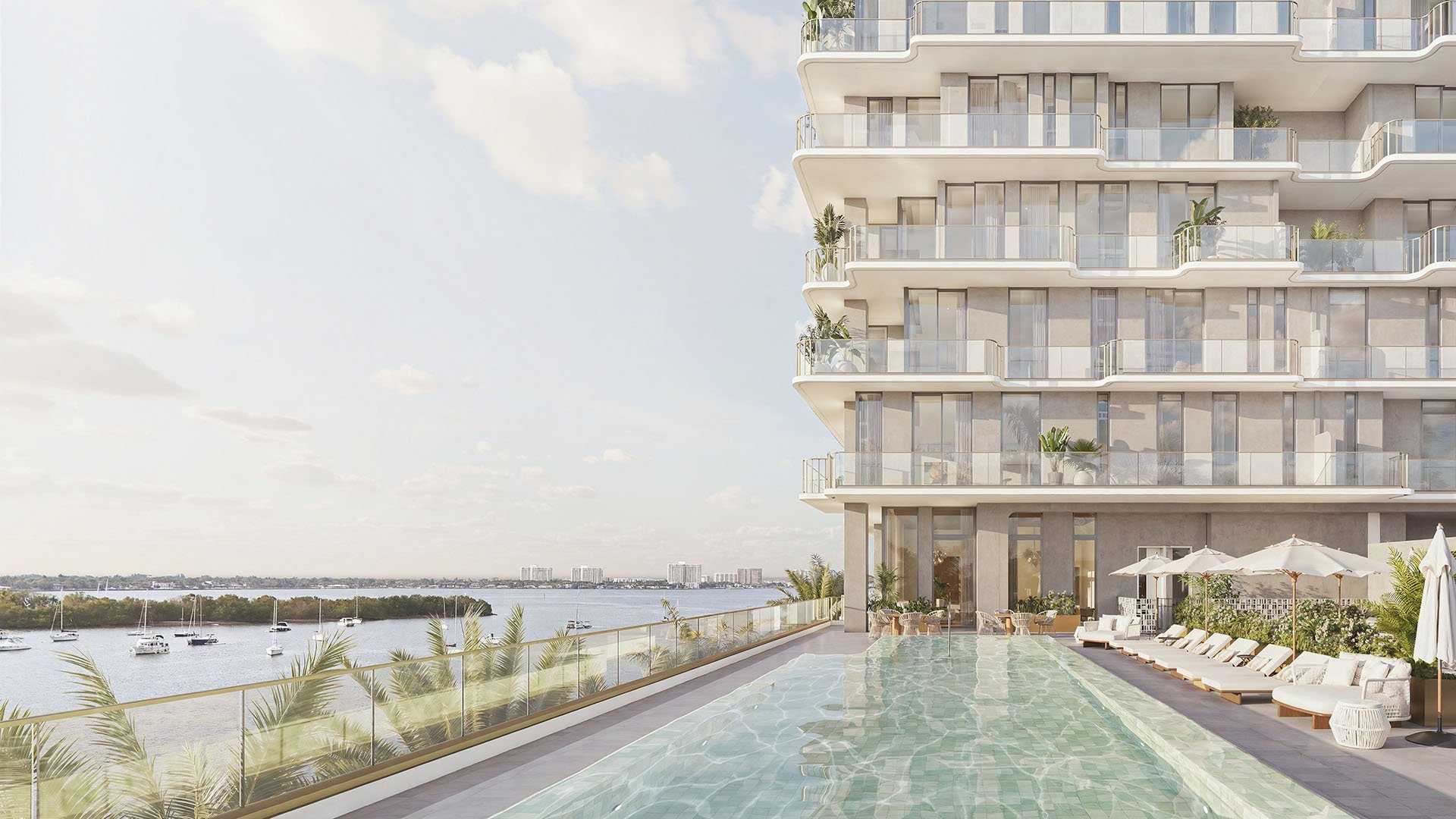
At 7918 West Drive, Tula Residences North Bay Village is planned as a 21-story boutique waterfront tower with 54 luxury residences, including six penthouses. Corner-unit designs overlook Biscayne Bay, and typical residences span approximately 1,590 to 2,345 interior square feet. Penthouse plans are substantially larger.
The project is under construction, with completion or occupancy targeted for fall or Q4 2026. Pricing begins at approximately $1.9 million, subject to availability and change during sales. For an international purchaser, however, the dollar price is only the opening figure. The ultimate cost in euros, pounds, Canadian dollars, Brazilian reais, or another funding currency depends on when each conversion occurs and the effective rate after spreads and transfer charges.
The largest currency decision is not the first deposit, but the 70% balance at closing.
Tula therefore merits two parallel evaluations. One concerns the residence, setting, and construction timeline. The other concerns the path by which home-currency capital becomes cleared U.S. dollars in escrow.
The payment plan calls for 20% at contract, another 10% six months later, and 70% at closing. This structure places 30% of the purchase price before completion and concentrates the majority in a single final transfer. It also creates fewer pre-closing payment events than a common Miami structure requiring 20% at contract, 10% at groundbreaking, 10% at top-off, and the balance at closing.
For a $2 million residence, the sequence translates to $400,000 at contract, $200,000 six months later, and $1.4 million at closing. At $3 million, it becomes $600,000, $300,000, and $2.1 million. These dollar obligations remain fixed under the contract, but their home-currency equivalents can move materially.
The schedule remains indicative until the executed purchase agreement establishes exact due dates, notice periods, grace periods, and default provisions. The six-month deposit offers a relatively identifiable intermediate date. Closing is less mechanical because its timing is tied to construction completion and contractual notice.
A foreign buyer converting separately for each stage effectively makes three currency decisions. The first two fund 30% of the price; the last funds 70%, unless a U.S. mortgage or another dollar source covers part of that amount. A favorable rate on the deposits can therefore be outweighed by an unfavorable move before closing.
At the approximately $1.9 million starting price, a 5% difference in the effective conversion rate represents a home-currency equivalent of about $95,000 before bank spreads and transfer costs. This illustration applies to the total price rather than predicting a particular currency move. It demonstrates why even a seemingly modest percentage change warrants attention in the acquisition budget.
A useful model separates each obligation rather than applying one forecast to the entire residence. The buyer can calculate the home-currency cost of the 20%, 10%, and 70% payments under several exchange-rate scenarios, then add estimated conversion spreads and wire expenses. The resulting range is more useful for decision-making than a single optimistic forecast.
The first approach is to buy more U.S. dollars early. This can provide budget certainty for later obligations, but it also commits capital sooner and may reduce flexibility. The buyer must consider where those dollars will be held, what protections apply, and whether early conversion aligns with broader liquidity, tax, and estate planning.
The second approach is to convert only as each payment becomes due. This preserves access to the original currency but leaves the remaining balance exposed to future rates. At Tula, the largest risk therefore remains open until the closing funds are secured.
A third approach is a staged framework combining cash conversions with appropriately timed hedging tools or a multicurrency account. FX forwards and options can involve premiums, collateral requirements, counterparty conditions, and jurisdiction-specific restrictions. Any strategy should align with the contractual dates and cover only the amount expected to be funded in cash. If financing will cover part of the closing balance, hedging the full 70% could create a mismatch.
These are planning structures, not universal recommendations. Regulated financial, legal, and tax advisers can assess the buyer's currency, residence, entity structure, financing plan, and risk tolerance.
North Bay Village buyers may also consider Continuum Club & Residences North Bay Village and Shoma Bay North Bay Village when defining a local comparison set. Nearby La Maré Bay Harbor Islands can broaden the geographic conversation without replacing project-specific underwriting.
The comparison should extend beyond asking prices. Buyers should examine the timing and concentration of deposits, anticipated closing window, contractual notice mechanics, and portion of final funds expected from non-dollar assets. Two residences with similar dollar prices can create different liquidity profiles when their payment calendars differ.
Because Tula is a pre-construction acquisition scheduled for future delivery, its FX exposure period is longer than that of a completed residence with a short closing timetable. That extended interval creates both optionality and uncertainty: it gives a buyer time to assemble dollars methodically, yet leaves more time for exchange rates to change.
Currency strategy is incomplete without transfer logistics. International-wire cutoffs, compliance reviews, correspondent-bank routing, and escrow verification can all affect arrival times. Waiting until the contractual deadline to initiate conversion or transmission introduces avoidable operational risk, even when sufficient funds are available.
Before signing, a buyer can create a payment calendar based on the agreement's actual language, identify the source currency for each stage, and assign responsibility among the bank, currency provider, counsel, and closing team. The plan should include a verification buffer and a procedure for confirming wiring instructions through trusted channels.
A disciplined review also distinguishes the contracted purchase price from the broader cash requirement. Currency spreads, transfer costs, financing assumptions, and professional fees should be tracked separately rather than folded into a single exchange-rate estimate. Scenario analysis can then clarify both the likely budget and the contingency liquidity the buyer wishes to maintain.
Evaluating Tula is not solely about architecture or bay views. For an overseas purchaser, it is also an exercise in coordinating a luxury asset with a sequence of dollar obligations.
For private guidance on South Florida opportunities and project-specific purchase planning, connect with MILLION.
If branded residences are on your mind — as a home or as an allocation — we would be glad to share what we are seeing, privately.
Begin a quiet conversationThe reported structure is 20% at contract, 10% six months later, and 70% at closing. The executed purchase agreement controls the actual dates and terms.
It represents 70% of the purchase price, making it the largest single dollar obligation. An unfavorable move near closing can outweigh savings on earlier deposits.
The reported schedule would require $400,000 at contract, $200,000 six months later, and $1.4 million at closing.
The corresponding amounts would be $600,000 at contract, $300,000 six months later, and $2.1 million at closing.
At an approximately $1.9 million price, it represents about $95,000 in home-currency equivalent before bank spreads and transfer costs.
Early conversion can improve budget certainty but commits capital sooner and may reduce flexibility. The appropriate approach depends on liquidity, financing, and professional advice.
Yes, but doing so leaves each future payment exposed to the exchange rate available at that stage. At Tula, most exposure would remain with the 70% closing balance.
A hedge or conversion plan should cover only the amount actually funded in cash. If a U.S. mortgage covers part of closing, the buyer's currency requirement may be lower.
Completion or occupancy is targeted for fall or Q4 2026. Contractual closing notice and construction progress determine the operative timing.
Buyers should allow for wire cutoffs, compliance checks, correspondent-bank delays, and escrow verification. Funds should not be converted or sent at the last possible moment.