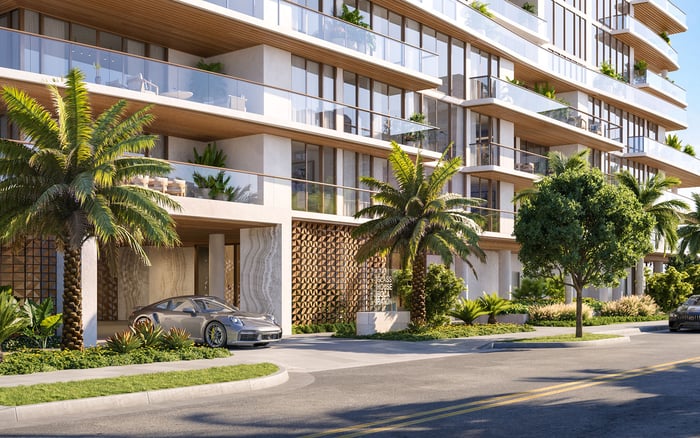
Current association fees at this branded Boca Raton condominium vary materially by residence. Buyers should look beyond the quoted monthly figure and examine budgets, guarantees, reserves, shared-service allocations and the likely cost structure after turnover.

At The Residences at Mandarin Oriental Boca Raton, the lifestyle proposition is unusually integrated. The condominium at 105 E Camino Real in Downtown Boca Raton connects to the Mandarin Oriental hotel by skybridge, extending resident access and signing privileges to the hotel. That relationship gives the ownership experience much of its appeal, but it also makes the association budget more complex than a straightforward calculation of elevators, landscaping and a pool.
Monthly association fees have ranged from $2,753 to $6,302 across the building. Individual residences underscore that variation: Residence #912 carried a monthly fee of $4,349, Residence #1001 carried $6,104, and Penthouses PH-09 and PH12 carried $6,302. The median was approximately $5,326, while a maintenance estimate placed the monthly figure near $1.30 per square foot, with actual charges varying by residence.
These figures are useful snapshots, not permanent ceilings. They reflect the costs assigned to particular residences during an asking period. On their own, they do not establish the stabilized cost of operating the property after sellout, association turnover or the expiration of any developer guarantee.
A quoted assessment is a snapshot of ownership cost, not proof of its stabilized ceiling.
In a developer-controlled community, owner assessments can remain below the association's full operating cost when the developer agrees to fund the difference between collected assessments and operating expenses. Commonly described as deficit funding or a budget guarantee, the arrangement has a straightforward effect: the monthly amount paid by early owners may not reveal what owners collectively would need to bear without developer support.
That does not establish that this condominium currently has an HOA subsidy, deficit-funding arrangement or budget guarantee. The available information does not identify a project-specific subsidy or post-guarantee assessment forecast. The answer must come from the condominium's signed offering documents, current association budget and guarantee provisions.
The governing documents may distinguish among reserve funding, budget guarantees and deficit-funding obligations. Buyers should have qualified counsel identify the provisions that apply to the condominium rather than relying on general assumptions.
The range in advertised fees warrants interpretation, not alarm. Larger residences, penthouses and differing allocation formulas can produce materially different obligations. PH-09's fee includes management, common areas, cable television, hot water, building insurance, pest control and pool service. Residence #1001's package also includes gas and interior maintenance, among other items.
Even detailed inclusion lists require context. Buyers should determine whether concierge staffing, security, shared amenities and Mandarin Oriental-level services are fully represented in the association budget. They should also identify costs allocated through a shared-facilities or hotel-services agreement, charges billed directly to a residence and expenses that could fall outside regular assessments.
This is the central Pricing & Trends question: not whether a fee appears high or low in isolation, but whether it accurately captures the service standard being purchased. For Branded Residences, the most elegant experience is often operationally intensive. Insurance, management, maintenance, common-area care and hospitality-caliber staffing require durable funding long after the sales period ends.
A serious review begins with the current association budget and reserve schedule. The buyer's attorney and financial adviser should reconcile projected expenses with actual or contracted services, then examine the documents for any developer guarantee, deficit-funding obligation or temporary subsidy. The analysis should identify when that support begins, when it ends and what follows.
Next, request the sold-versus-developer-owned unit count and determine how developer-owned residences are treated for assessment purposes. Under some deficit-funding structures, a developer may fund the operating shortfall rather than pay regular assessments on its inventory. As a result, early owner payments may differ from the property's full expense burden.
Closing contributions also merit scrutiny. A purchaser should understand where those contributions go, how they are recorded and whether they support operations, reserves or another stated purpose.
Finally, request a post-guarantee pro forma. It should model the same service program without developer support and account for reserves, insurance, staffing, maintenance and shared hotel-related costs. Sensitivity testing can then show how the residence's obligation changes if expenses rise or the allocation basis shifts. This exercise is more revealing than simply annualizing the current listing fee.
Comparison shopping is valuable only when the comparison is normalized. Nearby options such as Alina Residences Boca Raton, Glass House Boca Raton and Mr. C Residences Boca Raton help frame the local luxury condominium set. Yet headline assessments should never be compared without examining residence size, included utilities, insurance treatment, staffing, amenity scope, reserves and any shared-service arrangement.
For readers using Buyer's Guides, the disciplined metric is expected annual ownership cost for an equivalent standard of service. One building may place more expenses within the regular assessment, while another bills certain services separately. A lower published fee may therefore represent a different bundle rather than superior efficiency.
Pre-Construction buyers should treat the first-year budget as a working assumption. Before relying on a monthly figure, request the signed budget, reserve schedule, shared-facilities agreement, hotel-service allocation, developer-guarantee language and post-guarantee forecast. Confirm whether special assessments, closing contributions or separately billed services could sit outside that number.
The objective is not to strip hospitality from the proposition. It is to ensure that the ownership model can sustain the promised experience. At this level, predictable service is itself an asset, and an adequately funded association helps preserve it.
The Residences at Mandarin Oriental Boca Raton offers a compelling connection between private ownership and hotel privileges. A sophisticated purchase decision pairs that appeal with a clear view of stabilized costs, separating today's marketed assessment from tomorrow's durable expense base.
For discreet guidance on South Florida's most considered residences, connect with MILLION.
If branded residences are on your mind — as a home or as an allocation — we would be glad to share what we are seeing, privately.
Begin a quiet conversationPublicly marketed fees have ranged from $2,753 to $6,302 per month, with material variation among residences.
No. A listing fee reflects a current asking-period assessment and may not capture costs after sellout, turnover or the end of developer support.
No project-specific subsidy or post-guarantee forecast is identified in the available information. Buyers should verify the position in the offering documents and association budget.
Residence 912 was marketed with a monthly association fee of $4,349.
Penthouses PH-09 and PH12 were each marketed with monthly HOA fees of $6,302.
Its published fee includes management, common areas, cable television, hot water, building insurance, pest control and pool service.
Request the current budget, reserve schedule, shared-facilities agreement, hotel-service allocation, guarantee terms, inventory count and a post-guarantee pro forma.
It can clarify how unsold inventory is treated and whether the developer pays regular assessments or funds an operating deficit under the governing arrangement.
Their treatment can affect association funding. Buyers should confirm their stated purpose and accounting.
Normalize for residence size, included services, insurance, staffing, reserves, amenities and separately billed costs rather than comparing headline dues alone.