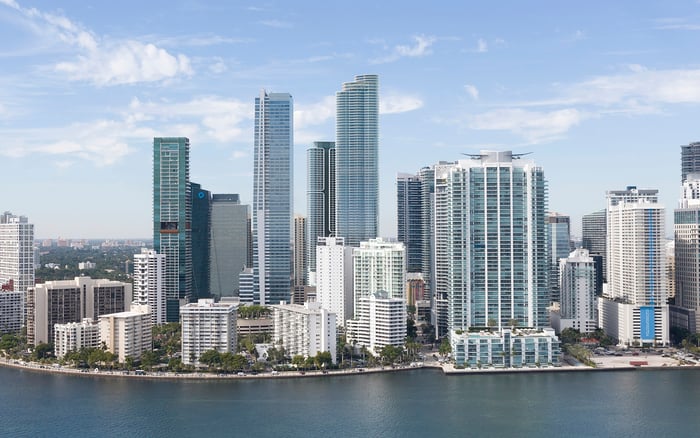
Colette’s staged, dollar-denominated payment structure gives international buyers several conversion windows. The central planning issue is the large illustrative closing balance, which can leave substantial foreign-exchange exposure outstanding through the expected closing period.

For an international buyer, evaluating Colette Residences Brickell requires two parallel judgments. The first concerns the residence itself: a planned five-story, 38-home building at 1880 Brickell Avenue, offering two- to four-bedroom configurations and floor-plan examples spanning approximately 2,423 to 3,184 square feet. The second concerns how a dollar-denominated price translates into the buyer’s home currency over a multiyear construction period.
That distinction matters because a preconstruction purchase does not involve a single currency conversion. It requires a sequence of conversions, each potentially executed at a different exchange rate. Asking prices have begun at roughly $2.79 million to $3.3 million, depending on the residence and available inventory, while one four-bedroom-plus-den example has been offered at $5.798 million. At this scale, even modest currency movement can materially alter the home-currency budget without changing the contractual dollar price.
A fixed dollar price can still become a moving home-currency obligation.
One described payment schedule calls for 10% at contract, 10% after 60 days, 10% at groundbreaking, 10% at top-off and 60% at closing. Estimated milestones place groundbreaking in Q3 2026, top-off in Q1 2028 and closing in Q4 2028. Each payment therefore creates a separate decision about when to acquire dollars.
The executed purchase agreement must determine the controlling percentages, milestone definitions, notice provisions and payment deadlines. Marketing shorthand and estimated construction dates should not govern treasury planning.
This principle applies when comparing Colette with other low-density or luxury Brickell choices, including 2200 Brickell. Architectural preferences may guide the shortlist, but contractual cash-flow timing defines the currency calendar.
At a $2.8 million purchase price, each 10% installment would equal approximately $280,000. If the 10-10-10-10-60 structure appears in the executed agreement, the final 60% balance would be about $1.68 million before closing costs.
This distribution is more consequential than the headline price alone. After four 10% payments, the buyer may have funded $1.12 million, yet the largest single dollar obligation remains outstanding. If the U.S. dollar strengthens against the buyer’s base currency before closing, purchasing that $1.68 million will require more home currency. If the dollar weakens, the home-currency burden moves in the opposite direction.
Larger acquisitions magnify both the dollar obligations and the operational need to coordinate conversions around milestone notices.
A disciplined plan assigns every payment to one of three approaches. The first is immediate conversion, placing the necessary dollars in position well before the due date. This provides clarity but may forgo a potential benefit if the buyer’s home currency later strengthens. Cash held in dollars also requires an appropriate custody and liquidity plan.
The second is to remain unhedged until payment. This preserves flexibility and allows favorable currency movement to benefit the buyer, but it leaves the full installment exposed. Such an approach should reflect a deliberate risk decision, not the accidental result of waiting for a construction notice.
The third is a hedge arranged through a regulated bank or currency specialist. A forward contract can improve budget certainty, although pricing costs, collateral requirements and lost upside may apply. Buyers can also divide an obligation into tranches rather than treating conversion as an all-or-nothing event. The appropriate mix depends on liquidity, risk tolerance, base currency and the certainty of the payment date.
Comparable decisions arise across Brickell’s broader pipeline. A purchaser weighing Una Residences Brickell or St. Regis® Residences Brickell should likewise map contractual installments before comparing the home-currency economics of competing residences.
The FX model should begin with the unit’s contractual dollar price, then incorporate the percentages and actual demand dates in the signed agreement. It should also account for closing costs, wire fees, bank spreads and every other dollar funding requirement. Together, these items can make the effective exchange rate less favorable than a headline market quote.
For every installment, a practical worksheet should show the dollar amount, contractual due date, home-currency funding source, conversion status and responsible institution. It should also include a reserve for timing friction. International transfers can involve compliance checks, intermediary banks and source-of-funds documentation, making a wire initiated on the deadline an avoidable risk.
Buyers intending to finance at closing face an additional layer. Currency exposure interacts with future interest rates, underwriting standards and required equity. A financing assumption made today may not match the terms available near a possible 2028 closing. The plan should therefore test both a financed closing and a higher-cash alternative, without presuming that future credit will arrive on present expectations.
Colette’s boutique positioning and large-format residences may appeal to buyers seeking a more private expression of urban Miami. Yet investment discipline remains essential. Within preconstruction, design quality and location are only part of the decision; payment mechanics can reshape the buyer’s actual cost in home currency.
That is why Colette also belongs in a broader pricing-and-trends discussion. A foreign buyer comparing nominal dollar prices must examine when those dollars become due, how much remains exposed and whether liquidity is concentrated around closing. The most useful comparison is not simply price per residence. It is the complete path from contract execution to final funding.
Legal and tax advice should be tailored to nationality, residence, holding structure and source of funds. Currency advice should likewise reflect the institutions and regulations relevant to the buyer rather than a generic market view.
Before committing, confirm the exact deposit schedule in the purchase agreement and translate every percentage into a dollar amount. Replace estimated milestones with contractual notice mechanics, then assign an FX strategy to each payment. Identify which exposures will be converted early, which may remain open and which could be hedged.
Next, stress-test the largest outstanding balance in home-currency terms. The objective is not to predict the exchange rate at closing. It is to establish whether the acquisition remains comfortable under less favorable conditions while preserving reserves for closing expenses and possible financing changes.
Finally, coordinate the real-estate attorney, tax adviser, lender and regulated currency provider before funds are due. For a residence whose principal balance may remain outstanding until late in construction, treasury planning is part of the acquisition itself. The most refined approach pairs confidence in the property with equal precision in the path used to fund it.
Explore South Florida’s most considered luxury residences with MILLION.
If branded residences are on your mind — as a home or as an allocation — we would be glad to share what we are seeing, privately.
Begin a quiet conversationColette Residences is planned for 1880 Brickell Avenue in Miami’s South Brickell area.
The five-story building is planned with 38 residences in two- to four-bedroom configurations.
Available examples range from approximately 2,423 to 3,184 square feet.
The schedule calls for 10% at contract, 10% after 60 days, 10% at groundbreaking, 10% at top-off and 60% at closing.
The signed agreement controls the percentages, milestones, notice provisions and deadlines.
Each 10% installment would be approximately $280,000.
The balance would be approximately $1.68 million before closing costs.
A stronger dollar means the buyer generally needs more home currency to acquire the same fixed dollar amount.
A regulated bank or currency specialist may offer hedging tools, but costs, collateral requirements and lost upside should be evaluated.
The budget should include deposits, closing funds, closing costs, wire fees, bank spreads and any financing-related equity requirement.