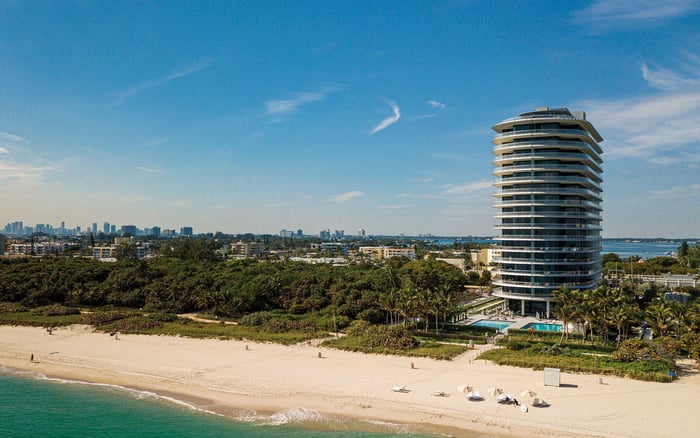
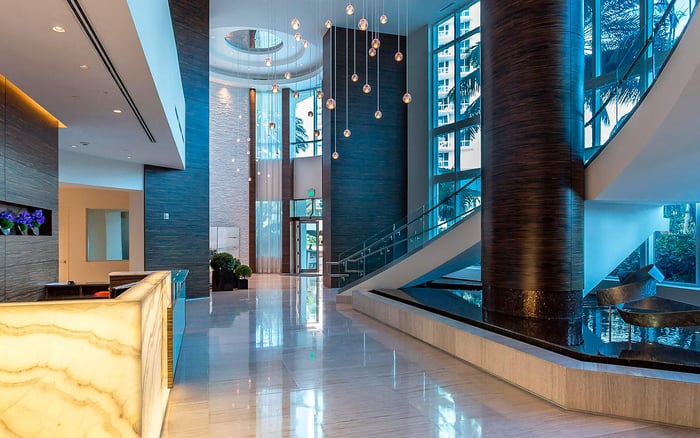
A discreet planning framework for aligning ownership, homestead intent, succession, and multigenerational use of an Arte Surfside residence.

At Arte Surfside, estate planning begins well before a deed is signed. The threshold question is what the residence is intended to be: a personal home, an estate-planning asset, a privacy vehicle, or an asset for which liability protection is a priority. A buyer may value several of these objectives, but counsel should establish their order of importance before recommending a form of title.
That distinction is particularly meaningful at a boutique oceanfront property of only 16 residences. Located at 8955 Collins Ave. in Surfside, the condominium was completed in 2020 near Bal Harbour and Miami Beach. Its three-, four-, five-, and six-bedroom layouts, each with direct Atlantic Ocean views, naturally invite long-term family use. Yet an elegant family retreat and a primary Florida residence do not necessarily require the same planning analysis.
The practical lesson is simple: title should follow intended use rather than become an afterthought at closing.
Married purchasers should ask whether tenancy by the entireties fits their broader plan. Florida recognizes this form of ownership for married couples, and its survivorship implications can shape how ownership passes when one spouse dies. It can also have creditor-protection implications, making correct formation and titling essential.
The conversation should be coordinated with existing estate documents rather than handled in isolation. Buyers should ask who is intended to control the residence during life, who should receive it at death, and whether automatic survivorship supports the family’s desired distribution. If children, prior-family beneficiaries, or multiple generations are part of the plan, the deed and estate documents should tell the same story.
This discipline applies equally when comparing nearby ownership opportunities such as The Surf Club Four Seasons Surfside or Fendi Château Residences Surfside. The architecture may change, but the planning sequence remains: purpose, title, succession, and use.
If Arte Surfside is intended to qualify as the owner’s Florida homestead, deed planning may require homestead-specific language. That is not a drafting detail to postpone. The intended status should be discussed with Florida counsel before execution and recording, particularly when a transfer-on-death strategy is also under consideration.
A second-home buyer should not assume that seasonal family enjoyment alone resolves the homestead question. Instead, the buyer should clearly explain the condominium’s intended residential role and allow qualified advisers to evaluate the applicable requirements. The objective is alignment among actual use, the deed, and the estate plan.
The distinction also matters when a family is choosing between a finished residence and another coastal option, including The Delmore Surfside. Ownership planning should be completed for the property ultimately selected, based on its intended function within the family balance sheet.
A Florida Lady Bird deed can provide for real property to pass to named beneficiaries at the owner’s death without probate. Structurally, it divides ownership into an enhanced life estate for the current owner and a remainder interest for the beneficiaries. For an owner focused on a non-probate transfer, it can therefore be an important subject for discussion.
Precision remains crucial. Drafting and recording requirements must be satisfied for the intended transfer to work, and homestead-specific language may be needed when the condominium is intended as homestead. Buyers should ask not merely whether a Lady Bird deed is available, but whether it fits the owner’s marital status, beneficiary plan, homestead intent, and desired lifetime control.
Large-format residences can support a multigenerational rhythm, but family use should be defined with the same clarity as succession. Before title is finalized, owners can give counsel a concise brief covering who will occupy the home, whether it is primarily personal or estate-focused, and who should ultimately receive the property.
The residence’s value also warrants disciplined coordination. Unit 702, a three-bedroom, three-bathroom residence spanning 3,136 square feet, sold for $12.25 million on July 10, 2025. The transaction equated to $3,906 per square foot. At that scale, ownership decisions deserve review alongside the family’s wider estate architecture rather than treatment as a routine closing selection.
A written planning brief can help the legal, tax, and real-estate teams work from consistent instructions. It should distinguish current enjoyment from eventual inheritance, flag any homestead intention, and identify whether survivorship or a named-beneficiary transfer is preferred. Final documents should be prepared and reviewed by qualified Florida professionals.
Before closing, buyers should convene their advisers around a concise decision agenda. First, define the condominium’s primary purpose. Second, test the proposed form of title against marital and survivorship goals. Third, determine whether homestead treatment is intended and whether the deed requires specialized language. Fourth, evaluate whether a Lady Bird deed supports the desired non-probate transfer. Finally, confirm that the recorded deed and the broader estate plan are coordinated.
This is not a one-size-fits-all exercise. The right structure depends on the owner’s facts and objectives. Discreet planning protects the family’s intentions by making them explicit while decisions can still be implemented cleanly.
What is the first estate-planning question for an Arte Surfside buyer? Decide whether the condominium is primarily a personal residence, estate asset, privacy vehicle, or liability-protection asset.
Where is Arte Surfside located? It is at 8955 Collins Ave., Surfside, Florida 33154.
How many residences are at Arte Surfside? The oceanfront condominium contains only 16 residences.
What residence sizes are represented at the property? The development includes three-, four-, five-, and six-bedroom layouts with direct Atlantic Ocean views.
Can married owners consider tenancy by the entireties? Yes. Florida makes this ownership form available to married couples, subject to correct formation and titling.
Why does survivorship matter when choosing title? Survivorship provisions can affect how a married couple’s ownership passes when one spouse dies.
Can tenancy by the entireties have creditor implications? Yes. It can carry creditor-protection implications, making precise legal guidance important.
What does a Lady Bird deed do in Florida? It can transfer real property to named beneficiaries at the owner’s death without probate.
Does a Lady Bird deed preserve an interest for the owner? It creates an enhanced life estate for the current owner and a remainder interest for beneficiaries.
Does homestead intent affect deed drafting? It may. Florida deed planning can require homestead-specific language when the condominium is intended to qualify as homestead.
To compare the best-fit options with clarity, connect with MILLION.
If branded residences are on your mind — as a home or as an allocation — we would be glad to share what we are seeing, privately.
Begin a quiet conversation