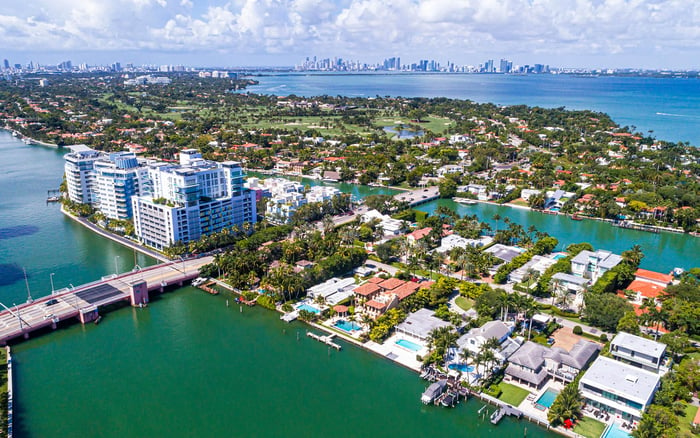
For Montreal buyers establishing a Miami Beach base, a considered purchase begins with the eventual exit. Coordinate cross-border tax advice, compare ownership structures, and distinguish future FIRPTA withholding from final tax and Florida transfer costs.

For a Montreal buyer, establishing a Miami Beach base is both a residential decision and a cross-border planning exercise. The home should suit the way you intend to live; its ownership structure should accommodate financing, succession and an eventual sale. These decisions belong together, before title is finalized.
A search that includes The Perigon Miami Beach can proceed alongside that advisory work. Selecting a residence and selecting its legal owner are separate tasks. Neither the building’s identity nor its intended personal use determines the buyer’s future U.S. tax treatment.
The starting point is status: a Montreal resident who is neither a U.S. citizen nor a U.S. tax resident should plan for FIRPTA withholding on a future disposition when treated as a foreign seller. Canadian residency alone does not remove U.S. exposure.
FIRPTA generally requires withholding of 15% of the amount realized, not 15% of the seller’s profit. The distinction matters when estimating cash available after a sale, particularly when financing remains outstanding.
The amount realized includes cash paid, the fair market value of other property transferred, and liabilities assumed by the buyer or remaining on the property. It is not the seller’s equity or the amount left after a mortgage payoff. Ask counsel to calculate the withholding base rather than applying a percentage to anticipated net proceeds.
Withholding is a tax-collection mechanism, not necessarily the final U.S. tax liability. The withheld amount is reconciled through the applicable U.S. tax filing. A resale model should therefore distinguish withholding, final tax, mortgage repayment and transaction costs rather than combine them into one estimated deduction.
The buyer generally bears responsibility for FIRPTA withholding. Your future purchaser’s closing team will therefore need to establish the seller’s status and the applicable treatment. Preparing documentation early helps keep that determination from becoming a last-minute negotiation.
A U.S. LLC is not an automatic solution to FIRPTA. When an entity is disregarded for tax purposes, the underlying owner’s status remains relevant to the withholding analysis. The name on the deed does not, by itself, answer the tax question.
Partnerships and corporations can produce different withholding and reporting consequences. A buyer acquiring a U.S. real-property interest from a foreign partnership may face 15% withholding on the amount realized. The relevant comparison is therefore personal ownership versus each specifically proposed structure-not personal ownership versus a generic category called an entity.
Before finalizing title and financing, ask U.S. and Canadian advisers to compare the implications for acquisition, the holding period, eventual disposition and succession. Request a coordinated explanation of the proposed owner’s classification, relevant filings and expected exit treatment. The rationale for an ownership recommendation should remain clear beyond the purchase closing.
For a buyer considering Five Park Miami Beach, this review belongs alongside the property decision, not after it. Establishing an entity later should not be treated as a routine administrative correction to an earlier title choice.
Buying a residence for personal enjoyment does not itself eliminate FIRPTA withholding on a later sale. The residential-use withholding exception has transaction-value and occupancy conditions. Your own use of the home is no substitute for checking the conditions applicable to the future transaction.
Similarly, a properly delivered non-foreign certification can support an exemption only when the seller genuinely qualifies as non-foreign. A Canadian address, a Florida address or a U.S. entity name should never substitute for the underlying status analysis.
The treaty framework recognizes U.S. taxing rights over U.S.-situated real-property income and gains and also addresses estate-tax matters. Counsel should evaluate current treaty provisions, applicable protocols and the family’s circumstances rather than assume Canadian residency provides a complete exemption. Succession deserves attention before the ownership structure is fixed.
FIRPTA is federal withholding associated with a foreign seller’s disposition. Florida documentary stamp tax is a separate transfer-tax issue and warrants its own line in the transaction budget.
Miami-Dade’s documentary stamp tax on deeds is $0.60 per $100, or portion thereof, of consideration. The county also imposes a $0.45 surtax per $100, or portion thereof, with an exception for transfers of single-family residences. Confirm the treatment of the specific property and transaction rather than assuming every residence or condominium qualifies for that exception.
Documentary stamp tax can include debt-related consideration, not simply cash paid. A later transfer into or out of an ownership entity can also raise documentary-stamp-tax questions. Before changing title, obtain a transaction-specific review rather than assuming a transfer within the family’s ownership arrangements is tax-free.
Whether the search leads toward Shore Club Private Collections Miami Beach and The Ritz-Carlton Residences® Miami Beach, the financial planning discipline remains the same: assess ownership and the eventual exit alongside the residence itself.
From purchase onward, preserve closing documents, improvement invoices and financing records. Retain applicable rental and currency-conversion records as well. A well-organized file gives advisers the material needed to evaluate a future sale without reconstructing years of ownership under closing pressure.
Ask for separate acquisition and resale models. The purchase model should identify the intended owner and transfer-tax questions. The resale model should distinguish expected withholding from estimated final tax and show how mortgage repayment affects available cash. Neither model should depend on an unapproved reduction in withholding.
A seller may apply for a withholding certificate using Form 8288-B when standard withholding exceeds the expected tax liability. That possibility requires advance planning: reduced withholding is not automatic, and approval should not be assumed at closing.
Forms 8288 and 8288-A, together with the withholding payment, are generally due within 20 days after transfer, subject to applicable withholding-certificate procedures. Have counsel and the closing team coordinate responsibilities and timing early, including how any certificate application affects the process.
The objective is not to let tax considerations dictate the residence. It is to ensure that a carefully selected Miami Beach home sits within an equally considered ownership plan, with the eventual exit understood from the beginning. This is a planning framework, not individualized tax or legal advice.
Explore a thoughtfully selected Miami Beach base with MILLION.
If branded residences are on your mind — as a home or as an allocation — we would be glad to share what we are seeing, privately.
Begin a quiet conversationYes. A buyer who will be treated as a foreign seller should consider future withholding when selecting ownership and modeling an eventual sale.
No. The general withholding is 15% of the amount realized, which is not the same as profit or proceeds after mortgage repayment.
It includes cash paid, the fair market value of other property transferred, and liabilities assumed by the buyer or remaining on the property.
Not necessarily. Withholding is a collection mechanism reconciled through the applicable U.S. tax filing.
The buyer generally bears responsibility for withholding. The seller’s status and supporting documents therefore matter to the closing team.
A seller may apply using Form 8288-B when standard withholding exceeds expected tax liability. Reduction is not automatic, and approval should not be assumed at closing.
Forms 8288 and 8288-A and the payment are generally due within 20 days after transfer, subject to applicable withholding-certificate procedures.
No. For a disregarded entity, the underlying owner’s status remains relevant, while other entity classifications require their own withholding and reporting analysis.
No. The residential-use withholding exception has transaction-value and occupancy conditions that must be evaluated for the particular sale.
The deed tax is $0.60 per $100, or portion thereof, of consideration, plus a $0.45 surtax with an exception for transfers of single-family residences. Confirm the exact transaction’s treatment, including debt-related consideration and any later entity transfer.