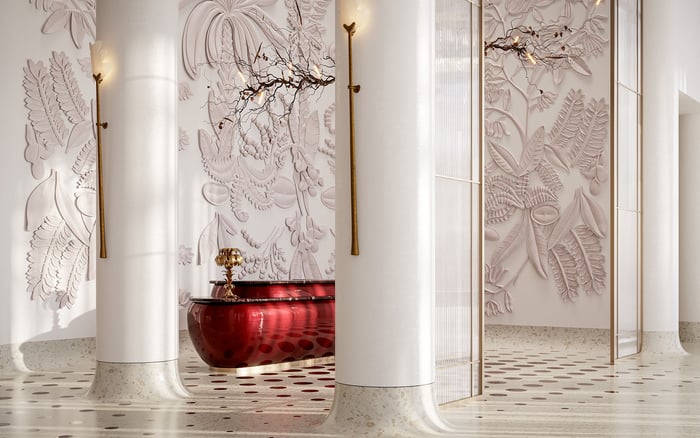
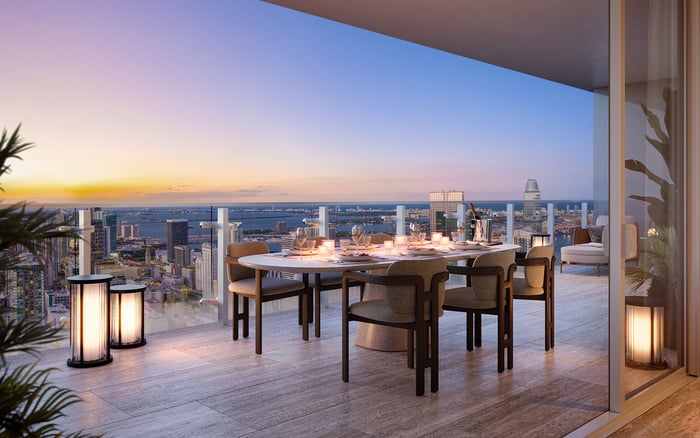
In a dense urban tower, luxury begins before the residence door. This buyer-focused examination considers how elevator zoning, controlled access, lobby sharing and service circulation can shape privacy at Faena Residences Miami.

At an ultra-premium address, privacy extends beyond tinted glass, generous setbacks and the residence itself. It begins on arrival and continues through every controlled threshold. At Faena Residences Miami Downtown Miami, that journey warrants particular scrutiny: vertical access can shape the emotional character of ownership.
In Downtown Miami, the elevator is more than transportation. It mediates the transition from an active city environment to a private home, influencing how often an owner encounters neighbors, visitors and staff. When circulation is discreet, the experience feels composed and personal. When too many paths converge, even an elegant tower can feel more public than expected.
A buyer should assess the route as one continuous experience: porte cochère, entry, reception, elevator lobby, car, residential landing and front door. Each point can preserve separation or introduce another shared encounter. The most successful sequence creates a gradual retreat from the energy of the street without making security feel conspicuous.
This is where design and architecture become operational rather than decorative. Sightlines, lobby scale, door placement and the volume of people moving through an arrival zone affect comfort as much as the finishes. Elevator privacy also shapes lifestyle, particularly for owners who value discreet arrivals, irregular schedules or a residence that serves as a calm urban retreat.
Private versus shared elevator access is a central consideration in an ultra-luxury tower. A private or limited-access landing can make the threshold feel residential and intimate. A shared lobby can still feel refined, but its character depends on how many homes it serves, how visitors are managed and whether traffic is efficiently zoned.
The distinction is not simply about prestige. Fewer shared moments can support quiet, reduce social exposure and make daily movement more predictable. Buyers considering other Downtown Miami towers, such as One Thousand Museum Downtown Miami, should apply the same analysis rather than rely on a tower's exterior identity alone.
Elevator zoning and the number of residences served by each car can affect wait times and the likelihood of repeated encounters. Dedicated zones may reduce unnecessary stops and organize access by floor grouping. Credential-controlled systems can further distinguish public, semi-public and resident-only areas.
These elements belong in due diligence; they should never be assumed. Faena Residences Miami's elevator count, elevator-to-residence ratio, destination-dispatch technology and private vestibule arrangement are not established here. Buyers should request current plans and operational details, then consider how the proposed system will perform during busy arrival periods.
The same discipline applies when comparing Waldorf Astoria Residences Downtown Miami and Casa Bella by B&B Italia Downtown Miami. Within branded residences, the strength of the name matters, but circulation determines whether hospitality feels personal or merely busy.
Resident privacy depends partly on what owners do not see. Deliveries, housekeeping, maintenance and building operations are essential, yet their routes can be arranged to minimize overlap with residential movement. Separating resident and service circulation can make a property feel calmer, more polished and more hospitality-driven.
Buyers should ask where service personnel enter, how deliveries reach a residence and whether operational traffic shares the primary cars or landings. The objective is not to erase service, but to integrate it discreetly. A well-managed route preserves convenience without turning the resident lobby into a working corridor.
Before assigning a value premium to elevator privacy, request precise answers. Determine how many residences each elevator bank serves, which floors share a car and how guests receive access. Ask whether an owner can authorize entry remotely, whether credentials restrict floor selection and what happens when multiple visitors arrive together.
Next, examine the landing. Is it shared, limited to a small group or dedicated to one residence? Where does the elevator open in relation to the front door? Consider acoustics, sightlines and whether someone waiting nearby can observe arrivals.
Finally, test the operational scenario. Ask how moves, deliveries, staff access and emergency procedures affect normal circulation. Review plans alongside management protocols, because physical separation is only as effective as its daily execution. In a Downtown Miami tower, these questions reveal whether exclusivity is embedded in the ownership experience or expressed primarily through visible amenities.
Privacy-oriented circulation may strengthen perceptions of value, exclusivity and long-term desirability. Its influence is cumulative: fewer unnecessary encounters, a smoother route home and clearer separation between resident and operational activity. None is as visually dramatic as a skyline view, yet each is experienced repeatedly.
For Faena Residences Miami, the buyer's task is to look beyond the elevator doors. The real luxury lies in the choreography-from curbside arrival to the final private threshold-and in how consistently it protects the feeling of sanctuary.
Why does elevator privacy matter in Downtown Miami? A dense urban setting creates more potential interaction among residents, guests, staff and the public.
Does Faena Residences Miami have private elevators? A private-elevator arrangement is not confirmed here, so buyers should verify current plans.
What is elevator zoning? It assigns elevators to selected floors or groups, potentially reducing stops, waits and social exposure.
How can credentials improve residential privacy? Controlled access can separate public, semi-public and resident-only spaces while limiting floor selection.
Is a shared elevator lobby necessarily undesirable? No. Its character depends on the number of homes served, visitor management and circulation efficiency.
What should buyers ask about service elevators? Ask whether deliveries, maintenance, housekeeping and moves use routes separate from resident circulation.
Why is the porte cochère relevant to elevator privacy? It begins the arrival sequence and can establish separation before an owner reaches the lobby.
Can elevator design affect perceived value? Privacy-oriented circulation may support perceptions of exclusivity, comfort and lasting desirability.
Should buyers rely on renderings to evaluate access? No. Buyers should review current plans, access protocols, elevator zoning and day-to-day management procedures.
What is the essential buyer takeaway? Evaluate the complete route home, not merely the residence landing or the elevator's interior finishes.
For a tailored shortlist and next-step guidance, connect with MILLION.
If branded residences are on your mind — as a home or as an allocation — we would be glad to share what we are seeing, privately.
Begin a quiet conversation