A buyer-focused framework for evaluating privacy, service and arrival at Faena Residences Miami, with emphasis on current plans, operating procedures and governing documents.

For buyers evaluating Faena Residences Miami Downtown Miami, privacy should be assessed as a sequence rather than a single feature. The useful inquiry follows residents, guests, staff and deliveries from the property boundary through common areas and into the residential elevator system.
Request the latest plans and governing documents for the specific residence under consideration. Marketing language may describe an overall concept, but stack-specific drawings and written access policies are more useful for understanding how the building is intended to operate.
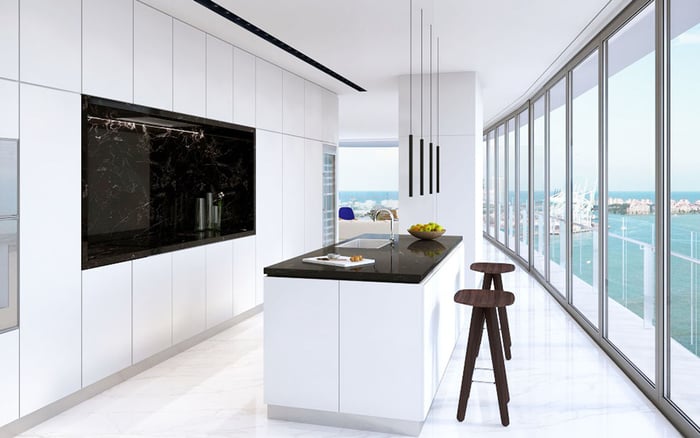
A polished rendering cannot demonstrate how an entrance performs during busy periods. Buyers should ask where residents, visitors, rideshare vehicles, valet operations and deliveries enter, wait and circulate. They should also identify where credentials are checked and whether different user groups share any part of the route.
The same analysis can be applied when comparing Aston Martin Residences Downtown Miami. Rather than comparing lobbies alone, examine the complete transition from the street to the residence and note every point where privacy depends on staffing or access control.
Terms such as private elevator, semi-private vestibule and controlled access can describe different arrangements. Buyers should obtain the current floor plan, stack plan and elevator diagram for the selected home, then confirm which doors, corridors and transfer points are shared.
The review should account for residents, guests, household employees, building staff and delivery personnel. Ask who can authorize access, how credentials are issued and revoked, and what procedures apply after regular staffing hours.
Service should be evaluated through written scope, availability and cost. Request a current schedule identifying which functions are included, which require reservations, which carry additional charges and how overnight requests are handled.
Response standards also matter. Ask how guest authorization, package handling, vehicle retrieval, maintenance entry and in-residence service requests are documented. Buyers considering Baccarat Residences Brickell can use the same questions to compare hospitality-oriented ownership models consistently.
Amenity quantity alone does not establish residential privacy. The more revealing questions concern location, access, operating hours, guest limits and event policies. Buyers should determine whether reaching a particular space requires movement through residential circulation or creates activity near the selected stack.
Request the current amenity plan and written rules rather than relying on broad descriptions. Confirm who may use each area, whether reservations are required and how private functions or invited guests are managed.
If project materials identify more than one arrival route, each should be reviewed separately. Buyers should map screening, waiting areas, staff responsibilities and the transition to residential elevators for every route represented in current documents.
This approach is also relevant when assessing Una Residences Brickell. The central issue is not the number of arrival options, but whether each option supports controlled and predictable movement.
Before committing, request the latest residence plan, stack plan, elevator diagram, amenity plan, access-control policy, staffing schedule, service menu and fee disclosures. Ask that any material representation about privacy or service be matched to the current project documents.
A practical review should also consider the buyer’s habits. Frequent entertaining, household staffing, regular deliveries and late arrivals can expose operational details that may be less important to another owner. The strongest choice is the residence whose circulation and service structure align with the owner’s expected use.
What should buyers evaluate first about privacy? Start with the complete route from entry to the residence, including screening points, shared corridors and elevator transfers.
Why are stack-specific plans important? Circulation and elevator relationships may differ by residence. The current stack and floor plans show the configuration relevant to the home being considered.
How should elevator privacy be verified? Request the latest elevator diagram and confirm access rules for residents, guests, staff and deliveries.
What should buyers ask about visitor access? Ask how visitors are authorized, where they wait and which common areas or elevators they may use.
How can buyers assess service quality before closing? Compare the written service scope, staffing schedule, response procedures and fees with the ownership experience being represented.
What delivery questions matter? Confirm where deliveries enter, who receives them, how packages are stored and whether delivery routes intersect with resident circulation.
How should amenity access be reviewed? Verify eligibility, guest limits, reservation requirements, operating hours and event rules in the current documents.
Why do busy-period procedures matter? Peak activity can reveal how effectively arrival, valet, guest and service movements are separated or coordinated.
Which documents are most useful for this review? Prioritize current residence and stack plans, elevator diagrams, access policies, service schedules, amenity rules and fee disclosures.
Should buyers rely on marketing descriptions alone? No. Material privacy, access and service expectations should be checked against current plans, disclosures and governing documents.
For a confidential assessment and a building-by-building shortlist, connect with MILLION.
If branded residences are on your mind — as a home or as an allocation — we would be glad to share what we are seeing, privately.
Begin a quiet conversation