For yacht-owning buyers at Delano Residences & Hotel Miami, marina proximity is only the starting point. A well-considered purchase separates residential benefits from berth rights, verifies the vessel’s entire route to the ocean, and plans for crew, provisioning, and guest transfers.
For a yacht owner, the most consequential feature of a Miami residence may lie beyond the building. The question is not simply whether the bay is nearby, but whether the vessel can leave its berth, reach the ocean, and return on terms that suit the household. Bridge clearance, water depth, and crew logistics turn an attractive address into a practical ownership decision.
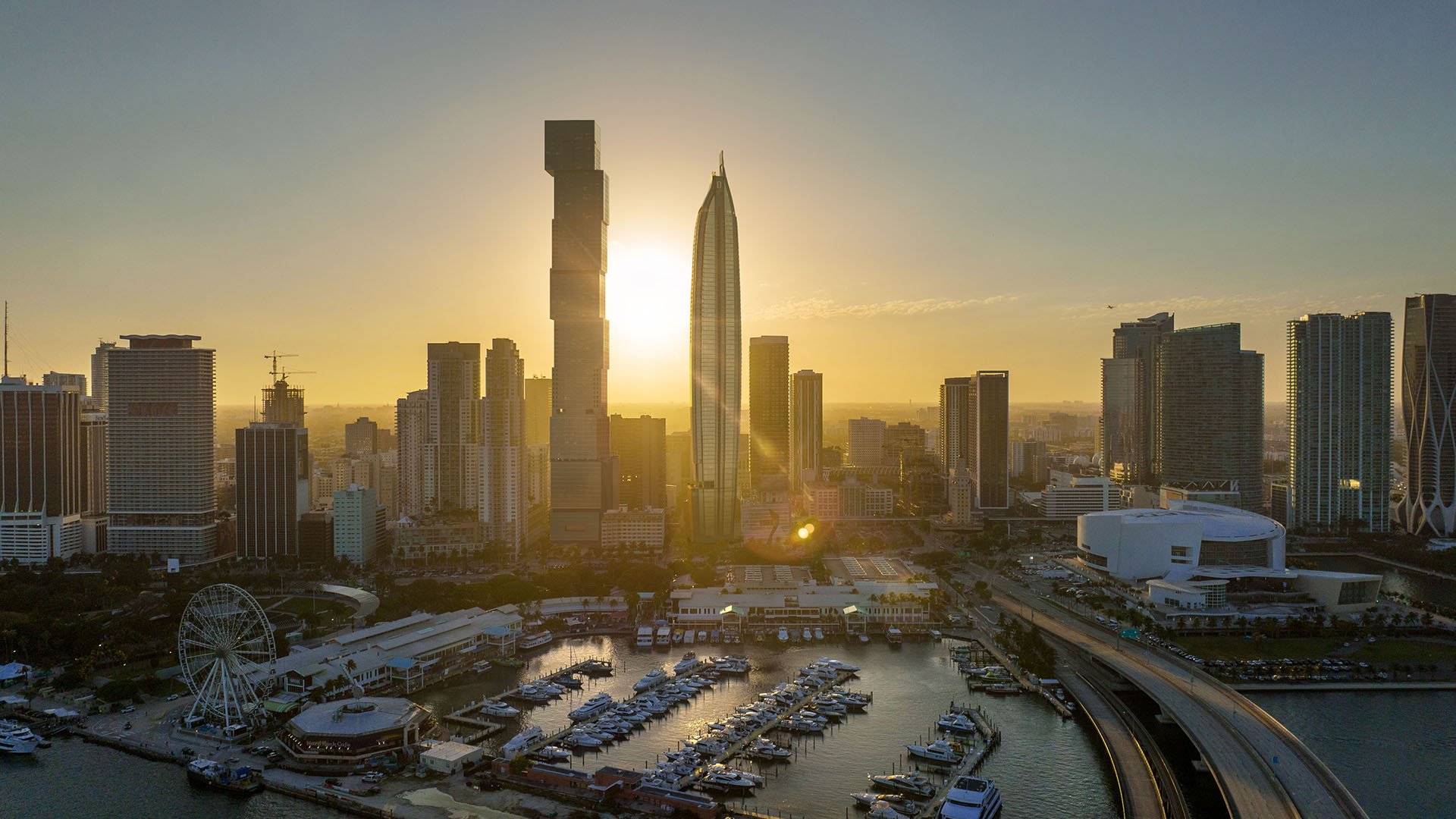
Delano Residences & Hotel Miami is marketed at 400 Biscayne Boulevard in Downtown Miami, steps from Bayside Marina and Bayfront Park. That proximity matters to the lifestyle, but it does not establish direct seawall frontage, private dock access, or a berth included with a residence.
The essential distinction is between living near the water and having a workable yachting arrangement. Buyers should evaluate the two separately before treating them as one purchase.
An on-site yacht marina, private slips, or a dedicated yacht dock are not publicly disclosed. That does not rule out a future arrangement; it means included berthing should not be assumed. Beach access at Delano Miami Beach is an advertised owner benefit, but beach access is not yacht dockage.
Ask for written clarification of any proposed boating arrangement: the marina, the specific berth, vessel acceptance, availability, and whether access depends on a separate agreement. A nearby marina is a location advantage, not evidence of an enforceable right to keep a particular yacht there.
The same discipline applies to a comparison with Aston Martin Residences Downtown Miami. Evaluate the residence and the boating arrangement separately rather than assuming either address settles the berthing question. What matters is what the buyer can secure for the intended vessel.
Air draft is the vessel’s height above the waterline, including towers, antennas, and other equipment. For fixed-bridge compatibility, that measurement-not yacht length-is decisive. A berth advertised for a certain vessel length does not establish whether the yacht can pass beneath every bridge between the berth and the ocean.
Government Cut provides an ocean outlet without a fixed bridge across the cut itself. It does not guarantee an unrestricted journey from every marina. The full dock-to-ocean route still requires review for bridge, draft, and traffic constraints. “No fixed bridges” must describe that complete route, not merely an inlet or a waterfront address.
Farther north, the fixed A1A bridge at Baker’s Haulover Inlet has an approximate vertical clearance of 32 feet. The Julia Tuttle Causeway bridge has an approximate fixed clearance of 56 feet. These are preliminary screening figures, not passage instructions. Before relying on a route, have the captain confirm current charts, water levels, vessel dimensions, and applicable bridge information.
An Indian Creek berth raises a different question: whether departure depends on an opening bridge. Miami Beach’s 63rd Street Bridge has approximately 11 feet of closed-position vertical clearance at mean high water. For a vessel unable to pass beneath it closed, the opening schedule becomes part of the day’s itinerary.
Older opening times and exceptions should not be treated as confirmation of today’s schedule. Have the current rules checked before evaluating the convenience of an Indian Creek berth, including how the return journey fits the intended day aboard.
For buyers also considering The Ritz-Carlton Residences® Miami Beach, this is a useful comparison framework, not a claim about that project’s dockage. Assess each proposed berth independently. A residence’s appeal and a vessel’s departure flexibility are distinct qualities; neither should stand in for the other.
Below the waterline, vessel draft must be matched to actual depths throughout the approach and at the assigned slip. A deep-water ocean channel does not establish sufficient depth inside a marina. Shallower sections or shoaling along the approach may constrain an otherwise attractive berth.
Indicative depths for Fontainebleau Marina and Sunset Harbour Yacht Club are roughly 7-10 feet. These figures are not assurances for every slip, approach, or water level. They warrant investigation of the specific berth, not a conclusion that a yacht will fit.
Ask the marina and captain to review actual approach and slip depths against the vessel’s draft, with particular attention to low-water conditions. Keep this assessment separate from advertised maximum yacht length. Length acceptance, overhead clearance, and water depth answer different questions; all must work together before the berth can support the purchase decision.
A Delano owner using a marina in Mid-Beach, Bal Harbour, or the Haulover area needs a separate road-logistics plan. Crew commuting, provisioning, and guest transfers must account for causeway congestion. Proximity on a map cannot establish whether preparing the yacht and moving guests will feel effortless.
Test the intended routine rather than relying on a single journey. Where will crew arrive, where can provisions be received, and how will guests reach the boat? Confirm what parking, loading, storage, and accommodation arrangements are available. These are due-diligence questions, not established Delano amenities. No guaranteed commute time should underpin the decision.
Deeded private office suites are described for select residences, but that does not establish approved use as crew facilities or yacht-storage space. Obtain the relevant use permissions before incorporating a suite into the operating plan. A private office should not become the assumed solution to an unresolved staffing or storage requirement.
Before committing, establish three things: which residential benefits are included, where the vessel can be berthed, and how the household and crew will use that berth. Ask for written berth terms, a captain-led route and depth review, and a realistic shoreside plan.
The outcome may be a Downtown home paired with an independently secured marina arrangement. That can be a considered choice, provided the separation is understood from the outset. The objective is not the shortest distance between residence and yacht, but a dependable connection between home life and time on the water.
For a discreet perspective on matching a South Florida residence to your waterfront priorities, explore MILLION.
If branded residences are on your mind — as a home or as an allocation — we would be glad to share what we are seeing, privately.
Begin a quiet conversationThe project is marketed at 400 Biscayne Boulevard in Downtown Miami, near Bayside and Bayfront Park.
An on-site marina, private slips, or a dedicated yacht dock are not publicly disclosed. Included berthing should not be assumed.
Beach access at Delano Miami Beach is an advertised owner benefit, not an established yacht-dockage benefit.
Air draft, the vessel’s height above the waterline including towers, antennas, and other equipment, determines overhead compatibility. Yacht length alone does not answer that question.
No fixed bridge crosses Government Cut itself, but the full route from the chosen berth still requires checking for bridges, depth, and traffic constraints.
Approximate fixed clearances are 32 feet at the A1A bridge at Baker’s Haulover Inlet and 56 feet at Julia Tuttle Causeway. These are preliminary figures that require current verification before navigation.
Its closed-position clearance is approximately 11 feet at mean high water, so some vessels require an opening. Confirm the current opening schedule before relying on the berth.
No. Indicative depths of roughly 7–10 feet at Fontainebleau Marina and Sunset Harbour Yacht Club do not guarantee adequate depth at every slip or along every approach, especially at low water.
Private office suites are described for select residences, but approved use for crew facilities or yacht storage is not established. Relevant permissions should be confirmed before planning such uses.
Evaluate crew commuting, provisioning, guest transfers, and causeway congestion for the selected marina. Parking, loading, storage, and accommodation arrangements need separate confirmation.