Parking is both a legal right and a daily experience. For South Florida luxury buyers, the better choice depends on documented ownership, walking routines, guest arrivals, wellness access, and the practical demands of leaving a residence unattended.

The most revealing parking question is not whether a residence offers valet. It is what the buyer owns, what the association assigns, and how each arrangement supports daily life. A discreet arrival matters. So does the ability to retrieve a car on your own terms, welcome dinner guests comfortably, or leave for several weeks with clear instructions in place.
Deeded parking and valet-centered parking are not necessarily opposing choices. One concerns the legal character of a parking right; the other concerns how vehicles are handled. Assigned parking can coexist with valet, and a polished arrival experience does not establish ownership of the space beneath it.
For a South Florida residence, a sound decision separates these layers before bringing them together. First, establish the parking entitlement. Then evaluate the service. Finally, test both against the way you intend to live.
An assigned condominium space should not automatically be treated as a deeded asset. In Miami condominiums, spaces may be assigned to residents while remaining under association control. Nor should a buyer assume that an assigned space can be purchased or sold independently. Those rights depend on the building's ownership and assignment arrangements.
Ask counsel to review the documents that establish the parking entitlement rather than relying on a listing description or a numbered bay. Confirm which spaces accompany the residence, how the assignment is recorded, and what restrictions apply to transfer or reassignment. If independent ownership is important, have that point established explicitly.
Keep the service inquiry separate. Whether residents can self-park, whether valet is optional, and how additional vehicles are accommodated are operational questions. They deserve written answers, but those answers cannot substitute for confirmation of the underlying legal right.
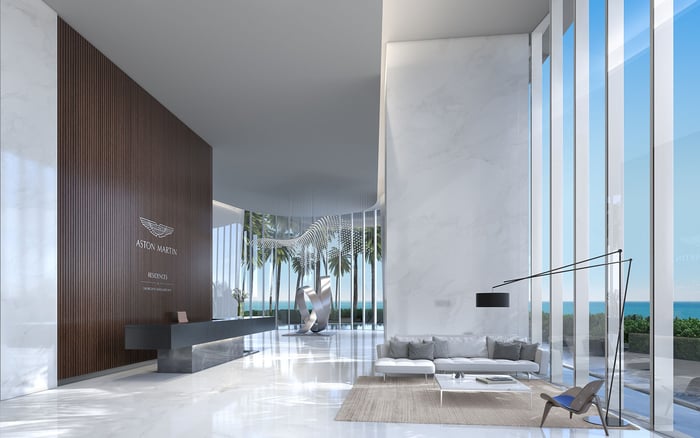
Aston Martin Residences Downtown Miami illustrates why the distinction matters: it combines assigned secured parking with 24-hour valet. Allocated parking and a service-led arrival can coexist. Neither feature, by itself, establishes that a space is deeded.
Porsche Design Tower presents a different physical relationship between car and home. Its vehicle-elevator system lets residents park beside their living rooms. The tower has 60 stories and 132 residences served by three vehicle elevators. For a buyer who values proximity to a vehicle, that arrangement merits consideration beyond the conventional garage-to-lobby journey.
Yet residence-adjacent parking does not establish unrestricted vehicle compatibility or a particular departure procedure. Ask about dimensions, operating rules, maintenance contingencies, and permitted access. The distinction is not simply private versus serviced. It is how much control you want and which responsibilities you are comfortable delegating.
A neighborhood label cannot tell you whether walking will replace driving in your routine. Test the routes you expect to use: morning coffee, dinner, groceries, and appointments. Consider crossings, the return journey, and whether the experience remains comfortable at the times you typically go out.
When comparing a Brickell candidate such as The Residences at 1428 Brickell, apply the same route-by-route assessment rather than assuming a particular parking arrangement or level of pedestrian convenience. The question is personal: which outings would you genuinely make without a car?
If many everyday trips become walks, valet may play a smaller role in daily scheduling. If driving remains central, access and retrieval deserve greater weight. Observe the arrival area at the times you expect to use it and ask how retrieval requests are handled. A service description is not a promise of a particular wait time.
A residence can offer beautiful social spaces without resolving the logistics of a dinner party. Ask how guest vehicles are received, whether reservations or advance notice are required, what charges apply, and how departures are managed when several guests leave together. Do not infer guest-parking capacity from the scale of the amenity program.
At Aston Martin Residences, the social amenities include a grand salon with a chef's kitchen, a catering kitchen, and a private dining room, along with an infinity-edge pool, cabanas, and a sky bar and lounge. These spaces suggest different settings for hosting, but access rules, reservation procedures, and operating costs still require confirmation.
Evaluate the whole evening, not just the room. Where does a guest arrive? How does a caterer gain access? Can visitors navigate comfortably between the arrival area and the gathering? For frequent hosts, those answers belong beside the dining-room dimensions in the purchase decision.
On-site wellness deserves consideration because it may reduce the number of trips you need to make. The useful question is whether the offering supports your routine, not simply whether a fitness center appears on the amenity list.
Porsche Design Tower pairs its distinctive parking system with a fitness center and a spa with Vichy showers. Aston Martin Residences includes a two-level fitness center with spinning and boxing rooms, alongside treatment rooms, a sauna, steam room, meditation room, and beauty services.
At Anantara Residences Miami, the wellness center exceeds 30,000 square feet on Level 6, overlooking Biscayne Bay. Facilities include Technogym strength and functional training, indoor and outdoor yoga and stretching, a Pilates and reformer studio, and dedicated boxing and Muay Thai spaces.
For a Coconut Grove comparison that includes The Well Coconut Grove, apply the same discipline: request project-specific details rather than carrying assumptions from another residence. An amenity list does not guarantee staffing, class schedules, availability, or access terms. Those details determine whether wellness genuinely becomes part of home life.
A second residence should be assessed as carefully for the weeks when its owner is absent as for the days when it is occupied. Valet availability alone does not establish a long-term vehicle-storage policy. Likewise, proximity to a private parking area does not settle how a vehicle will be managed during an extended absence.
Request written guidance on storage, key custody, authorized drivers, vehicle movement, and the procedure for returning unexpectedly. If charging or battery maintenance matters, ask what is permitted and who is responsible. Clarify any fees and distinguish vehicle handling from residence oversight.
The goal is not to assume that service removes every obligation. It is to know which tasks remain yours, which can be delegated, and how authorization is documented.
Compare each candidate through four practical scenarios: an ordinary weekday, an evening of entertaining, a wellness-focused morning, and an extended absence. Record the parking right separately from the service arrangement, then identify the unresolved questions in each scenario.
The right residence is the one whose documented rights and operating procedures fit your habits, not the one with the most theatrical arrival. Independence and attentive service can both be luxurious when their boundaries are clear.
Explore South Florida residences with MILLION to refine a shortlist around the way you intend to live.
If branded residences are on your mind — as a home or as an allocation — we would be glad to share what we are seeing, privately.
Begin a quiet conversationNo. A space may be assigned to a resident while remaining under association control, so the legal entitlement requires confirmation.
Do not assume so. Transfer rights depend on the building's ownership and assignment arrangements.
Yes. Aston Martin Residences combines assigned secured parking with 24-hour valet, illustrating that allocation and service are separate features.
No. Valet describes vehicle handling, not the legal ownership of the space.
Its vehicle-elevator system allows residents to park beside their living rooms. Vehicle compatibility and operating procedures should still be verified.
Walk the routes you expect to use at the times you typically go out. Consider crossings, comfort, and whether those trips would genuinely replace driving.
Ask about guest arrivals, capacity, advance notice, charges, and simultaneous departures. Social amenities alone do not establish guest-parking arrangements.
Facilities that support your routine may reduce off-site trips. Confirm access, schedules, staffing, and costs before relying on advertised amenities.
It advertises a wellness center exceeding 30,000 square feet, with strength training, yoga, Pilates and reformer facilities, and dedicated boxing and Muay Thai spaces.
Confirm vehicle-storage rules, key custody, authorized access, vehicle-movement procedures, and any applicable fees. Do not assume valet service includes extended-absence care.