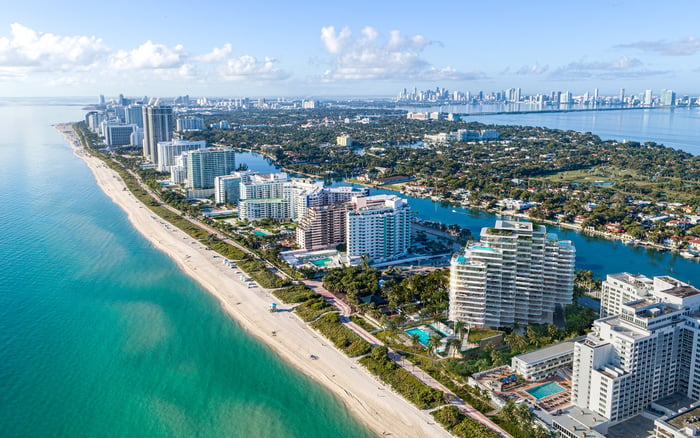
Miami’s luxury buyers face a refined choice between vertical glamour and landed privacy. High-rise condominiums deliver sky‑high views, curated design, and full‑service amenities in the city’s most dynamic districts. Private estates, by contrast, offer scale, autonomy, and grounds that become an owner’s personal resort. This editorial weighs neighborhoods, architecture, lifestyle, privacy, upkeep, and investment dynamics to help you decide whether a five‑star tower or a secluded residence aligns best with the way you want to live in South Florida.

Miami’s high‑end real estate offers two distinct expressions of luxury. On one side are residences in the sky, where architecture, amenities, and service converge into a turnkey lifestyle with cinematic views. On the other are private estates, where land, space, and autonomy create a personal domain tailored to the owner. The decision is not simply a budget calculation. It is a calibration of how you want to move through the city, how often you travel, the level of privacy you require, and the degree of control you want over your environment. This guide compares the two paths across neighborhood context, space and design, lifestyle and amenities, privacy and maintenance, and the investment lens, so you can determine whether a tower or an estate best fits your definition of home.
In Miami, location often determines form. Urban districts with walkable access to dining, culture, and business are dominated by best‑in‑class towers. Brickell, for example, is synonymous with vertical living, where new icons rise amid a skyline of glass and light.
Prefer greenery and the cadence of a neighborhood? Coconut Grove and Coral Gables have long been estate territory, prized for tree‑lined streets, parks, and a village sensibility. Buyers focused on micro‑area identity often filter for Coconut-grove and Coral-gables when the brief calls for family‑friendly neighborhoods close to elite schools and yacht clubs. Pinecrest, too, delivers expansive lots and a quieter rhythm, while private islands and guard‑gated enclaves appeal to those seeking maximum seclusion.
That said, a few locations blur the line. Coconut Grove mixes landmark estates with a handful of exceptional low‑ and mid‑rise residences that keep the canopy and the bayfront at center stage. The waterfront collection at Park Grove Coconut Grove places sculptural towers within a park‑like setting, offering Grove lifestyle with vertical views. Sunny Isles Beach, meanwhile, reads like an oceanfront museum of branded architecture. There, towers capture direct beaches and sunrise panoramas, giving condo buyers a resort‑by‑the‑sea existence that a landlocked home cannot replicate.
Condos deliver a particular architectural thrill. From a 40th‑floor living room, floor‑to‑ceiling glass erases the boundary between interior and horizon, framing the Atlantic, Biscayne Bay, or a city that glitters after dark. In Miami’s top buildings the design narrative is author‑driven. At the Grove, Park Grove Coconut Grove pairs celebrated architecture with a five‑acre landscape and a museum‑caliber art program, embodying the idea of a curated residential park. Up the coast, Eighty Seven Park Surfside is a limited‑edition beachfront statement of light, air, and terraces that float over sand and native parkland. In Sunny Isles, Armani Casa Sunny Isles Beach extends Giorgio Armani’s aesthetic into private life, with tailored lobby compositions and residences that read like couture apartments on the sea. Downtown, One Thousand Museum Downtown Miami gives the skyline a sculptural exoskeleton and a private helipad, placing art, engineering, and convenience in the same breath.
Inside these towers, craftsmanship is exacting and often delivered turn‑key. Kitchens are contemporary showpieces. Baths are spa‑quiet. Sound attenuation, lighting, and technology are integrated from the start. And while structural limits apply, many high‑floor residences can be personalized through finishes and furniture programs. At the top, multi‑level penthouses now reach mansion scale, with private pools, summer kitchens, and salons that align with the most demanding entertaining briefs.
Houses, by contrast, are canvases without ceilings on imagination. The value begins with land. A half‑acre bayfront site with a dock becomes a private resort where indoor and outdoor rooms flow across water, lawn, and loggia. Program is limited only by taste and code. Think double‑height salons for art, temperature‑controlled wine galleries, wellness suites with sunlight and cold plunge, a carriage court for an automobile collection, or a guest pavilion for multigenerational living. Historic Mediterranean villas hold stories and craftsmanship from earlier eras. Contemporary glass‑and‑stone compositions bring minimalist lines to subtropical gardens. Most important, the owner directs everything from orientation to materials to landscape. If autonomy matters more than altitude, a house offers design sovereignty that no condominium can match.
At the top of Miami’s condo market, daily life is structured like a private club. Expect 24‑hour concierge and valet, resident lounges, children’s suites, co‑working salons, and wellness floors that fold together cardio, weights, studios, treatment rooms, and hydrotherapy. Pool decks operate as living rooms in the sky. Some buildings elevate convenience further with private dining rooms and on‑premise restaurants reserved for residents. In a few icons, engineering pushes the envelope. The profile of One Thousand Museum Downtown Miami includes a private helipad that compresses travel time and routes around street‑level congestion, a fitting metaphor for the time‑savings baked into tower living.
For houses, the amenity list is entirely your own. A lap pool can be oriented for morning sun. An outdoor kitchen can be configured for live‑fire or a pizza oven. A dock sets the stage for weekend runs to Elliott Key. Inside, a screening room can sit next to a billiards gallery or a listening lounge. The distinction is philosophical. Condos centralize amenities and outsource their upkeep to a professional team. Houses individualize amenities, then rely on private staff or trusted vendors to operate them. If you favor social connection and the ease of taking an elevator to every leisure, a tower aligns. If you favor solitude and hosting on your terms, an estate wins.
Privacy and security are structured differently in each format. In best‑in‑class towers, controlled entries, doormen, and restricted elevators create a multi‑layered perimeter between street and residence. Upper floors add natural separation. Modern envelopes, shutters, and impact glazing strengthen storm resilience. The result is lock‑and‑leave simplicity that suits frequent travelers and owners with multiple homes.
Estates extend privacy to the property line. Gates, walls, layered landscaping, and camera networks create visual and physical seclusion. Guard‑gated communities add an outer ring of comfort. Inside, spatial buffers and generous setbacks keep daily life quiet and unseen. For public figures or those who host at scale, a house’s ability to disappear into its own grounds is incomparable. The trade‑off is responsibility. In a condominium, common‑area operations, reserves, and major systems are coordinated through the association and its management team. Monthly dues can be significant, and special assessments are possible, but predictability and professional oversight reduce personal bandwidth. In a house, every contractor and every schedule is yours to design. Many owners employ an estate manager, housekeepers, landscapers, pool technicians, and private security to mirror the condo’s convenience while preserving control. The question is whether you prefer to delegate to a building or to your own staff.
Although lifestyle should lead, the market lens matters. Single‑family homes in prime locations benefit from land scarcity. You can design a new residence, but you cannot mint new bayfront parcels on demand. That inherent constraint has historically supported value, especially in neighborhoods where demand is end‑user driven and turnover is measured in years rather than seasons. Houses also offer flexibility. A strategic renovation can reset a property’s competitive set. Lot size, orientation, and water frontage further differentiate performance across micro‑markets.
Condominiums, by contrast, can be more cyclical because supply tends to arrive in waves. A surge of deliveries can temporarily create choice for buyers and pressure for sellers. Carrying costs deserve attention. Dues underwrite staff, insurance for the association, energy in common spaces, and reserves, and they vary by building scale and amenity ambition. Iconic towers often defy averages. A branded or architecturally singular property in an irreplaceable position can hold or compound value due to reputation, design, and a resident profile that prizes the address. Leasing flexibility varies widely across towers. Ultra‑luxury buildings often impose longer minimum lease terms that favor quiet and stability rather than short‑term rotation. If income is a priority, confirm policies early and align the strategy with your intended use of the residence.
In both categories, the best investments tend to be those you love and use. Enjoyment turns holding periods into advantage. For a frequent traveler who values time and wishes to centralize maintenance, a tower can be the smarter financial and lifestyle equation. For an owner who wants scale, family continuity, and the ability to customize at will, a house often anchors a longer horizon.
To talk through these trade‑offs in the context of specific buildings and neighborhoods—from Park Grove Coconut Grove and Eighty Seven Park Surfside to Armani Casa Sunny Isles Beach and One Thousand Museum Downtown Miami—connect with our team via MILLION Luxury for private guidance and curated options.
What type of buyer fits a condo best in Miami’s luxury segment? Buyers who value turnkey living, iconic views, hotel‑level services, and the ability to lock and leave. Frequent travelers and those with multiple homes often prioritize a tower’s convenience.
Where should I focus for landed privacy close to top schools? Look to Coconut Grove and Coral Gables for a blend of proximity and tranquility. Filtering by Coconut-grove and Coral-gables helps surface estates with generous lots and a village feel.
Are condos or houses easier to maintain in South Florida’s climate? Condos, because associations handle common‑area systems, exteriors, and reserves. Houses offer more control but require hands‑on management or a reliable private team.
Which has stronger long‑term value, a house or a condo? Houses benefit from land scarcity and end‑user demand. Condos can be cyclical, yet singular addresses—especially beachfront or architecturally important towers—can perform exceptionally over time.
If I want the best of both worlds, where do I look? Seek hybrid locations and curated buildings that balance neighborhood character with vertical perks. The Grove offers this via Park Grove Coconut Grove, while Sunny Isles mixes resort beachfront with design‑driven towers like Armani Casa Sunny Isles Beach.
If branded residences are on your mind — as a home or as an allocation — we would be glad to share what we are seeing, privately.
Begin a quiet conversation