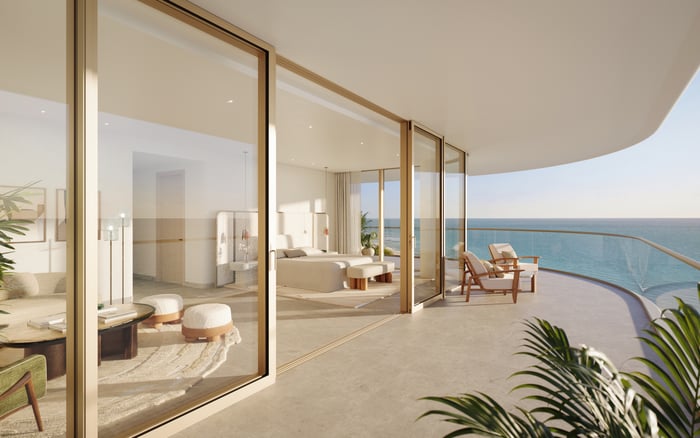
At The Cove Residences Edgewater, storage lockers and cold storage support a compelling seasonal-use proposition, but public materials do not define exclusive rights, dimensions, transferability, or bicycle-room access. Buyers should make the final declaration, purchase agreement, exhibits, assignments, and association budget the controlling record at closing.

For a seasonal owner, the most consequential features of a luxury residence are not always the most photogenic. Secure storage for luggage, bicycles, golf equipment, beach gear, household supplies, and personal effects can determine whether each arrival feels effortless or operationally complicated. At The Cove Residences Edgewater, these practical questions deserve careful attention before closing.
The planned 40-story, 134-residence condominium is positioned on the Edgewater waterfront. Plans span two-bedroom through four-bedroom-plus-den configurations, with total areas ranging from approximately 1,469 to 3,068 square feet. In-unit closet cabinetry, pantries, kitchen islands, and built-ins provide a useful foundation, while advertised storage lockers and cold storage add another layer of convenience.
Yet the presence of storage does not, by itself, establish ownership. A locker's dimensions, location, transfer rights, and legal form have not been publicly specified. For a buyer intending to leave Miami for months at a time, that distinction belongs at the center of closing diligence.
A storage amenity becomes an ownership asset only when the closing documents define the right.
A locker can be structured in materially different ways. It may be included in a unit's legal description, assigned as a limited common element, documented separately, licensed to an owner, or allocated through association rules. Each structure can affect exclusivity, resale, relocation, and the association's authority over future use.
The structure that will govern at The Cove has not been publicly identified. Buyers should therefore ask counsel to trace the locker through the final condominium declaration, exhibits, purchase agreement, and any separate assignment. A sales conversation, floor-plan notation, or feature sheet should not substitute for a document identifying the specific right conveyed.
This scrutiny is especially relevant in pre-construction purchases, where presentations can precede final operating documents. Buyers comparing Aria Reserve Miami or other Edgewater options should apply the same standard: determine what is legally attached to the residence, what is merely available, and what remains subject to association control.
Key questions include whether a locker transfers automatically on resale, whether it can be sold or assigned separately, and whether the association may relocate, resize, or reassign it. The answers shape both daily convenience and the residence's future marketability.
A bicycle room has not been identified, nor have capacity, access, security, reservations, or long-term storage been explained. That absence does not prove a bicycle facility will not exist. It means buyers should not treat bicycle accommodation as guaranteed until it appears in controlling documents or final building rules.
For a seasonal cyclist, capacity alone is not enough. Ask about access hours, surveillance or controlled entry, registration, fees, guest bicycles, maintenance restrictions, and whether bicycles may remain during an extended absence. E-bike owners should also confirm battery, charging, and fire-safety rules. A secure room that prohibits long-term parking may not satisfy a second-home owner's needs.
The same diligence applies when evaluating newer waterfront residences such as EDITION Edgewater. The useful comparison is not simply whether a bicycle room is promoted, but how access and storage rights are governed after turnover.
“Owner closet” often suggests a private, owner-only enclosure that can remain secured between stays. No distinct program under that name has been publicly described for The Cove. Its shared-storage references are limited to storage lockers and cold storage.
That vocabulary matters. A private closet inside the residence, a shared locker elsewhere in the building, and a delivery-oriented cold-storage area perform different functions. In-unit cabinetry can hold clothing, linens, tableware, and personal items, but it may not accommodate oversized luggage or recreational equipment. A building locker could address those needs, although its utility depends on size, climate conditions, access, and legal allocation.
Cold storage should be considered separately. It can be valuable when perishable deliveries arrive before an owner reaches the property or while the owner is temporarily away. It is not evidence of long-term personal storage, nor does it replace a secured locker or private closet.
A successful seasonal setup begins with an inventory. Buyers should estimate the volume and dimensions of the items they expect to leave in Miami, then measure those requirements against the residence's in-unit storage and any documented locker. The floor-plan range is broad, so storage needs will vary significantly by residence type and household.
The development is described as offering approximately 42,000 square feet of amenities. Association dues of approximately $1.35 per square foot, a Miami Beach beach-club membership, and the first year at Residence Yacht Club have also been referenced. These elements may enrich seasonal living, but buyers should reconcile every cost and inclusion against the final association budget and governing documents.
For households considering Villa Miami alongside The Cove Residences, the most useful comparison is operational rather than cosmetic: arrival logistics, delivery handling, storage access, recurring costs, and the rules that remain in force during long absences. Within buyer's guides, these details often distinguish a graceful seasonal residence from one that requires continual improvisation.
There is also an address discrepancy to reconcile. Groundbreaking was associated with 456 NE 29th Street, while the listed address is 496 NE 29th Street, Miami, Florida 33137. Buyers should ask closing counsel and the title team to confirm the controlling legal address, parcel information, unit description, and recording details.
The final document review should answer several practical questions:
Is a specific storage space identified, and where is that identification recorded?
Is the right deeded, assigned, licensed, or governed solely by association policy?
What are the locker's dimensions, location, access protocol, and permitted contents?
Does the storage right transfer with the residence on resale?
Can the association relocate, resize, revoke, or reassign the space?
Is bicycle storage provided, and may a bicycle remain during seasonal absences?
Do e-bike, charging, registration, security, or fee rules apply?
Is any private owner-only closet included inside or outside the residence?
How does cold storage operate, and how long may deliveries remain there?
Do the final budget and association documents confirm promoted dues and memberships?
These are not peripheral questions. They define how the property functions when the owner is present, how it is protected when the owner is away, and what a future purchaser can expect to receive.
The Cove's combination of in-unit cabinetry, advertised lockers, cold storage, and extensive amenities supports a persuasive lock-and-leave concept. It does not yet establish that every owner receives an exclusive, permanent, or transferable storage allocation, a bicycle-space entitlement, or a private owner closet.
The prudent approach is precise and unemotional: convert each seasonal-use expectation into a documented closing item. When the declaration, exhibits, assignment instruments, rules, and budget align, convenience becomes dependable rather than assumed.
For discreet guidance on evaluating The Cove Residences and other South Florida opportunities, connect with MILLION.
If branded residences are on your mind — as a home or as an allocation — we would be glad to share what we are seeing, privately.
Begin a quiet conversationYes. Storage lockers are identified as a building feature, but their quantity, dimensions, location, and legal allocation are not publicly specified.
Public materials do not confirm that. Buyers should check the final declaration, legal description, exhibits, and any separate assignment or license.
That has not been publicly defined. The closing documents should state whether the right transfers, can be assigned separately, or remains subject to association control.
The publicly available feature set does not identify a bicycle room or specify its capacity, access, security, or reservation rules.
Confirm access hours, security, registration, fees, long-term parking, guest use, and any e-bike battery or charging restrictions.
No distinct owner-closet program is described by that name in public materials. Buyers should distinguish in-unit closets from shared storage lockers.
No. Cold storage is designed to support delivery holding, while long-term personal storage requires a separate secured space and defined access rights.
Groundbreaking was associated with 456 NE 29th Street, while the developer fact sheet lists 496 NE 29th Street. Closing counsel should confirm the controlling legal address and parcel details.
The final declaration, purchase agreement, exhibits, assignment instruments, association rules, and budget should control rather than preliminary marketing.
Its in-unit cabinetry, advertised lockers, cold storage, and amenities support that use case. The reliability of the arrangement depends on the rights and rules confirmed at closing.