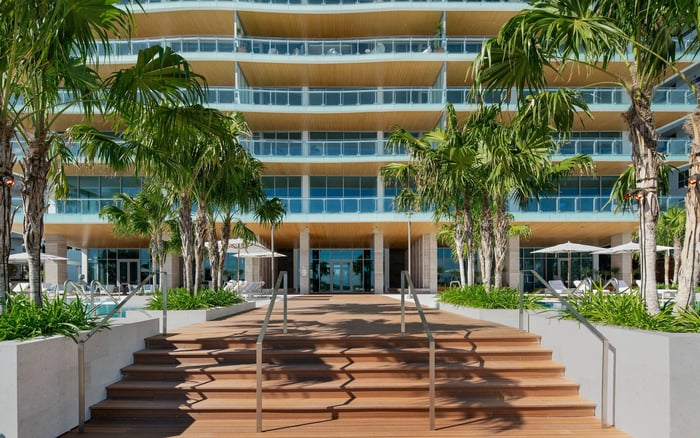
At Arte Surfside, disciplined underwriting separates fixed condominium obligations from hospitality spending, gratuities, and other resident-elected services.

At 8955 Collins Avenue, Arte Surfside combines private terraces and direct beach access with the operating character of an intimate resort. Its service package includes a residential butler, lifestyle concierge, on-site general manager, 24-hour security and valet, and pool and beach service. Amenities include indoor and outdoor pools, a spa, sauna and steam room, yoga studio, fitness center, and residents' lounge.
That proposition is precisely why a buyer should resist compressing every recurring expense into a single monthly figure. The useful distinction is between mandatory costs that preserve and operate the condominium and personal consumption that varies with household habits. Regular assessments belong in the first category. Gratuities, food orders, separately charged housekeeping, and other à la carte services generally belong in the second, subject to confirmation in the governing documents and current service menu.
This separation is an underwriting best practice, not a publicly established Arte rule. It gives an owner a clear view of the residence's fixed carrying cost while preserving an equally realistic allowance for the service culture that distinguishes the building.
Luxury ownership is clearest when the cost of the building is separated from the cost of using its services.
The association's current operating budget should identify the common expenses funded through regular assessments. At a service-rich property, those expenses may encompass staffing, security, valet operations, amenity maintenance, pool and beach functions, insurance, management, common-area utilities, and other shared obligations. Buyers should not assume that the presence of a service means every use is prepaid.
For example, Arte residents have been offered ordering from The Surf Club Four Seasons menu for delivery to a residence, pool, or beachside. That availability illustrates the distinction: the infrastructure and coordination behind a service may form part of the residential experience, while the meal, delivery-related charge, service charge, or gratuity may remain a consumption-based expense. Proximity to The Surf Club Four Seasons Surfside adds context to the area's hospitality standard, but it does not replace a line-by-line review of Arte's own billing arrangements.
Every material service should therefore receive one of three labels: included in regular assessments, billed separately by management or a vendor, or paid directly by the resident when used. Anything unclear should be resolved in writing before closing.
Public fee figures demonstrate why buyers need current association records. Reference figures have included an average association fee of $3.86 per square foot per month, $11,147 per month for a lower penthouse, and $11,796 per month for Unit 702. Differences can arise from residence size, timing, inclusions, or the way the figures are presented.
None of these figures should supersede the association's current budget or the estoppel certificate for the residence being acquired. The estoppel is particularly important because it can disclose the unit's account status and associated amounts at that point in the transaction. Recent financial statements provide context on actual operations, while the reserve schedule or study helps distinguish ordinary annual expenses from longer-term capital planning.
This scrutiny is relevant across the boutique oceanfront market. A buyer comparing Arte with Eighty Seven Park Surfside or Fendi Château Residences Surfside should normalize mandatory dues first, then compare discretionary services separately. Otherwise, one household's dining, tipping, and staffing preferences can distort the apparent cost of one property relative to another.
A separate operating budget does not mean optional spending is immaterial. It means that spending is modeled according to behavior rather than mistaken for a fixed condominium obligation. Begin with the services the household expects to use: valet, beach and pool assistance, residential butler requests, food delivery, housekeeping, and any other staffed convenience offered under current terms.
For each item, establish the frequency, stated price, service charge, applicable tax, customary gratuity policy, and billing party. Determine whether a service charge is distributed to staff, retained by an operator, or treated differently. Do not assume that a service charge eliminates gratuity-or that gratuity is required-without reviewing current written guidance.
An owner who occupies the residence seasonally may have concentrated months of high service use. A full-time household may have steadier consumption. Guests, entertaining, beach days, vehicle activity, and frequent in-residence dining can all influence the discretionary layer. Keeping that layer outside core association dues produces a more useful annual cash-flow forecast and makes adjustments easier as usage changes.
For MILLION readers exploring Lifestyle considerations and Buyer's Guides, the practical lesson is simple: budget for the experience you intend to enjoy, but do not confuse that experience with the legal and financial obligations attached to ownership.
The acquisition itself requires a third ledger. For general Miami Beach planning, cash buyers may budget approximately 1% to 3% of the purchase price for closing costs, while financed purchases can be higher depending on loan expenses and building-specific charges. This range is directional, not an Arte quotation.
Condominium transactions can include estoppel or resale certificates, transfer fees, move-in charges, title services, and recording fees. Financing can introduce additional lender and loan-related expenses. Buyers should request an itemized estimate from their closing professionals and verify which charges are payable by the buyer under the contract.
The distinction matters in a high-value resale. Arte sold out for nearly $225 million, and Unit 702 closed for $12.3 million in 2025, leading Miami-Dade County's weekly condominium sales at the time. At that price level, percentage assumptions are useful for early planning, but precise dollar estimates and building-specific confirmations should govern the final funds-to-close calculation.
Before the review period expires, request the current operating budget, recent financial statements, reserve schedule or study, estoppel certificate, governing documents, house rules, management agreement, and current service menu with pricing. The service menu should clarify the treatment of butler, concierge, valet, beach service, food delivery, housekeeping, staffing, service charges, and gratuities.
Then reconcile the documents with the contract and latest unit ledger. Confirm regular assessments, any separately assessed obligations disclosed for the unit, application and transfer charges, move-in requirements, payment timing, and the party receiving each payment. If the documents use broad categories such as hospitality, resident services, or food and beverage, request enough detail to avoid counting a cost twice or omitting it entirely.
Surfside buyers can also use nearby Ocean House Surfside as a comparison point, but the analysis should remain disciplined. Match fixed association obligations with fixed obligations, reserves with reserves, and personal consumption with personal consumption. Amenity labels alone do not establish equivalent staffing, service scope, or billing treatment.
The most reliable Arte analysis has three parts: transaction costs due at closing, mandatory recurring condominium obligations, and discretionary hospitality spending. This structure protects the integrity of the comparison while acknowledging that service is central to the property's appeal.
It also produces a budget an owner can manage. Fixed obligations can be monitored against association disclosures. Optional services can be adjusted to occupancy and preference. One-time closing expenses remain visible rather than disappearing into an imprecise first-year carrying-cost estimate. The result is not necessarily a lower number, but a more intelligible one-the foundation of confident luxury ownership.
For confidential guidance on evaluating Arte and South Florida's service-led residences, connect with MILLION.
If branded residences are on your mind — as a home or as an allocation — we would be glad to share what we are seeing, privately.
Begin a quiet conversationIt separates mandatory condominium obligations from spending that varies with dining, gratuities, housekeeping, and other resident-elected services.
No reviewed public information establishes such a rule. The separation is an underwriting best practice for clearer ownership planning.
Request the current budget, financial statements, reserve schedule or study, estoppel certificate, governing documents, house rules, management agreement, and current service menu.
No. Published figures can vary by residence, date, and inclusions, so buyers should rely on current association documents and the unit's estoppel certificate.
Displayed figures have included $11,147 for a lower penthouse and $11,796 for Unit 702, while one building page showed $3.86 per square foot monthly. These are reference points only.
The service package includes a residential butler, lifestyle concierge, on-site general manager, 24-hour security and valet, and pool and beach service.
Buyers should confirm whether coordination is included while the meal, delivery-related charge, service charge, tax, and gratuity are billed separately.
Potential charges include title and recording costs, estoppel or resale certificates, transfer fees, move-in charges, and financing expenses where applicable.
General Miami Beach guidance suggests approximately 1% to 3% of purchase price, but the final amount depends on the contract and building-specific charges.
Compare mandatory dues with mandatory dues, reserves with reserves, and discretionary consumption separately. This prevents personal service habits from distorting the analysis.