For luxury buyers comparing Fisher Island with Key Biscayne, headline pricing is only the beginning. Modeled property-tax rates suggest a meaningful annual difference, while primary-residence eligibility and the Save Our Homes cap can shape the longer ownership horizon.
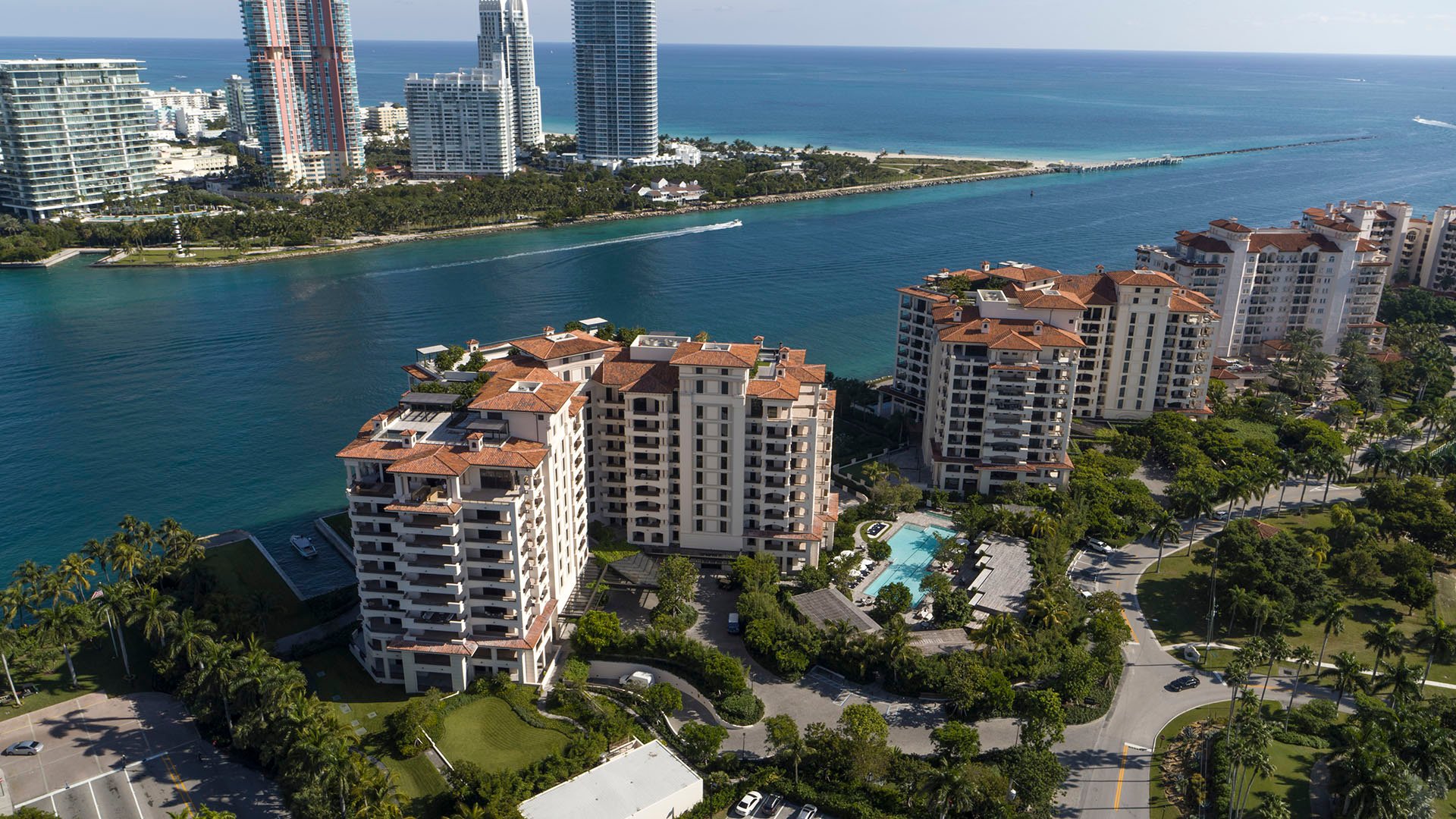
Fisher Island and Key Biscayne occupy rare positions in South Florida luxury real estate. Both offer a distinctly residential relationship with the water, yet their ownership economics are not interchangeable. For a buyer considering a primary home, seasonal retreat, or long-hold investment, property tax can create a material difference in recurring costs.
The central comparison is straightforward, though not absolute. A working Key Biscayne rate of approximately 15.5 mills equates to 1.55% of taxable value before exemptions. A generalized Fisher Island cost benchmark uses approximately 1.94% of assessed fair-market value. At an equivalent value, the Key Biscayne model is about 20% lower. That is a useful planning contrast, not a parcel-specific tax quote.
At luxury values, a modest rate difference can become a meaningful annual obligation.
Miami-Dade property tax is calculated by multiplying taxable value after exemptions by the applicable total millage rate, then dividing by 1,000. One mill equals $1 of tax for every $1,000 of taxable value. The relevant inputs are taxable value, available exemptions, applicable taxing authorities, and the property's total millage.
This distinction matters because the municipal rate does not represent the entire bill. In Key Biscayne, village millage is joined by countywide, School Board, and other applicable taxing components. Buyers should not apply a village-only figure as though it were the complete rate.
The municipal figures also underscore the importance of annual review. Key Biscayne's village-only millage was 2.9794 in 2024 and was proposed at 3.0777 for 2025. A later sequence lists 2.8846 for 2025 and 3.0066 proposed for 2026. Proposed figures should always be distinguished from adopted total millage.
At the 1.55% Key Biscayne working rate, $5 million in taxable value produces an estimated $77,500 tax before exemptions. The same model yields approximately $155,000 at $10 million and $310,000 at $20 million.
Using the 1.94% Fisher Island benchmark, comparable estimates are approximately $97,000 at $5 million, $194,000 at $10 million, and $388,000 at $20 million. At $40 million, the Fisher Island benchmark implies approximately $776,000 annually.
The difference is particularly clear at $10 million: approximately $39,000 per year separates the two models. That gap may be secondary to a buyer's preferred setting, residence, or service profile, but it warrants a dedicated line in the annual ownership budget.
These figures are illustrative, not forecasts. Actual bills depend on taxable value, exemptions, taxing district, assessment history, and the property's treatment after purchase. The Fisher Island percentage is a generalized effective-rate assumption, not an official parcel-specific millage quotation.
Key Biscayne's approximately 15.5-mill total adopted rate is among the lower rates in Miami-Dade. For context, the working comparisons are roughly 16.9 mills in unincorporated Miami-Dade and about 20 mills in the City of Miami.
That relative position can be compelling when evaluating a residence such as Oceana Key Biscayne or another island property with a high taxable value. The advantage is clearest when two properties are modeled at the same value and under the same exemption assumptions. It should not be mistaken for a guarantee that one buyer's final bill will be lower than another's.
For waterfront buyers, this is the disciplined way to frame the location: Key Biscayne combines a comparatively low modeled base with access to the same countywide homestead framework available to an eligible Fisher Island primary residence.
Fisher Island's working 1.94% benchmark makes tax sensitivity increasingly visible as values rise. Buyers considering The Residences at Six Fisher Island or The Links Estates at Fisher Island should model the specific parcel rather than transfer a generalized percentage directly into a final budget.
The same discipline applies when comparing established residences such as Palazzo del Sol and Palazzo della Luna. Acquisition price, current assessment history, taxable value, and primary-residence plans must be considered together. The island name alone does not determine the final bill.
A higher modeled tax burden does not settle the lifestyle decision. It simply prices one component of ownership more accurately. For an ultra-prime buyer, clarity is often more valuable than a superficially low estimate that omits parcel-level variables.
Homestead treatment turns on primary-residence qualification, not the choice between Fisher Island and Key Biscayne. An eligible homeowner in either market may receive the relevant exemption and the Save Our Homes assessment-growth limitation.
The annual Save Our Homes cap is the lesser of 3% or the applicable change in the Consumer Price Index. It limits annual assessment growth for a qualifying primary residence. At multimillion-dollar values, this long-term restraint can be more strategically important than the exemption's immediate reduction in taxable value.
A 2025 Fisher Island ownership example uses a homestead exemption of $50,722. In the context of a luxury residence, that flat amount has limited impact relative to the property's total value. The more consequential question is whether the home genuinely qualifies as the owner's primary residence and can benefit from capped assessment growth over time.
A second home should not be modeled as homesteaded. Buyers deciding between seasonal occupancy and a primary move should run separate scenarios rather than treat homestead as an automatic feature of Florida ownership.
Property tax is only one line within annual carry, but it is the line most directly informed by taxable value and millage. Begin with the parcel's assessment history and applicable total rate, then test the budget with and without exemptions. For a contemplated primary residence, add a longer-term view of capped assessment growth. For a non-homesteaded property, do not assume that protection.
Viewed through the lens of buyer's guides, the strongest comparison is not a single percentage. It is a consistent set of scenarios reflecting the buyer's intended acquisition value, holding period, and occupancy status. Association obligations and other property-specific ownership costs should be reviewed separately so that the tax advantage is not mistaken for the entire carry profile.
Key Biscayne presents the lower modeled property-tax burden at equal taxable value before exemptions. Fisher Island carries the higher generalized benchmark, with the dollar difference widening as value rises. At $10 million, the illustrative annual spread is $39,000; at larger values, disciplined parcel-level analysis becomes even more important.
For a qualifying primary residence, both locations offer the same strategic doorway to homestead treatment and Save Our Homes. For a seasonal residence, neither should be modeled with benefits reserved for an eligible primary home. The refined choice is therefore not simply which island has the lower rate, but which property, use pattern, and ownership horizon justify the complete annual carry.
To compare South Florida's most distinguished residences with discreet, property-specific guidance, connect with MILLION.
If branded residences are on your mind — as a home or as an allocation — we would be glad to share what we are seeing, privately.
Begin a quiet conversationYes. The working comparison uses about 1.55% for Key Biscayne and a generalized 1.94% benchmark for Fisher Island.
At equal value before exemptions, the two working rates produce an illustrative annual difference of approximately $39,000.
One mill is $1 per $1,000 of taxable value, so 15.5 mills is equivalent to 1.55%.
No. The bill also reflects countywide, School Board, and other applicable taxing authorities.
At 15.5 mills, $5 million of taxable value produces an estimated $77,500 before exemptions.
Using the generalized 1.94% benchmark, the estimate is approximately $388,000 annually.
Potentially, yes. Eligibility depends on primary-residence qualification rather than whether the property is on Fisher Island or Key Biscayne.
For a qualifying primary residence, annual assessment growth is limited to the lesser of 3% or the applicable Consumer Price Index change.
No. A second home should not be assumed to receive benefits that require primary-residence eligibility.
Actual bills depend on taxable value, exemptions, taxing district, assessment history, and the property's treatment after purchase.