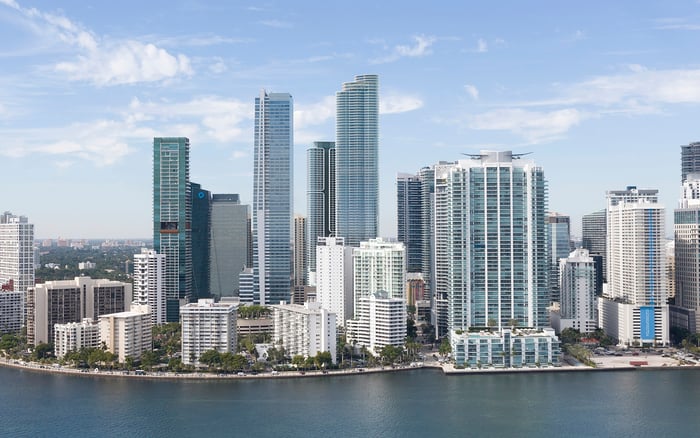
Brickell and Coconut Grove share the same fundamental homestead framework. The meaningful ownership-cost comparison lies in buyer eligibility, portability, parcel-level taxation and the recurring obligations of the individual residence.

Choosing between Brickell and Coconut Grove is ultimately a decision about how you want to live. Assessing the financial commitment requires a different lens: the residence’s intended use, the buyer’s existing homestead position and the obligations attached to the property.
Neither neighborhood offers a universal homestead advantage. Eligibility depends on permanent Florida residence, not a Brickell or Coconut Grove address. For a luxury buyer, that distinction matters: two similarly priced residences can carry different ownership costs without either neighborhood offering inherently preferable tax treatment.
A shortlist spanning 2200 Brickell and Park Grove Coconut Grove should begin with the same financial questions. Will this be your permanent residence? Are you transferring an eligible Florida homestead benefit? Which taxing authorities apply to the property, and what are its recurring expenses?
The address shapes the lifestyle. The owner’s circumstances and the property’s particulars shape the tax analysis.
For tax year 2026, Florida’s maximum combined homestead exemption is $51,411. It reduces taxable value, not the tax bill dollar for dollar, and does not apply equally across every levy.
The first $25,000 applies to all property-tax levies, including school taxes. The additional exemption applies only to non-school levies. A buyer therefore should not subtract the full $51,411 from assessed value and apply one combined rate to the result. School and non-school components must each use their applicable taxable values.
Save Our Homes is a separate benefit. Beginning in the second year a property receives homestead exemption, it limits annual assessed-value increases to 3% or the change in CPI, whichever is lower. The homestead assessed-value increase limit for 2026 is 2.70%, excluding new construction.
This is not a ceiling on annual tax-bill growth. The protection applies to assessed value; the bill also reflects applicable rates and exemptions. New construction and other qualifying changes fall outside the ordinary assessment-growth limitation.
For a buyer planning a long holding period, the distinction is important: the exemption reduces taxable value, while the cap restrains future assessed-value increases. They serve different purposes, even when both benefit the same residence.
An eligible owner moving between Florida primary residences may transfer up to $500,000 of accumulated homestead assessment difference to another Florida homestead. That difference is the eligible gap between the previous property’s market value and assessed value. It is not a $500,000 tax credit, cash payment or guaranteed benefit for every purchaser.
Portability can reduce the new home’s assessed value and resulting taxable value. The benefit follows the owner, not the neighborhood. A qualifying move to Una Residences Brickell should be evaluated under the same portability framework as a qualifying move to Coconut Grove.
Review timing before closing arrangements are fixed. The portability window requires establishing the new homestead within three consecutive January 1 dates after abandoning the previous homestead. The standard application deadline is March 1 of the year for which the benefit is requested.
The transfer requires an application; a purchase does not trigger it automatically. Ask your advisers to confirm the eligible assessment difference, applicable window and filing requirements early. Include a prospective benefit in the acquisition model only after its eligibility and amount have been evaluated.
The purchase’s intended use can change the analysis more substantially than the neighborhood choice. A second home or investment property generally does not qualify for the owner’s homestead exemption or Save Our Homes protection.
For someone evaluating Four Seasons Residences Coconut Grove as a seasonal residence, a prudent budget therefore differs from one premised on qualifying permanent Florida residency. The same distinction applies to a seasonal purchase in Brickell.
Do not build an ownership budget around homestead simply because the residence is in Florida. Nor should you assume portability is available merely because you previously owned Florida property. Establish whether the previous residence carried an eligible homestead assessment difference and whether the new purchase will qualify.
A single neighborhood-wide percentage is not a useful basis for comparison. Each ad valorem tax component is calculated as:
Applicable taxable value × millage ÷ 1,000.
Calculate the components using the parcel’s taxing authorities, then combine them. Keep school and non-school exemption treatment distinct, and use rates appropriate to the tax year being modeled.
The proposed FY 2026-27 countywide operating rate of 4.5740 mills was approved for transmittal. It is neither the complete parcel tax rate nor a final combined rate for Brickell or Coconut Grove. Do not use it as a shortcut for either neighborhood’s total property-tax burden.
For each candidate, request a buyer-specific estimate that separates market value, assessed value, exemptions, any eligible portability benefit and taxable values. An existing tax bill should prompt questions about those inputs, not substitute for an analysis of your own circumstances.
Property tax is only one line in an ownership budget. A meaningful annual-carry comparison also requires residence-specific association charges, insurance costs and any special-assessment obligations. A lower modeled tax bill alone does not establish lower overall carry.
Use the same budget structure for both neighborhoods. Request the applicable association budget and payment schedule, obtain insurance quotations suited to the intended ownership and use, and ask for documentation of any special assessments. Separate recurring expenses from one-time obligations, and identify the period each figure covers.
Check what an association charge includes before adding separate expense allowances. Keep financing costs, if applicable, distinct from underlying property expenses so that your purchase structure does not obscure the comparison between residences.
Where a cost remains uncertain, test more than one budget scenario rather than treating an estimate as a fixed obligation. The aim is not to manufacture a neighborhood winner, but to understand each home’s financial commitment using comparable assumptions.
Compare your finalists using the same ownership-use assumption, tax year and expense categories. Confirm homestead eligibility first, evaluate portability second, calculate parcel-level taxes third and complete the recurring-cost review before drawing a conclusion.
Brickell and Coconut Grove should compete on the residences and lives they offer, not on an assumed tax advantage. The stronger purchase is the one whose financial obligations are as clearly understood as its personal appeal.
Explore your next residence with MILLION.
If branded residences are on your mind — as a home or as an allocation — we would be glad to share what we are seeing, privately.
Begin a quiet conversationNeither neighborhood has an inherent homestead advantage. Eligibility depends on permanent Florida residence and the owner’s qualifying circumstances.
The maximum combined exemption is $51,411 for tax year 2026. It reduces taxable value rather than the tax bill dollar for dollar.
No. The first $25,000 applies to all property-tax levies, including school taxes, while the additional exemption applies only to non-school levies.
The limitation begins in the second year a property receives homestead exemption. Annual assessed-value increases are limited to 3% or CPI, whichever is lower, subject to exceptions such as new construction.
No. The 2.70% limit applies to homestead assessed-value increases for 2026, excluding new construction, not directly to the annual tax bill.
It is the maximum eligible accumulated homestead assessment difference that may transfer to another Florida homestead. It is not a $500,000 tax credit.
No, portability requires an application. The standard deadline is March 1 of the year for which the benefit is requested.
The new homestead must be established within three consecutive January 1 dates after abandoning the previous homestead. Confirm the relevant dates before relying on the benefit.
A second home or investment property generally does not qualify for the owner’s homestead exemption or Save Our Homes protection. Budget according to the property’s intended use and confirmed eligibility.
Use buyer-specific parcel tax estimates alongside residence-specific association charges, insurance costs and special-assessment obligations. Compare the same tax year, ownership use and expense categories rather than assuming either neighborhood is universally cheaper.
.jpg&width=700&height=438&fit=cover)