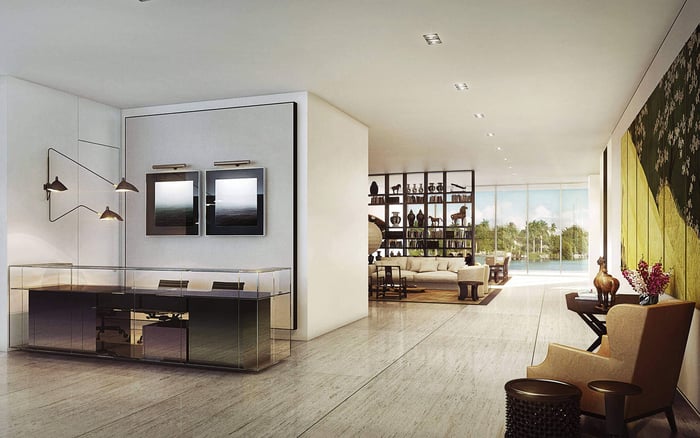
A grand piano deserves more than a beautiful setting. Before committing to a South Florida residence, assess the proposed location’s structural capacity, sound transmission, environmental stability, delivery access, and alteration permissions.

A grand piano can define the character of a residence: a setting for private practice, intimate performances, or the pleasure of living with an exceptional instrument. Yet the most photogenic position is not necessarily the most suitable. Before committing to a South Florida home, establish whether the intended location works structurally, acoustically, and environmentally.
The distinction is between a piano that fits and one that belongs. A generous salon does not establish floor capacity; handsome finishes do not establish sound isolation. Treat the instrument as an early design requirement, and have its proposed location reviewed before the purchase becomes difficult to reconsider.
Begin the buyer’s brief with the instrument’s verified dimensions and weight, a marked floor plan, intended playing hours, and any proposed acoustic construction. Together, these give advisers a defined proposal to assess rather than a general question about whether the residence can accommodate a grand.
Florida’s building-code framework addresses minimum dead, live, and impact loads. Luxury positioning is no substitute for structural verification. Structural-design provisions distinguish uniformly distributed loads from concentrated loads; where both checks apply, the condition producing the greater structural effect governs.
Dividing the piano’s weight by the room’s square footage is not a meaningful substitute for assessment. Ask a structural engineer to examine the proposed position, the instrument’s support points, and the supporting construction. The question is not simply whether the room is large enough, but how the load reaches the structure and, ultimately, the foundation.
For a Brickell search that includes The Residences at 1428 Brickell, keep the inquiry specific to the residence and placement under consideration. A project name or architectural impression cannot answer a unit-level engineering question.
Confirm the applicable requirements for the particular property and alteration. Do not treat one code edition or a general residential guideline as establishing the governing requirements for every home.
The piano may account for only part of the proposed load. Acoustic platforms, floating floors, and heavier wall assemblies add weight that belongs in the structural review from the outset.
Ask the structural engineer and acoustic adviser to work from the same proposed design. Otherwise, a piano position accepted in principle may later be paired with an isolation assembly that changes the loading assumptions. Clarify what was assessed: the instrument alone, or the instrument together with the planned construction.
Avoid a universal safe-weight rule. Suitability depends on the location and supporting structure, not a single number applicable across South Florida residences. A written assessment should identify the reviewed position and proposed additions so later design changes can be checked against it.
Room acoustics and sound isolation solve different problems. The first concerns how the piano sounds within the room; the second, how sound and vibration reach other spaces.
Airborne sound isolation relies on a combination of mass, airtight sealing, and decoupled assemblies. Structure-borne vibration travels through building connections and may require a different response. Increasing wall mass alone does not necessarily address transmission through shared slabs, walls, or other structural connections.
When considering a Miami Beach residence, including The Perigon Miami Beach, ask advisers to distinguish these pathways rather than accept a broad promise of soundproofing. This is a due-diligence question, not a statement about any project’s acoustic performance.
Floating floors and resilient systems also require careful detailing. Rigid connections to surrounding construction can bypass the intended isolation. Have the proposed assembly reviewed as a complete system rather than selecting individual products in isolation.
A spacious room can still produce excessive reverberation, flutter echo, or low-frequency buildup. Reflective parallel surfaces deserve attention, as does the relationship between the instrument and the room’s finishes. Floor area alone cannot predict a satisfying musical experience.
Start with an acoustic assessment of the proposed room and the buyer’s intended use. Describe plans for solo practice and occasional performances clearly so the adviser understands what the room is expected to support.
In a Coconut Grove search that includes Park Grove Coconut Grove, evaluate each candidate room on its own terms rather than treating visual openness as acoustic assurance.
Rugs, upholstered furniture, curtains, bookshelves, and strategically placed acoustic panels offer adjustable ways to shape the room’s sound before permanent alterations. They should not, however, be mistaken for a complete solution to sound transmission into neighboring residences.
Avoid placing the piano in direct sunlight, near heating or cooling registers, or where temperature and humidity change rapidly. Where possible, consider alternatives to exterior-wall placement and assess whether a solid wall offers a better arrangement.
The best outlook may therefore require compromise. Review the proposed position in relation to glazing and air-conditioning outlets, not simply the furniture plan. Ask a piano specialist to assess environmental suitability without assuming a universal humidity target.
For buyers comparing Boca Raton options such as Alina Residences Boca Raton, include a moisture assessment in the proposed diligence. The purpose is to understand the intended room’s conditions, not to infer instrument suitability from the address or finish level.
A successful placement also depends on getting the instrument there. Ask a specialist mover to assess the proposed delivery route, including relevant doors, turns, elevators, and access arrangements. Seek written confirmation of any building approvals needed for that route rather than assuming ordinary furniture access settles the question.
For a condominium, request the applicable rules on playing hours, nuisance, flooring changes, acoustic work, and alteration approval. These are proposed buyer inquiries, not universal association requirements. Distinguish permission to bring in the piano from permission to build an isolation system or use the room as intended.
Ask transaction counsel how structural review, acoustic feasibility, delivery approval, and moisture assessment can be addressed within negotiated diligence terms. The objective is a purchase decision informed by written findings, identified permissions, and a realistic scope of work-not assurances that everything can be solved after closing.
Explore South Florida residences with your musical priorities in mind at MILLION.
If branded residences are on your mind — as a home or as an allocation — we would be glad to share what we are seeing, privately.
Begin a quiet conversationLuxury positioning does not establish structural suitability. A structural engineer should assess the instrument’s proposed location and supporting construction.
No. Where distributed and concentrated load checks apply, the condition producing the greater structural effect governs.
Prepare verified instrument dimensions and weight, a marked placement plan, and details of proposed acoustic construction. The review should address the actual arrangement.
Yes. Floating floors, acoustic platforms, and heavy wall assemblies add load and should be assessed with the piano.
No. Room acoustics concern sound within the space, while isolation addresses transmission to other spaces, including airborne sound and structure-borne vibration.
Not necessarily. Added wall mass alone may not resolve vibration transmitted through shared slabs or other structural connections.
They can provide adjustable room treatment alongside upholstered furnishings, bookshelves, and acoustic panels. They are not a complete substitute for sound isolation.
Avoid direct sunlight, heating or cooling registers, and locations exposed to rapid temperature or humidity changes. Consider alternatives to exterior-wall placement where possible.
No universal threshold should be assumed. Structural suitability and acoustic performance need assessment for the particular instrument, location, and room.
Clarify delivery access, applicable playing and nuisance rules, and permissions for flooring or acoustic alterations. These are proposed diligence inquiries, not requirements shared by every association.