A discreet residential framework for finance executives evaluating South Florida after a business relocation, with emphasis on access, privacy, liquidity, family needs, and long-term ownership strategy.

For finance executives moving a business, a team, or a family office presence to South Florida, the residential decision should never be treated as an afterthought. The home becomes a command center, a hospitality venue, a family anchor, and, in many cases, a balance-sheet asset that must remain legible to future buyers.
The most effective search begins with a private map of daily behavior. Where are board meetings likely to occur? How often will New York, Palm Beach, the Caribbean, or Latin America remain part of the weekly rhythm? Is the residence primarily a primary home, a second home, or a hybrid base that must perform across seasons? These questions matter as much as view, architecture, or amenity profile.
South Florida rewards precision. A five-minute difference in bridge access, school routing, marina proximity, or airport preference can change the long-term usefulness of a property. For an executive household, residential strategy is less about chasing a fashionable address and more about acquiring the right kind of control.
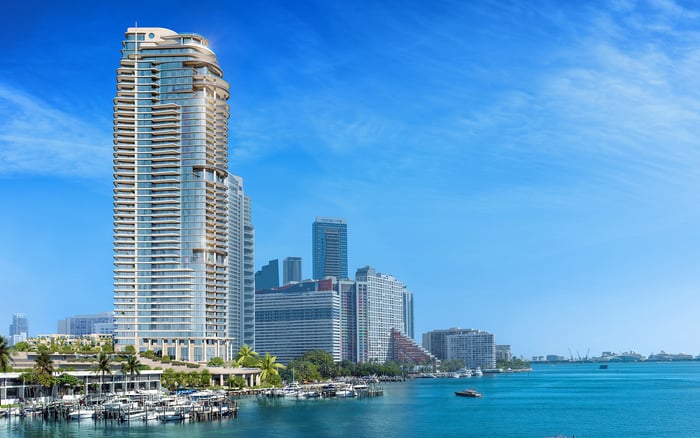
Brickell remains the natural first reference point for many finance buyers because it concentrates business energy, private dining, banking relationships, and condominium inventory within a vertical, walkable environment. For executives who expect frequent office presence, a residence such as St. Regis® Residences Brickell fits a familiar global pattern: service, discretion, water views, and immediate access to the city’s financial core.
Yet the best answer is not always the closest answer. A founder, portfolio manager, or chief investment officer may prefer the softer cadence of Coconut Grove, the resort-like privacy of Miami Beach, or the quieter capital culture of Palm Beach County. The correct home should reduce friction, not simply shorten a commute on paper.
A useful exercise is to divide the week into zones: office, airport, school, wellness, dining, boating, and private hosting. When those zones are weighted honestly, the neighborhood hierarchy usually becomes clear.
Finance executives are trained to separate narrative from fundamentals. The same discipline applies to residential acquisition. A beautiful residence can still be the wrong purchase if its carrying costs, association structure, floor plan, resale universe, or renovation exposure do not align with the owner’s time horizon.
Condominiums offer convenience, security, lock-and-leave practicality, and an amenity platform that can simplify a demanding schedule. Single-family homes offer land, privacy, customization, and a deeper sense of permanence. Neither category is universally superior. The right choice depends on staff needs, entertaining patterns, children, pets, parking, storage, and appetite for maintenance.
For a buyer file, it can be useful to label the search by intent: investment, new construction, primary residence, and second home. Those labels should not become marketing slogans. They should become filters for negotiations, inspections, governance review, and exit planning.
Privacy in South Florida is not only about gates and elevators. It is about arrival sequence, service access, staff circulation, package handling, guest management, marina visibility, and the ability to host without turning the residence into a spectacle.
Some executives require a residence that can accommodate advisers, visiting partners, or family office personnel without compromising household life. Others need a retreat that remains deliberately separate from business. A bayfront condominium, a branded tower, a boutique building, and a gated estate solve different privacy problems.
In Miami Beach, buyers often weigh beachfront access against traffic patterns and seasonal activity. A project such as The Perigon Miami Beach may appeal to those seeking a polished coastal address with a residential feel, while still remaining connected to the city’s cultural and dining circuits.
For executives relocating with family, the residential decision frequently turns on matters that are not visible in a listing presentation. School commutes, after-school activities, grandparents, domestic staff, pet routines, sports, medical access, and weekend travel all shape the correct address.
Coconut Grove and Coral Gables often enter the conversation when buyers want a more established residential rhythm, mature landscaping, and access to private education corridors. In that context, Four Seasons Residences Coconut Grove speaks to a buyer who wants hotel-caliber service within a neighborhood that feels less transactional than the urban core.
For some families, Palm Beach County or Boca Raton may offer a stronger long-term fit. The appeal can include a calmer daily pace, country club adjacency, larger residences, and a different relationship between business life and home life. Alina Residences Boca Raton is the kind of address that can resonate with buyers evaluating Boca Raton as a sophisticated, service-oriented alternative to Miami.
Ultra-prime residential property is emotional, but it should not be purchased without a liquidity thesis. Finance executives understand that exit windows, buyer depth, and product differentiation matter. The same logic applies to a waterfront condominium or estate.
A residence with rare view corridors, strong building governance, thoughtful floor plans, and an address with enduring demand is generally easier to defend over time than a property acquired only for novelty. That does not mean avoiding distinctive architecture. It means understanding whether the distinctiveness expands the future buyer pool or narrows it.
Pre-construction and recently completed residences can be attractive when the executive wants modern systems, wellness programming, valet convenience, and fewer renovation variables. Resale properties may offer established operations, immediate occupancy, and a clearer understanding of how a building lives day to day. The decision should be paired with counsel on contract structure, deposits, timelines, and transfer flexibility.
The South Florida relocation conversation is no longer only Miami-centric. West Palm Beach has become an increasingly serious option for executives who want proximity to Palm Beach, private aviation convenience, cultural polish, and a more measured urban scale. A residence such as Forté on Flagler West Palm Beach can serve buyers who want waterfront orientation and a refined base north of Miami.
Fort Lauderdale can also be compelling, particularly for executives who value boating, beach access, and a less compressed urban environment. It offers a different kind of coastal utility, with strong appeal for households that want a primary residence to function like a private resort without losing access to South Florida’s business corridors.
For many buyers, the smart approach is not to choose a city first. It is to choose a life pattern, then test which city supports it with the least compromise.
The luxury search should include more than finishes and views. Buyers should review association governance, reserve posture, insurance exposure, rental policies, parking rights, storage, service staffing, pet rules, renovation procedures, and guest protocols. For single-family homes, the lens expands to seawalls, elevation, roof condition, landscaping, security systems, generators, dockage, and household staffing logistics.
Executives should also think carefully about entity ownership, estate planning, financing preferences, and cross-border considerations where relevant. Those topics require specialized legal and tax advice, but the real estate search should be organized early enough to accommodate them.
A well-run acquisition process protects attention. The goal is to avoid reactive decision-making during a relocation window, especially when a business move, school transition, and household setup are happening at the same time.
The strongest residential strategies are rarely the loudest. They are the ones that make the executive’s week calmer, the family’s routine easier, and the ownership story cleaner. South Florida offers extraordinary variety, from Brickell towers and Miami Beach oceanfront residences to Coconut Grove, Boca Raton, Fort Lauderdale, and West Palm Beach.
For a finance executive, the opportunity is to treat the home as part of the relocation architecture. When business geography, household needs, privacy, governance, and liquidity are aligned, the residence becomes more than an address. It becomes a durable operating advantage.
Should finance executives buy before or after relocating to South Florida? Many buyers benefit from narrowing neighborhoods before the move, then timing the purchase around school, office, and family logistics.
Is Brickell the best area for a finance executive? Brickell is highly practical for office proximity, dining, and urban access, but it is not the only strategic choice.
When does Miami Beach make sense for a relocating executive? Miami Beach works well when coastal lifestyle, privacy, hospitality, and cultural access are central to the household plan.
Should an executive choose a condo or a single-family home? Condos favor service and convenience, while single-family homes offer more privacy, land, and customization.
What should be reviewed in a luxury condo purchase? Governance, insurance, reserves, rental rules, parking, storage, staffing, and renovation procedures all deserve close review.
Why consider West Palm Beach? West Palm Beach may suit buyers seeking Palm Beach proximity, private aviation convenience, and a measured urban pace.
Can a South Florida home also be an investment? It can be evaluated through that lens, but lifestyle use, holding period, carrying costs, and resale depth should guide expectations.
Is new construction preferable for relocation buyers? New construction can reduce renovation burden and offer modern services, though contracts and delivery timing require scrutiny.
How important is airport access? Airport access can be decisive for executives who travel frequently between financial centers, family offices, and client markets.
What is the first step in building a residential strategy? Define the household’s weekly operating map, then compare neighborhoods against that routine rather than against prestige alone.
For a discreet conversation and a curated building-by-building shortlist, connect with MILLION.
If branded residences are on your mind — as a home or as an allocation — we would be glad to share what we are seeing, privately.
Begin a quiet conversation