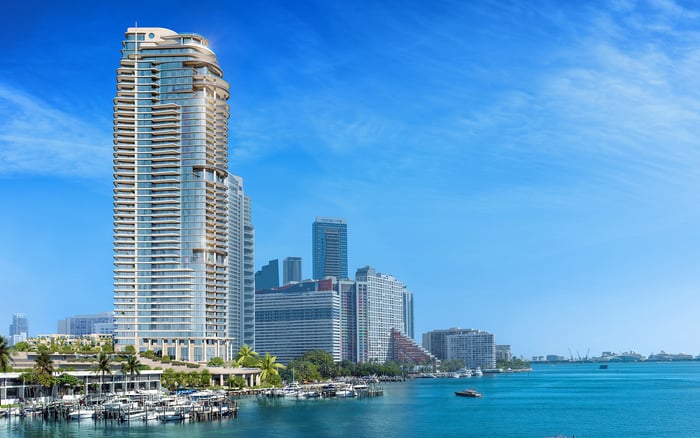
A buyer-focused guide to reading Brickell luxury condo fees through service quality, reserve discipline, insurance exposure, and assessment risk.

In Brickell, monthly condo fees are visible at a glance and harder to interpret with confidence. A buyer may compare two residences by price per square foot, view corridor, floor height, or interior finish, yet the quieter measure of ownership quality often sits inside the association budget. Fees, reserves, insurance, and assessment risk form the operating architecture of a luxury building. They determine not only what an owner pays, but how gracefully the property can age.
For affluent buyers, the question is not simply whether a fee is high or low. It is whether the fee is intelligently built. A well-run association uses monthly income to support staffing, security, amenities, building systems, common areas, and future repairs. A low fee can look appealing at first, but if it underfunds maintenance or reserves, the discount may prove temporary. A higher fee can be entirely rational when it supports meaningful service, strong reserves, and a disciplined capital plan.
This is especially relevant in Brickell, where buyers often compare new towers, boutique projects, and established resale buildings within a few blocks of one another. Someone considering Baccarat Residences Brickell, for example, may be evaluating a lifestyle proposition as much as a balance sheet. The point is to understand what the association is collecting, why it is collecting it, and whether the building appears prepared for the next decade of ownership.
In conversation, buyers often use “HOA fee” as shorthand, even when referring to condominium association assessments. In a luxury condo, that monthly charge can include building staff, common-area utilities, amenity maintenance, management, security, landscaping, cleaning, insurance components, reserve contributions, and other shared operating costs. The exact composition varies by building, which is why the budget matters more than the headline number.
Service is the first layer. A full-service Brickell tower with extensive amenity spaces, attended arrival, valet operations, and elevated hospitality expectations will usually have a different cost profile than a more restrained building. The second layer is infrastructure: elevators, mechanical systems, facade components, pools, garages, and life-safety systems. The third layer is planning. A building that reserves with discipline may feel more expensive monthly, but it may also be less vulnerable to abrupt special assessments.
For new-construction purchasers, the early budget deserves particular attention. Initial estimates may not fully reflect mature operating patterns once the building is fully occupied and all services are stabilized. Buyers comparing projects such as 2200 Brickell should ask how the projected budget transitions from launch to long-term association control, and which assumptions support staffing, amenities, insurance, and reserves.
Reserves are not glamorous, but they are among the clearest indicators of stewardship. They are the funds set aside for future repair and replacement of major components. In a tropical, waterfront, high-rise environment, capital needs are not theoretical. Buildings require sustained attention, and sophisticated owners should expect boards to plan accordingly.
The reserve conversation should begin with three questions. Which components are included? How are estimated useful lives and replacement costs being evaluated? Is the contribution level consistent with the building’s physical complexity and service standard? A reserve line that looks modest may be efficient, or it may be insufficient. The answer is found in the reserve schedule, meeting minutes, recent projects, and the building’s history of capital planning.
For resale buyers, reserves can be especially revealing. A mature building with transparent reserve practices, recent maintenance history, and orderly board communication may provide greater confidence than a property with a superficially lower monthly fee but vague capital planning. The luxury market rewards views and design, but it also rewards governance.
Insurance has become one of the most scrutinized operating categories for condominium associations. A buyer does not need to become an insurance specialist, but should understand that master policy costs, deductibles, coverage limits, exclusions, and allocation methods can materially influence the building budget. The association’s insurance program also interacts with what an individual owner may need to carry separately.
The key is to read insurance as part of a wider risk profile. A high-quality building may still face rising premiums. A carefully managed association will communicate clearly, budget realistically, and avoid hiding recurring insurance pressure in optimistic assumptions. Buyers should ask for current insurance information, understand deductibles, and consult appropriate insurance and legal advisors before closing.
In Brickell, where waterfront proximity, tower height, and amenity complexity can shape operating costs, insurance should never be treated as a footnote. A buyer considering Una Residences Brickell, for instance, should evaluate the residence and the building experience alongside the association’s risk management posture.
A special assessment is not automatically a sign of poor management. It may reflect a necessary capital project, insurance change, legal matter, or repair that exceeds available funds. The risk lies in surprise, scale, and frequency. A building that regularly relies on assessments for predictable needs may be signaling that monthly fees or reserves have not kept pace with reality.
Assessment risk is best evaluated through documents, not assumptions. Buyers should review board minutes, budgets, reserve information, pending projects, engineering discussions, litigation disclosures where applicable, and recent owner communications. Patterns matter. One well-explained assessment for a defined improvement is different from recurring, poorly communicated charges.
Investment buyers should be especially careful. Carrying costs influence yield, exit value, and tenant economics. A residence that appears attractively priced can become less compelling if the association’s future capital needs are opaque. Conversely, a well-capitalized building with transparent governance can support buyer confidence, even if the monthly fee is not the lowest in the set.
The most refined approach is not to ask, “Which building has the lowest fee?” It is to ask, “Which building offers the most durable value for its fee?” That comparison should include service level, amenities, reserve funding, insurance exposure, management quality, owner communication, and the near-term capital plan.
Brickell buyers often move between branded residences, design-led towers, and more residentially discreet addresses. A purchaser reviewing Cipriani Residences Brickell may be drawn to hospitality, arrival sequence, and lifestyle identity. Those attributes should be weighed alongside the association budget, because the experience must be maintained long after the purchase contract is signed.
There is no universal ideal fee. Some owners prefer extensive services and accept the cost. Others value a quieter building with fewer shared amenities and a leaner operating structure. The correct answer is personal, but the diligence should be rigorous.
Before committing, request the current budget, reserve information, association financials, meeting minutes, insurance summary, rules, pending assessment notices, and any available capital planning materials. Ask direct questions: What major projects are anticipated? Are reserves considered adequate by the board’s planning framework? Have fees increased recently? Are there known insurance changes? Are any assessments under discussion?
Then test the monthly cost against your own ownership plan. A primary resident may value services differently from a second-home owner. A long-term holder may accept stronger reserve contributions as prudent protection. An investment buyer may focus on predictable carrying costs and resale liquidity. In every case, the fee should be read as part of the residence’s total design, not as an isolated charge.
Are higher condo fees always bad in Brickell? No. Higher fees may reflect deeper service, stronger staffing, better maintenance, or more disciplined reserve funding.
Can a low monthly fee increase assessment risk? It can if the fee does not adequately support reserves, maintenance, insurance, and predictable capital needs.
What documents should I review before buying? Review the budget, reserve information, meeting minutes, insurance details, rules, financials, and any assessment notices.
Do new condos have more predictable fees? Not always. Early budgets may evolve as the building matures, occupancy stabilizes, and real operating costs become clearer.
Why do reserves matter so much? Reserves help fund future repairs and replacements, reducing reliance on sudden special assessments.
Is insurance included in condo fees? Association insurance is often part of the shared budget, but owners typically need separate personal coverage as well.
How should resale buyers evaluate older buildings? Focus on maintenance history, reserve discipline, recent capital projects, minutes, and whether assessments appear recurring.
Can assessments affect resale value? Yes. Unresolved or poorly explained assessments can affect buyer confidence and negotiation dynamics.
Should lifestyle amenities justify higher fees? They can, if the services are well-managed, financially sustainable, and aligned with how you intend to use the residence.
What is the smartest way to compare Brickell fees? Compare total value: service, reserves, insurance, governance, capital plans, and the quality of the living experience.
To compare the best-fit options with clarity, connect with MILLION.
If branded residences are on your mind — as a home or as an allocation — we would be glad to share what we are seeing, privately.
Begin a quiet conversation