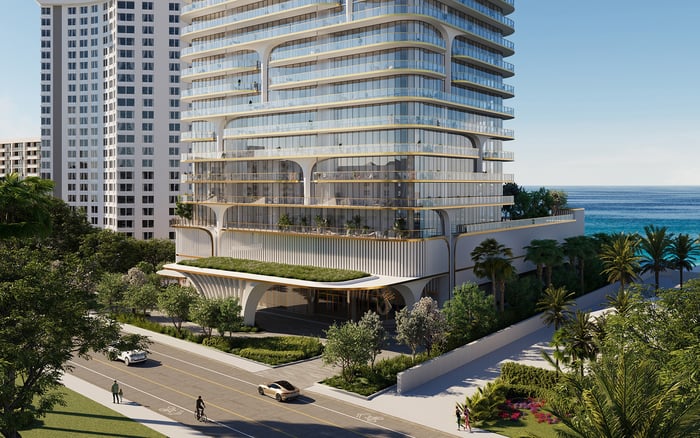
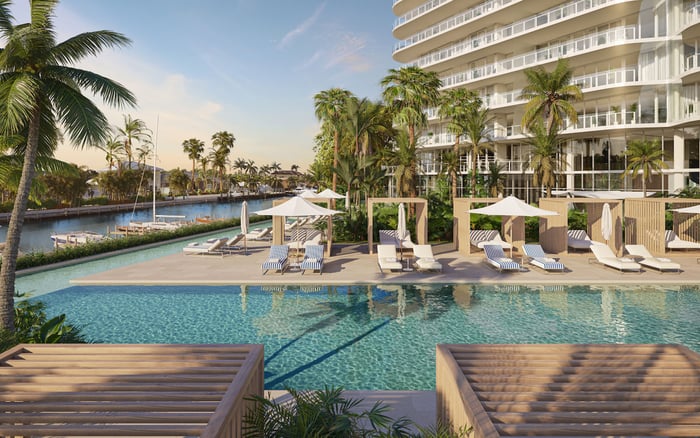
An elegant arrival is only the beginning of residential privacy. This buyer’s audit examines the advertised features at The Ritz-Carlton Residences® Pompano Beach and the written confirmations needed to understand elevator access, invited guests, service circulation, and waterfront amenities.
The most revealing privacy question is not how a residence looks behind its front door. It is who can reach that door, by which route, and with whose permission. At The Ritz-Carlton Residences® Pompano Beach, the advertised architecture offers a compelling starting point: a 32-story oceanfront Beach Tower and a 14-story Marina Tower on the Intracoastal Waterway, with private elevator lobbies advertised for each residence.
For a buyer, architecture and operating policy warrant separate scrutiny. A secluded threshold can support discretion without establishing a dedicated elevator, restricted floor access, or a fully separate delivery route. The features discussed here are advertised specifications, not confirmation of completed installations or current procedures. The purchase decision should rest on written commitments and clearly mapped access-not assumptions attached to the word private.
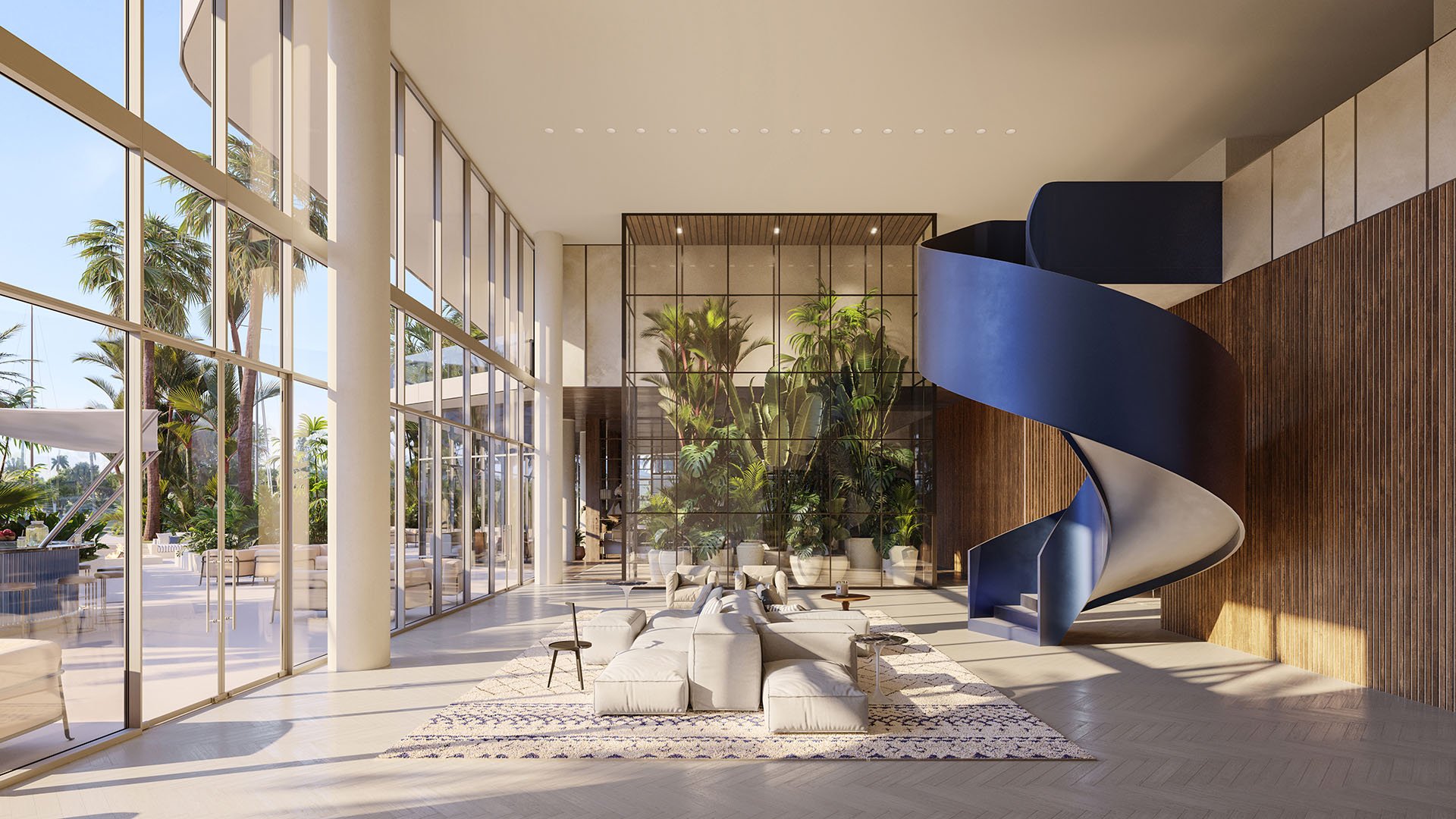
Advertised arrival features include a porte-cochère drop-off and an oceanfront lobby, complemented by 24/7 valet service. These describe the setting and service availability. They do not explain how a resident’s identity, vehicle, or destination is handled during a busy arrival period.
Ask whether valet can retrieve a car without announcing a name or unit number. Establish where invited guests wait, how drivers identify their passengers, and whether visitors pass the point where residents enter their elevator route. Request a walkthrough from both drop-off and garage arrival to the residential threshold, marking every shared waiting area.
Visual privacy matters as much as admission control. Review sightlines from seating areas and ask how conversations at reception are kept discreet. Evaluate a gracious lobby both as an architectural experience and as a place where personal information is exchanged.
A private elevator lobby is not proof of an elevator dedicated to one residence. The essential questions concern the car serving that lobby, the permissions required to select a floor, and the rules for anyone traveling without a resident.
Request the elevator access-control specification for the residence under consideration. Have the relevant team identify whether cars are shared, which destinations each credential permits, and whether an invited visitor can reach the residential landing unaccompanied. Ask separately about service access and the relationship between the elevator lobby and the residence’s entrance.
The architectural review should address visual and acoustic separation, not just the outline of the landing on a sales plan. Buyers also considering Armani Casa Residences Pompano Beach should apply the same questions independently, without assuming equivalent elevator arrangements or privacy policies.
Guest control puts a private address to the test of everyday household life. The supplied specifications do not establish guest credentialing or after-hours admission. Ask who authorizes entry, how that authorization is recorded, and what happens when a visitor arrives before the host or cannot reach them.
A useful written response should distinguish permission to enter the lobby from permission to use an amenity or access a residential floor. Establish whether credentials are time-limited and floor-restricted, whether escorts are required, and whether a resident can cancel permission remotely. Treat each as a question, not an assumed capability.
Test the proposed policy against ordinary situations: an overnight guest, a dinner invitation, or a family member arriving late. The objective is not maximum friction. It is a clear boundary between hospitality extended by a resident and access granted through an undefined exception.
Service elevators are among the advertised building features. Their presence alone does not establish that staff, deliveries, residents, and guests never share corridors or arrival areas. The meaningful evidence is a circulation diagram showing how loading areas, service elevators, corridors, and residences connect.
Ask the team to trace a grocery delivery, a furniture installation, and a household employee’s arrival. Identify where each person checks in, waits, changes elevators if necessary, and approaches the unit. Confirm which deliveries may reach the residence and which must remain at a designated collection point.
For household staff and vendors, request written rules governing individually issued credentials, access records, expiration, and revocation while the owner is away. Where routes overlap, examine the operating protocol rather than treating overlap itself as proof of inadequate privacy. Controlled circulation depends on both layout and management.
The private beach club is advertised as reserved for residents, with an oceanfront lounge, chaise lounges, beach storage, food-and-beverage service, and water-sports programming. The Marina Tower’s private marina is marketed with 13 boat slips exclusively for owners, alongside a boat pick-up/drop-off slip and an Intracoastal boardwalk.
Neither resident-only wording nor owner-exclusive slips establish the rules for invited guests. Ask how beach, marina, garage, and amenity entrances are controlled, whether permissions differ by tower, and how people arriving by boat are admitted. The pick-up/drop-off function warrants a separate explanation of boarding, waiting, and onward access to residential areas.
The advertised resort deck includes two oceanfront infinity pools. Other advertised amenities include private dining with a chef’s kitchen, a bar lounge and library, a media room, spa, business center, and fitness center. Request guest limits and admission procedures for each relevant space rather than assuming one policy covers the entire property.
For a Broward buyer also considering Rosewood Residences Hillsboro Beach, the useful comparison is not which name sounds more private. It is how clearly each property documents resident authority, visitor permissions, service routes, and arrival discretion. This is a framework for comparison, not a claim that the projects share operating arrangements.
Request a package containing the condominium declaration, rules, access-control specifications, circulation diagrams, valet agreement, delivery procedures, and camera and access-log policies. Have counsel distinguish enforceable provisions from descriptions of intended service. For surveillance and entry records, clarify who may view them, how long they are retained, and how requests are handled.
Before committing, assemble a written access matrix covering residents, invited guests, household staff, vendors, and deliveries. For each group, identify permitted destinations, the authorizing party, escort requirements, and revocation procedures. Request separate answers wherever the Beach Tower and Marina Tower differ.
The aim is a residence that feels effortless because its boundaries are understood. Elegant arrival spaces and private elevator lobbies matter most when their operating rules support the household’s actual rhythm-whether the owner is entertaining, returning late, or away for an extended stay.
For a discreet perspective on South Florida residences and buyer due diligence, connect with MILLION.
If branded residences are on your mind — as a home or as an allocation — we would be glad to share what we are seeing, privately.
Begin a quiet conversationThe project is marketed as a 32-story oceanfront Beach Tower and a 14-story Marina Tower on the Intracoastal Waterway.
No. A private elevator lobby does not establish a dedicated elevator car; sharing arrangements and floor-access permissions require written confirmation.
Advertised features include a porte-cochère drop-off, an oceanfront lobby, and 24/7 valet service. These features do not establish specific arrival-privacy procedures.
That is not established by the supplied specifications. Buyers should request written rules covering resident authorization, escorts, and floor-restricted credentials.
No. Buyers should review circulation diagrams showing connections between loading areas, service elevators, shared corridors, and residences.
Ask whether credentials are individually issued and logged, whether permissions expire, and whether access can be revoked while the owner is away.
The advertised resident-only designation does not establish whether invited guests are permitted or subject to limits. Request the applicable guest and entrance-control rules.
The private marina is marketed with 13 boat slips exclusively for owners. Advertised features also include a boat pick-up/drop-off slip and an Intracoastal boardwalk.
Request the condominium declaration, rules, access-control specifications, circulation diagrams, valet agreement, delivery procedures, and camera and access-log policies.
Ask whether vehicle retrieval can occur without announcing names or unit numbers. Review where visitors wait and whether those areas expose residents’ onward routes.