An evidence-first guide to comparing Boca Raton waterfront residences for separation from service elevators, shared circulation, and public venues.
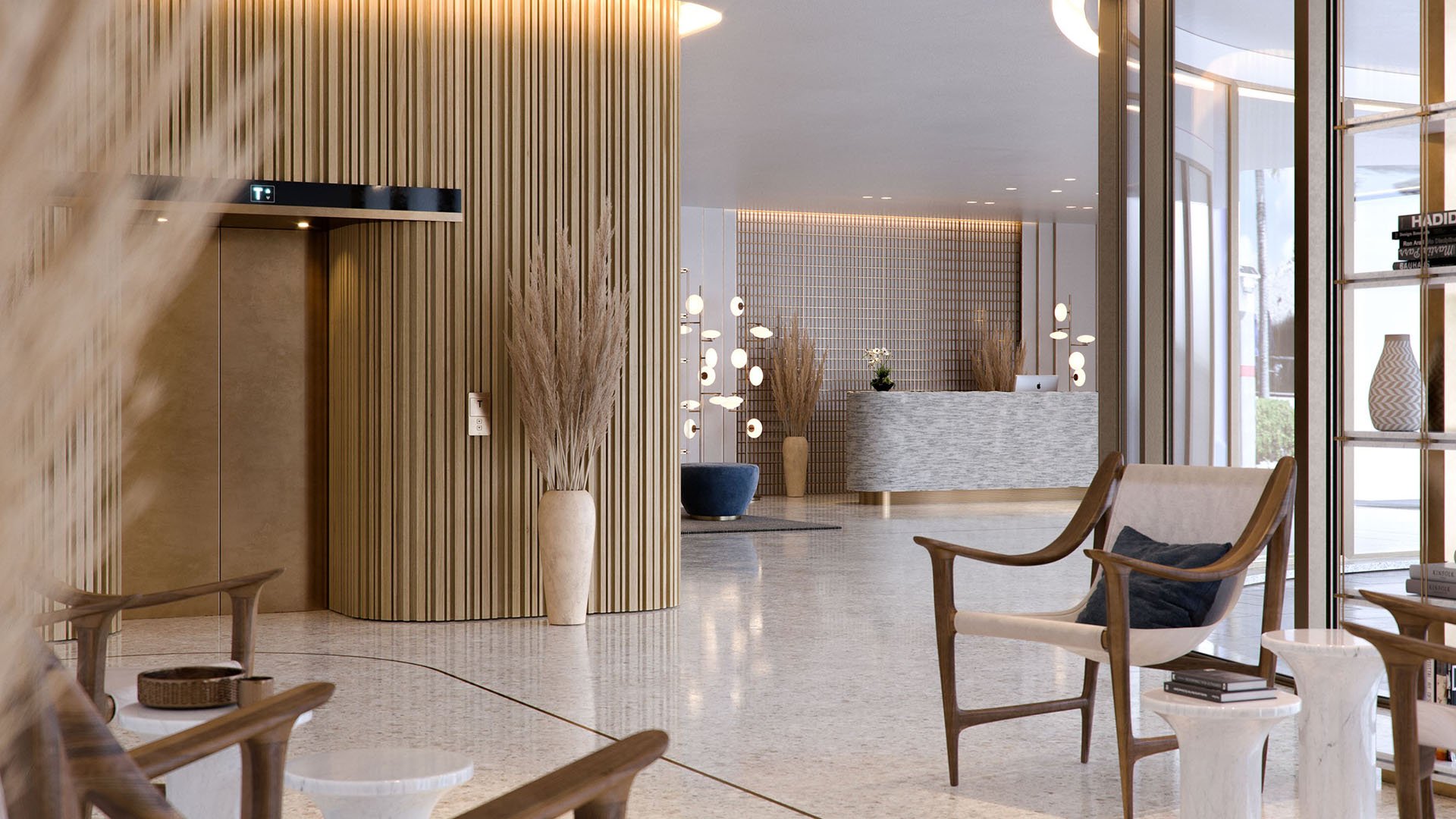
For buyers focused on quiet interiors, a Boca Raton waterfront address is only the beginning of the evaluation. The decisive questions concern the position of the individual residence: its relationship to elevator shafts, service routes, mechanical areas, shared corridors, and public venues.
No unit should be described as protected from operational or public-space noise without property-specific documentation and direct inspection. Marketing terms such as “private elevator” or “private foyer” may describe an arrival sequence, but they do not establish measurable acoustic performance.
Begin with the complete floor plate for each residence under consideration. A unit plan alone may omit the surrounding conditions that matter most. The broader drawing should be reviewed for passenger and service elevators, stairs, refuse areas, utility spaces, loading or delivery paths, and shared amenities on the same level.
The levels immediately above and below also deserve attention. A residence may appear well separated on its own floor while remaining close to an operational room or public venue vertically. Buyers should ask for documents that clarify these relationships rather than relying on a building-wide description.
A direct or controlled elevator arrival can limit time spent in a shared corridor, but the configuration must still be studied in detail. Buyers should determine whether the elevator is dedicated, shared among several residences, or controlled only by access credentials.
The location of the shaft relative to bedrooms and primary living spaces is equally important. Entry-door construction, foyer depth, wall assemblies, and the route used by staff or deliveries can affect the experience. These conditions vary by floor and residence, so conclusions should remain unit-specific.
Service movement deserves a separate review from resident circulation. Ask how deliveries, maintenance personnel, housekeeping, and refuse collection reach the floor. Then trace whether those paths pass the residence entrance or share nearby doors and vertical systems.
Public venues should be examined by both distance and route. A lounge, pool area, fitness space, lobby, or event setting may generate movement through elevators and corridors even when it does not share a wall with the residence. The relevant issue is how people and operations move through the building around the specific home.
A Boca Raton search may include Alina Residences Boca Raton, Glass House Boca Raton, Mr. C Residences Boca Raton, and The Residences at Mandarin Oriental Boca Raton.
These project references are starting points for comparison, not claims about acoustic performance. Each available residence should be assessed through its plans, disclosures, building documents, and in-person conditions.
Schedule more than one visit when possible, with appointments at different times. Spend time at the residence entrance, in bedrooms, and in the main living area while normal building movement occurs. Listen for elevator operation, closing doors, corridor conversations, deliveries, and activity associated with nearby shared spaces.
Inspect the entry threshold and note every wall adjoining a common or operational area. Ask which elevator is used for service activity and how guests reach the floor. If a venue is nearby, examine its access path and hours disclosed in the available property materials.
A specialist may be appropriate when interior quiet is a deciding factor. The goal is not to infer certainty from a project name or amenity description, but to assemble enough unit-level evidence for a measured comparison.
Create a consistent worksheet for every shortlisted residence. Record elevator configuration, corridor exposure, service routing, adjacent rooms, spaces above and below, entry conditions, and observations from each visit. Separate verified documents from statements that still require confirmation.
A strong choice is the residence with the most convincing unit-specific evidence, not necessarily the building with the broadest privacy language. When evidence is incomplete, the conclusion should remain conditional.
Can a private elevator prove that a residence will be quiet? No. Elevator terminology describes access or arrival conditions, not verified acoustic performance.
Which drawing is most useful when reviewing elevator adjacency? Request a complete floor plate that shows the target residence and surrounding building systems.
Why should buyers examine the floors above and below? Vertical adjacencies can reveal operational or shared spaces that are not visible on the residence’s own plan.
Should passenger and service elevators be evaluated separately? Yes. Their routes, usage, and proximity to the residence may differ.
How can public venues affect a residence without sharing a wall? They may create movement through nearby elevators, doors, lobbies, or corridors.
Is one property tour enough to assess interior calm? A single visit may not reflect conditions at other activity levels, so repeat visits can provide a broader view.
Which rooms deserve the closest adjacency review? Buyers prioritizing quiet should pay particular attention to bedrooms, living areas, and the entry foyer.
What should be documented during an inspection? Note elevator operation, corridor activity, service movement, door conditions, and nearby shared spaces.
Can building-wide descriptions replace unit-level analysis? No. Floor, stack, orientation, and adjacency can vary among residences within the same property.
What is the safest way to compare Boca Raton waterfront residences for quiet interiors? Use the same document review and inspection checklist for every candidate, and keep conclusions limited to verified unit-specific evidence.
For a confidential assessment and a building-by-building shortlist, connect with MILLION.
If branded residences are on your mind — as a home or as an allocation — we would be glad to share what we are seeing, privately.
Begin a quiet conversation