Five aviation-oriented property and search options in Miami-Dade, with a collector’s checklist for distinguishing airfield access from genuine lock-and-leave readiness.
For a collector who travels frequently, the most persuasive residence is one that remains composed in the owner’s absence. Airport access matters, but so does the less visible infrastructure: a receiving route that accommodates a crated work, lighting designed around the collection, and environmental controls with a documented response to interruption.
The five options below form an aviation-oriented shortlist, not a certification of museum-grade performance or turnkey management. They represent different ownership strategies: two aviation estates, two airport-led residential searches, and a Downtown Miami tower candidate. Their order is a starting point for selection, not a ranking of verified art-protection systems. Direct airfield connectivity, a private terminal for commercial flights, and an emergency helipad are distinct propositions.
1. Lindbergh’s Landing aviation estate: 17920 SW 154th Street
This South Miami-Dade property offers the shortlist’s clearest home-to-airfield connection: five acres with direct access to Lindbergh’s Landing Airport, identified as FA35. The residential airstrip lies just beyond the backyard, making aviation access the defining reason to investigate the estate.
For an owner seeking departure convenience, that connection deserves attention. It does not establish a staffed, low-maintenance ownership model. Before treating the property as lock-and-leave, confirm airport-use permissions, aircraft suitability, estate-management arrangements and the systems protecting the collection during extended absences.
2. Luxury Aviation Estate at Lindbergh’s Landing: 18105 SW 158th Street
The second estate is another South Miami-Dade candidate associated with FA35. Lindbergh’s Landing is a private, single-runway airport without a control tower or customs facilities. Those characteristics should guide the aviation review before the residential decision advances.
The appeal is an aviation estate rather than merely a home within driving distance of a terminal. Turnkey management and art-protection performance still require property-specific confirmation. Buyers should have their aviation team assess operating permissions and aircraft suitability, rather than equating a private airport with unrestricted private-jet use.
3. MIA private-terminal corridor: a commercial-travel home search
This option is a search strategy, not an identified residence. MIA’s PS private terminal occupies the historic Pan Am headquarters at 4900 NW 36th Street. It serves commercial passengers seeking to bypass public terminals, not owners seeking residential private-aircraft access.
For households that alternate between private aviation and scheduled flights, this can be a useful complementary search. Select the residence on its own management and collection-care merits, then test the ground transfer against actual travel patterns. The terminal experience alone says nothing about a home’s freight access, staffing or environmental resilience.
4. Miami-Opa Locka Executive Airport: a Fontainebleau Aviation-led search
Fontainebleau Aviation operates a 52-acre facility with dual terminal access at Miami-Opa Locka Executive Airport. That provides an aviation anchor for a residential search, not a particular condominium or estate recommendation.
Do not infer residential proximity from the operator’s name or assume a transfer time for an untested address. Start with the aviation arrangements, then evaluate candidate homes individually. Keep airport convenience separate from the equally important questions of receiving logistics, unattended-home oversight and climate-control continuity.
5. Aston Martin Residences: Downtown Miami waterfront
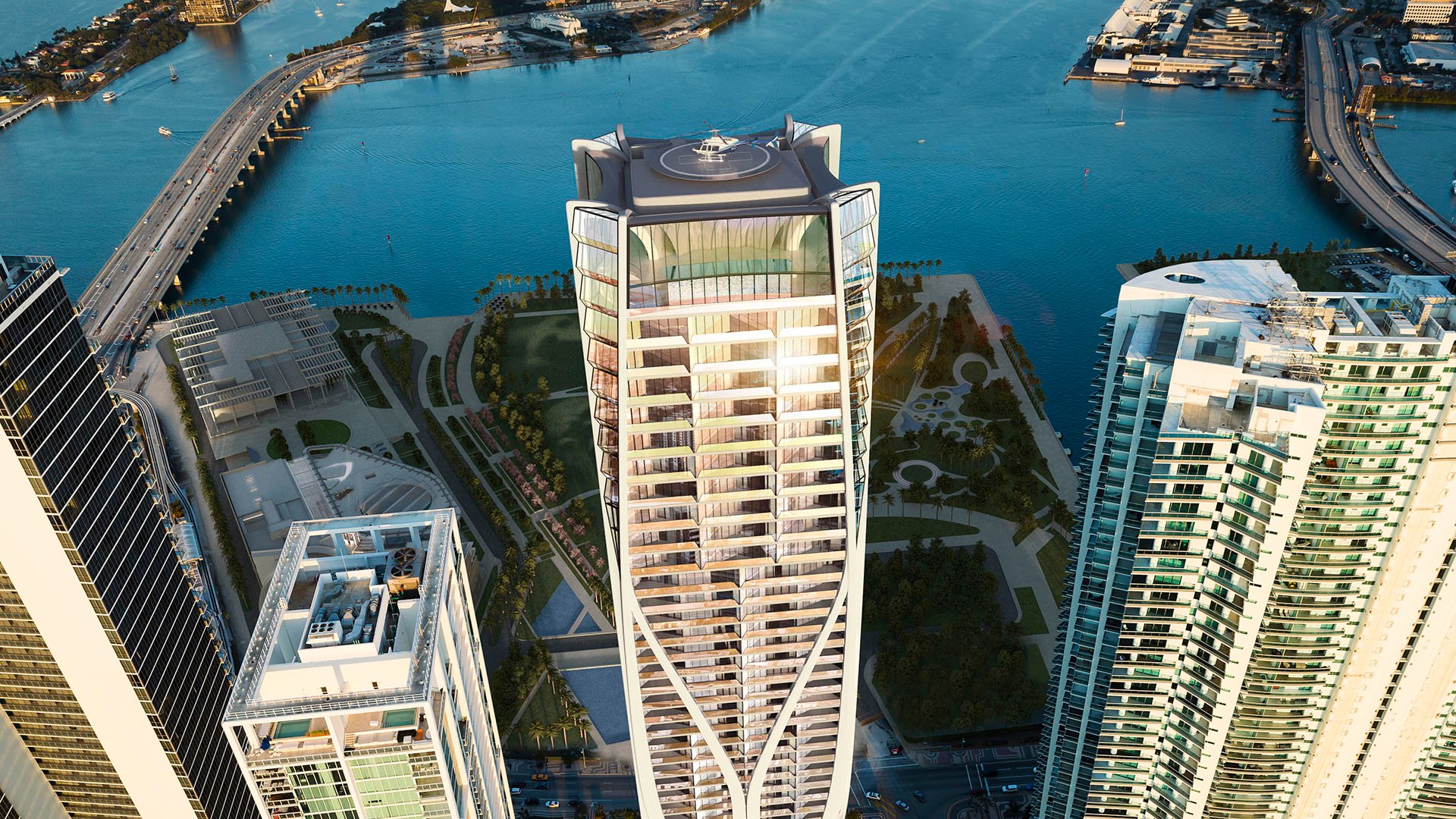
Aston Martin Residences is the shortlist’s named urban-tower candidate, but its rooftop helipad should not be counted as an owner aviation amenity. Its stated use is emergency-services only, with no private residential or owner access; confirm that restriction directly with building management.
Consider the building as a residential option requiring a separate airport transfer. Museum-grade lighting, art-handling provisions and climate-resilience performance require their own documentation. The decisive question is not whether the silhouette suggests aviation convenience, but whether the particular residence and its operating arrangements support extended owner absences.
The two Lindbergh’s Landing properties put estate management at the center of the purchase. Ask for a written scope covering inspections, contractor access, environmental alerts and responsibility when the owner is abroad. A direct airfield connection answers none of those questions.
Evaluate second-home ownership through an absence plan, not simply a departure checklist. Identify who receives an alert, who can enter the property and who can authorize corrective work. For a collection, ask the proposed manager and art adviser to agree on escalation procedures before closing. Do not assume ordinary housekeeping includes collection oversight.
Museum-grade should be a brief to demonstrate, not an adjective to accept at face value. Request lighting specifications and have the collection’s adviser review their suitability for the works intended for display. Ask how daylight, dimming and installation constraints will be addressed in the actual rooms.
If a Brickell search includes The Residences at 1428 Brickell, apply the same brief without assuming the address establishes collection readiness. Compare documented unit-level provisions with the collection’s requirements, not architectural identities. Credit no lighting performance without the relevant specifications.
Ask for service-elevator dimensions and load limits, receiving-route measurements and art-installation rules. Review the entire journey from delivery vehicle to final wall, including doors, turns and any staging location. Approval to receive a work is not evidence that its crate can reach the residence.
For buyers considering Aston Martin Residences Downtown Miami, this operational review should sit alongside the aviation-access clarification. Obtain written handling procedures before scheduling a shipment. Apply the same discipline to an estate, checking access and installation arrangements against the actual work.
Request environmental-control targets and explicit generator coverage for in-unit HVAC. Ask which equipment remains powered during an interruption, how conditions are monitored and who responds when the owner cannot. Assess backup power against the residence’s actual environmental needs rather than treating it as a blanket assurance.
A Coconut Grove comparison involving Park Grove Coconut Grove should use the same questions; inclusion in a search does not establish those capabilities. Seek a documented operating plan rather than inferring resilience from positioning or presentation.
The strongest purchase is the one whose aviation arrangements, management responsibilities and collection-care requirements work together. Confirm current availability and access permissions, then make the technical review part of the buying decision-not a post-closing project.
For a discreet residential search shaped around your aviation routine and collection, connect with MILLION.
If branded residences are on your mind — as a home or as an allocation — we would be glad to share what we are seeing, privately.
Begin a quiet conversationNo. The shortlist includes two aviation estates, two airport-led search strategies and one urban tower candidate; management and art-protection capabilities require individual confirmation.
The five-acre estate at 17920 SW 154th Street has direct access to Lindbergh’s Landing Airport, with the airstrip described as just beyond the backyard.
The second aviation-estate candidate is at 18105 SW 158th Street, Miami, FL 33187.
No. FA35 is identified as a private, single-runway airport without a control tower or customs facilities.
No. PS serves commercial passengers seeking to bypass public terminals; it is not a residential private-aircraft access service.
It operates at Miami-Opa Locka Executive Airport, with a facility described as spanning 52 acres and offering dual terminal access.
The helipad is described as emergency-services only, not available for private residential or owner access. Confirm the restriction with building management before making an aviation-related purchase decision.
Request lighting specifications and have the collection’s adviser assess their suitability for the intended works. Review daylight, dimming and installation constraints in the actual residence.
Request service-elevator dimensions and load limits, receiving-route measurements and installation rules. Check the complete route against the dimensions of the crated work.
Confirm environmental-control targets and whether generator coverage includes in-unit HVAC. Establish how conditions are monitored and who responds during the owner’s absence.