A buyer-focused shortlist of five Brickell-area residential options, distinguishing coastal-resilience obligations and hurricane planning from the building records and school-route checks families should obtain before purchasing.

For a family coordinating private-school life, a Brickell residence must answer questions beyond layout, views and service. Can the household leave safely when required? Which systems remain available during a power interruption? What records distinguish coastal-maintenance obligations from completed work?
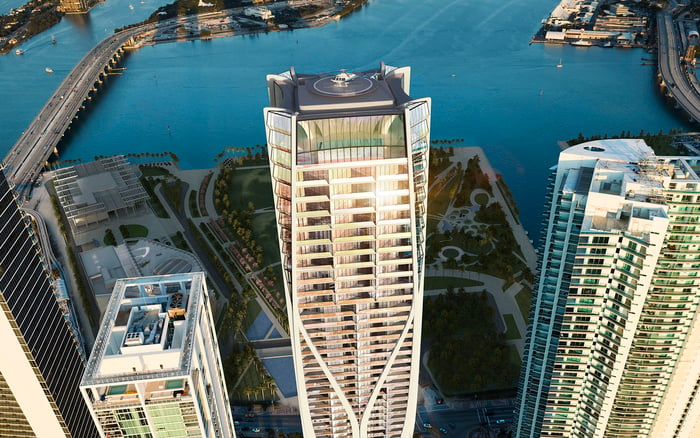
The five selections below offer different starting points for that review. Inclusion does not certify superior wind resistance, uninterrupted access or current unit availability. Brickell Key is an island-wide residential category rather than a single condominium; Aston Martin Residences is a Brickell-adjacent option. Building performance and available inventory require individual confirmation.
Families considering Aston Martin Residences Downtown Miami should separate the address’s appeal from the evidence needed to support an offer. The same discipline applies throughout this shortlist: architectural distinction and operational readiness are separate considerations.
1. Brickell Key residences: island-level coastal obligations
Brickell Key merits attention for documented island-level coastal-resilience planning. A coastal-resiliency study is listed for the island, and its seawall is subject to annual inspection and maintenance requirements intended to provide protection against a 100-year flood. These are meaningful subjects for due diligence, not confirmation that every obligation has been fulfilled.
For families, the next step is condominium-specific. Request the latest applicable seawall inspection findings, repair closeouts, funding responsibilities and resident-reentry procedures. Neither an island study nor an inspection requirement establishes uninterrupted bridge access. Evaluate the chosen building and the journey off the island separately.
2. Aston Martin Residences: Brickell-adjacent consideration
Aston Martin Residences belongs in this search as a Brickell-adjacent candidate, not a verified leader in storm performance. General descriptions of newer neighborhood towers and hurricane-impact glazing cannot establish this residence’s wind rating, envelope condition or post-storm services.
Before relying on it to support household continuity, obtain property-specific wind-mitigation documentation and written emergency-operation procedures. Ask which systems function during an outage, which services stop and who authorizes resident return. A premium address warrants the same scrutiny as every other candidate.
3. Bristol Tower: Brickell Avenue diligence candidate
Bristol Tower is the shortlist’s Brickell Avenue candidate for a close review of essential-system continuity. Its inclusion is not evidence of superior access or resilience. The relevant diligence standard is backup generation for essential lighting, elevators and emergency exits, supported by regular testing.
Request the generator load schedule, testing history and fuel-duration assumptions-not simply an assurance that backup power exists. For a household organizing school departures, establish which elevators and access systems are covered and what restrictions management may impose after a storm.
4. Echo Brickell: building-specific verification first
Echo Brickell is another Brickell Avenue candidate whose suitability depends on building-specific records. Neighborhood-wide discussion of stringent codes and hurricane-impact glazing cannot substitute for this tower’s glazing specifications, maintenance history or operational procedures.
Review wind-mitigation records alongside flood and elevation documentation, insurance terms and applicable coastal-maintenance obligations. Keep three questions distinct: how the envelope is specified, how it has been maintained and how the building plans to restore services. An answer to one does not resolve the others.
5. Solaris at Brickell Bay: published hurricane planning
Solaris at Brickell Bay has documented hurricane procedures dated August 2025. They identify building personnel and separate office and front-desk contacts, demonstrating an established communication framework.
That framework is useful for families coordinating instructions across parents, caregivers and household staff. It does not establish generator coverage, uninterrupted habitability or a reopening deadline. Request the current procedures and confirm how residents receive updates when normal communications are disrupted.
The Brickell Bay Drive resiliency project is intended to address future storm surge and sea-level rise while improving waterfront connectivity, open space and the natural environment. Plans call for an eight-foot seawall to replace an existing 4.2-foot wall. Those dimensions describe planned work, not completed construction or verified protection at a particular residence.
Likewise, the separate Brickell and Coconut Grove seawall project covers three seawalls in the Fair Isle and South Grove Bayside neighborhoods. Its name is not evidence of work at an unrelated Brickell address.
When comparing the shortlist with Una Residences Brickell, maintain the same distinction: neighborhood infrastructure, condominium responsibilities and unit-level exposure belong in separate review files. A nearby public improvement does not establish a building’s maintenance condition or emergency readiness.
A school-access decision should begin with the family’s actual destinations and schedules, not a general impression of proximity. Confirm admissions independently, then test the ordinary morning journey and a practical alternate route. Include the time needed to leave the residence and reach the vehicle-not just the drive from the curb.
Keep routine convenience distinct from post-storm access. Ask management how garage reopening, elevator restrictions and resident reentry are communicated. Ask each school separately about closure notices and reopening procedures. Neither a residential hurricane manual nor a coastal-protection requirement certifies the full school journey.
For families also considering 2200 Brickell, apply the same route-testing exercise without presuming an advantage. Compare documented household routines, not unmeasured commute claims.
Before advancing an offer, organize the review around three questions: what is protected, what remains operational and what maintenance has actually been completed?
Wind and water: Obtain current wind-mitigation records, glazing documentation, flood and elevation documents, and relevant insurance records. Have qualified advisers explain what each document establishes.
Essential operations: Request generator loads, testing records, fuel-duration assumptions and resident-reentry procedures. Clarify which systems are covered rather than assuming backup power serves the entire residence.
Coastal stewardship: Review applicable inspection findings, completed repairs, outstanding work and assessments. Distinguish requirements and planned work from documented completion.
For the family buyer, the strongest choice is the residence whose records support both the ownership decision and a realistic contingency plan. Brickell Key’s coastal obligations and Solaris’s published procedures provide different kinds of evidence; neither replaces a complete building review. Hold every candidate to that same standard.
For a tailored residential search aligned with your family’s priorities, connect with MILLION.
If branded residences are on your mind — as a home or as an allocation — we would be glad to share what we are seeing, privately.
Begin a quiet conversationNo. The shortlist does not establish comparative engineering performance, and each building requires an individual review of wind, flood, maintenance and emergency-operation records.
No. Current inventory must be confirmed separately for the selected building and residence.
Brickell Key has documented island-level coastal-resilience planning and seawall maintenance and annual-inspection requirements. These do not establish the condition of an individual condominium.
No. Coastal-protection obligations do not establish uninterrupted bridge access or a guaranteed post-storm departure route.
Its hurricane procedures dated August 2025 identify building personnel and separate office and front-desk contacts. This demonstrates communication planning, not verified backup-power coverage or reopening time.
Plans call for an eight-foot seawall replacing an existing 4.2-foot wall. This does not establish completed construction.
No. Wind-protection specifications and the ability to operate elevators, access systems and other essential services are separate questions requiring building-specific documentation.
Request the generator load schedule, testing records and fuel-duration assumptions. Confirm which essential systems are covered rather than assuming every elevator or residence receives power.
Confirm admissions independently and test the actual morning journey and an alternate route. Coordinate school closure communications with building reentry and service-restoration procedures.
Review applicable inspection findings, completed repair documentation, outstanding work and assessments. A maintenance requirement or proposed improvement is not proof that work has been completed.