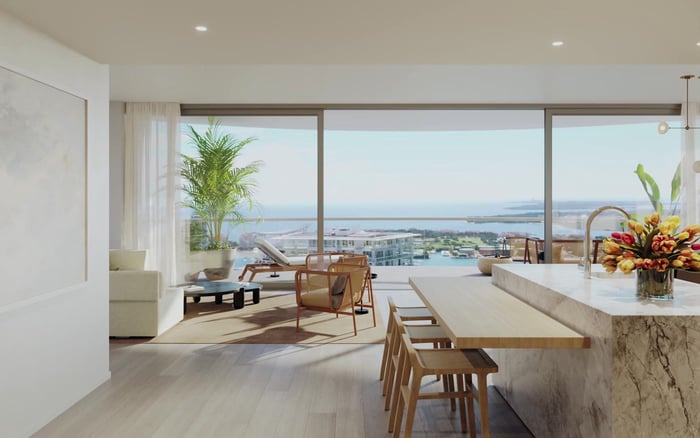
Private dining can be a compelling extension of a South Florida home, but access depends on more than an amenity rendering. Buyers should examine governance, reservations, guest rules, service arrangements, costs, privacy, and completion status before relying on the space for Miami Art Week entertaining.

For buyers who entertain during Miami Art Week, a private dining room can feel almost as consequential as the residence itself. It may provide a polished setting for a collector dinner, a quiet breakfast before the fairs, or an intimate evening without the logistics of a restaurant reservation. Yet “private dining access” can describe markedly different arrangements.
The first question is not how the room looks, but what the purchaser is actually entitled to use. Ask whether access is established in the condominium documents, controlled through house rules, offered by a hotel or club operator, or presented as a service that management may later modify. A beautiful rendering does not establish ownership, priority, availability, or operating standards.
This is the central principle of a buyer’s guide review: separate the physical room from the legal and operational framework surrounding it. A useful lifestyle amenity is one that can be reserved, serviced, and enjoyed on terms aligned with the buyer’s expectations.
Reservation mechanics warrant close attention. Buyers should request the current or proposed booking policy, including advance windows, minimum and maximum reservation periods, cancellation terms, blackout dates, and any priority system. Clarify whether all owners receive equal access, whether certain residence categories have preference, and whether management may close the room for building events or private functions.
Miami Art Week offers an especially useful stress test. Ask management to explain how it would handle simultaneous requests during a high-interest period. If your intended dinner has a fixed date, determine whether the reservation can be confirmed months in advance or only within a shorter rolling window. Also ask whether an owner may hold multiple dates while plans are finalized.
Do not assume concierge assistance guarantees availability. The distinction between arranging a request and securing a reservation should be explicit.
A dining room without an operating plan may leave the owner coordinating every detail. Ask whether food must come from an approved provider, whether outside chefs and caterers are permitted, and which party supplies servers, tableware, linens, flowers, and post-event cleaning. Confirm access to preparation areas, refrigeration, warming equipment, storage, and waste removal without assuming any of these elements are included.
Alcohol service warrants separate scrutiny. Determine what the building permits, whether a licensed provider is required, and whether outside bottles may be brought into the space. Ask who bears responsibility for compliance, staffing, breakage, and damage.
Buyers comparing hospitality-oriented concepts such as Cipriani Residences Brickell and ORA by Casa Tua Brickell should seek project-specific written answers rather than infer services from branding or design language. Branded residences can differ materially in how residential amenities are governed and delivered.
Private dining succeeds only when guests can arrive gracefully. Ask where vehicles are received, how names are cleared with security, whether invitations must be submitted in advance, and how guests reach the room without entering resident-only areas. Confirm guest-count limits and whether vendors, assistants, drivers, photographers, or security personnel count toward the total.
Evaluate privacy in practical terms. Is the route discreet? Can others reserve adjoining spaces at the same time? Are sound, music, photography, and décor subject to restrictions? If artwork or valuable objects will be displayed, ask about installation rules, security oversight, insurance requirements, and removal deadlines.
Location also shapes the evening. A buyer considering Miami Beach options such as Shore Club Private Collections Miami Beach should map the entire guest journey, not merely assess the dining room. In Brickell, the same exercise should account for arrival timing, service-elevator procedures, and vendor loading rules.
Present an Art Basel entertaining plan to the sales team or management as a concrete scenario. Specify the anticipated guest count, preferred date and hours, catering format, alcohol service, music, floral installation, photography, and required setup time. Then request a written explanation of what is permitted, who grants approval, and which costs may apply.
The response can reveal whether the amenity accommodates spontaneous hosting or demands substantial lead time. It can also expose dependencies, including operator approval, staffing availability, deposits, insurance certificates, or limits on outside vendors. These are not minor details when a dinner is tied to invitations, art advisers, chefs, or travel schedules.
For an Edgewater comparison, Villa Miami can be included in the same diligence process. The objective is not to presume equivalence among projects, but to compare written access terms on a consistent basis.
Before signing, identify every representation that materially influenced the purchase. Request the governing documents, amenity rules, fee schedules, management agreements when available, and the projected completion or activation status of the dining space. Ask counsel to assess whether access is appurtenant to ownership, subject to change, or dependent on a separate membership or operator.
If the residence is not yet complete, clarify what happens if the dining venue opens after the home, changes design, adopts different rules, or remains unavailable during the buyer’s intended stay. Material assurances should appear in the appropriate contract materials rather than remain conversational.
Finally, establish a fallback plan. Even a carefully managed room may be unavailable because of maintenance, private programming, or competing demand. A residence that works beautifully without the amenity offers the strongest foundation; private dining should elevate ownership, not carry the entire entertaining strategy.
Does a private dining room automatically belong to the condominium association? Not necessarily. Buyers should verify ownership, control, and access rights in the applicable documents.
Can an owner reserve the room for Miami Art Week far in advance? That depends on the booking policy. Request the advance window, priority rules, and blackout dates in writing.
Are outside chefs usually permitted? Policies vary. Confirm approved-vendor requirements, insurance, kitchen access, staffing, and cleanup obligations.
Should concierge service be treated as a reservation guarantee? No. Clarify whether the concierge can confirm a booking or merely submit and coordinate a request.
What fees should a buyer investigate? Ask about room charges, deposits, staffing, cleaning, security, corkage, equipment, damage, and cancellation costs.
Can guests enter without the owner accompanying them? Access rules differ. Confirm pre-clearance procedures, escort requirements, arrival routes, and limits on unaccompanied guests.
Do vendor personnel count toward the guest limit? They may. Obtain a definition covering caterers, servers, photographers, musicians, assistants, and private security.
What should pre-construction buyers request? Request written details on control, anticipated rules, service scope, fees, opening status, and the right to modify amenities.
How can privacy be evaluated before purchase? Walk the arrival route and ask about adjoining bookings, sound rules, photography, surveillance, and resident-only circulation.
What is the most important question to ask? Ask whether the promised experience is an enforceable ownership benefit or a changeable operational privilege.
When you're ready to tour or underwrite the options, connect with MILLION.
If branded residences are on your mind — as a home or as an allocation — we would be glad to share what we are seeing, privately.
Begin a quiet conversation