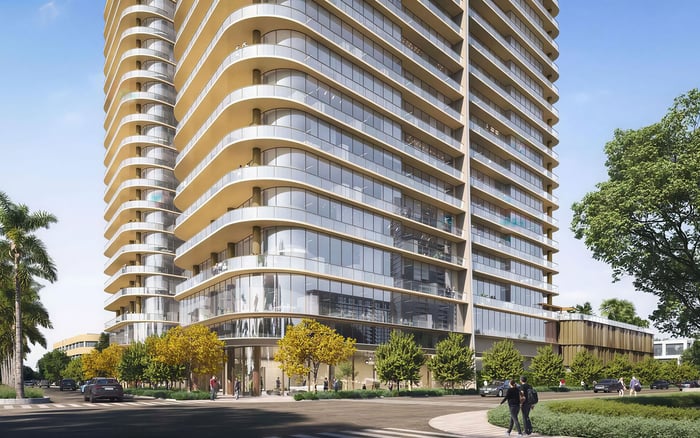
Conflicting completion dates for Miami Tropic Residences make timing a central purchase consideration. Buyers coordinating a domicile transition or school-year move should separate their construction investment from their occupancy plan, with contract review and independently verified housing arrangements.

For a family considering Miami Tropic Residences, the most consequential question may not be which floor or exposure to select. It may be whether the residence can accommodate a move tied to a school opening, a change of domicile or the sale of an existing home. Those decisions require more precision than an advertised completion year provides.
Jean-Georges Miami Tropic Residences is marketed as a 48-story, 329-residence condominium from Terra and Lion Development Group, with architecture by Arquitectonica and interiors by Yabu Pushelberg. Its design credentials belong in the purchase evaluation. They do not resolve the separate question of when a particular buyer can occupy a residence.
The disciplined approach is to make two distinct decisions: whether to purchase the future home, and how to house the family on its required timetable. The second should remain workable if the first takes longer than expected.
Public completion estimates are inconsistent. They include 2028 and a more specific Q2 2028 estimate, as well as 2027 and a delivery window between Q4 2027 and Q1 2028. Another estimate points to 2029. A 2028 completion date also appears alongside language projecting delivery in 2030 and beyond.
These discrepancies establish inconsistent public information, not a verified sequence of developer-announced delays. Nor do they establish a dependable delivery window. Treating the earliest date as a promise would be imprudent; treating the latest as a confirmed revised schedule would be equally unsupported.
Even the advertised street address varies, with both 3501 NE 1st Avenue and 3600 NE 1st Avenue appearing. Confirm the property's legal identification and address against the purchase documents rather than carrying marketing details into legal or school paperwork.
Before committing, request a dated written schedule from the developer and ask counsel to distinguish the current estimate from contractual obligations. Separate anticipated construction completion, the closing process and the point at which occupancy will actually be available. The objective is clarity about each milestone, not simply a more reassuring year.
A condominium purchase should not be treated as proof of a completed domicile transition. Neither paying deposits nor reaching closing should be assumed sufficient to resolve Florida domicile, homestead eligibility or obligations connected with a former state.
For a household coordinating its move with a particular tax year, the practical question is what the plan depends on. If it requires living in this residence by a fixed date, an uncertain completion schedule becomes a weakness in the broader strategy. Ask qualified legal and tax advisers to assess the proposed transition independently of the sales timetable.
That review should address the household's actual circumstances and any alternative housing arrangement under consideration. Do not assume that an interim lease automatically satisfies every relevant requirement. Advisers should evaluate the home the family can actually use, rather than a future residence whose occupancy remains contingent.
Keep the purchase file and relocation plan distinct. One concerns a contractual investment; the other concerns where the household will live and the requirements its advisers identify.
A completion year is too broad to anchor a child's first day of school. Even a quarterly estimate cannot, by itself, establish that a residence will be available for the family's intended move.
Begin with the chosen school's requirements and the household's latest workable relocation date. Confirm attendance boundaries where relevant, acceptable residency documentation, enrollment deadlines and any admissions conditions directly with the appropriate school or district. A future condominium purchase should not be assumed to establish eligibility, secure admission or reserve a place.
Then evaluate ready-to-occupy interim housing separately from the condominium purchase. Verify its availability for the intended period, its suitability for the household and its practical relationship to the school. An advertised property is not confirmation that the family can occupy it when needed.
There is no supported universal buffer to apply here. Instead, identify the point at which the family must secure another home if occupancy remains uncertain. The benefit is continuity: a child's school arrangements need not depend on the tower meeting a marketing estimate.
An advertised payment schedule calls for 10% at contract, 10% after 90 days, 10% at groundbreaking and 10% at top-off, with 60% due at closing. The staged payments total 40% before closing. These are advertised terms, not a substitute for the agreement presented to a particular purchaser.
The distinction matters because substantial capital may be committed before the residence is available to occupy. Ask counsel to verify the actual deposit obligations and milestone definitions. Your liquidity plan should accommodate those obligations alongside any interim housing and relocation costs you choose to undertake.
Counsel should also review the contract's provisions for delivery, extensions, closing notices and remedies. Ask whether cancellation rights, refunds or limits on extensions exist, and under what conditions. Do not presume that a missed advertised year creates a right to exit, or that deposits can be transferred to another property.
A comparison with Cipriani Residences Brickell should begin with the same question: what independently confirmed occupancy information supports the household's required move? A compelling alternative is not automatically a solution to a timing constraint. Its documents and availability need separate review.
Likewise, buyers considering Four Seasons Residences Coconut Grove should distinguish long-term residential preference from near-term relocation suitability. Neither a neighborhood choice nor a project name establishes school access, admission availability or delivery certainty.
Apply a consistent comparison framework across the shortlist: verified occupancy expectations, contractual commitments, capital required before closing and the cost of maintaining flexibility. This keeps the evaluation focused on the family's constraints, rather than allowing an appealing design presentation to substitute for timing evidence.
The strongest strategy does not require rejecting Miami Tropic Residences because public dates conflict. It requires understanding which parts of the family's plan can tolerate uncertainty and which cannot.
Before proceeding, assemble a written developer timing update, counsel's assessment of the agreement, a separately advised domicile plan and school-specific guidance. If the family must relocate before occupancy is confirmed, secure suitable housing on its own merits. Revisit the plan as construction and contractual milestones become clearer.
A future home can remain an attractive purchase without becoming the single dependency behind a tax transition or academic year. Preserving that distinction protects the household's freedom to choose the residence for the right reasons.
For a considered approach to South Florida residences and relocation priorities, connect with MILLION.
If branded residences are on your mind — as a home or as an allocation — we would be glad to share what we are seeing, privately.
Begin a quiet conversationSeveral public listings identify 2028, but other published estimates differ. An advertised year should not be treated as a guaranteed occupancy date.
No. They establish inconsistent public information, not a verified sequence of developer-announced schedule changes.
The project is marketed as a development by Terra and Lion Development Group, with architecture by Arquitectonica and interiors by Yabu Pushelberg.
Miami Tropic Residences is marketed as a 48-story tower with 329 residences.
Public listings show both 3501 NE 1st Avenue and 3600 NE 1st Avenue. Confirm the address and legal property identification against purchase documents before using either in formal paperwork.
A purchase or closing should not be assumed sufficient to establish domicile or resolve homestead and former-state obligations. Qualified legal and tax advisers should assess the household's circumstances.
A completion estimate does not establish occupancy, enrollment eligibility or admission availability. Confirm school-specific requirements directly and arrange housing that supports the intended move.
One advertised schedule calls for four 10% installments at contract, after 90 days, at groundbreaking and at top-off, followed by 60% at closing. Counsel should verify the terms in the purchaser's actual agreement.
Do not assume that an advertised date creates a cancellation or refund right. Counsel should review delivery obligations, extension provisions and any remedies in the purchase agreement.
There is no supported universal buffer. Base interim housing decisions on confirmed availability, school requirements, adviser guidance and the household's latest workable relocation date.