A disciplined comparison of Bay Harbor Islands and North Bay Village starts with total carrying costs, moves to contractual owner rights, and only then weighs the appeal of branded service and waterfront amenities.

The choice between Bay Harbor Islands and North Bay Village is not simply a contest between residential restraint and branded hospitality. For a discerning buyer, the more useful distinction is between what a residence promises, what ownership costs, and what owners can actually decide.
A polished arrival and a waterfront outlook may establish desire. Neither reveals the association’s financial resilience, the duration of a management agreement, or the voting threshold required to change services. Begin with total carrying cost, verify owner rights, and then decide whether the service offering earns its premium.
That sequence avoids two misleading shortcuts: assuming lower municipal taxes mean lower overall expenses, or treating restrictive zoning as evidence of stronger owner control.
The 2025 adopted municipal millage rates were 3.4583 mills for Bay Harbor Islands and 5.7062 mills for North Bay Village. These are municipal components, not combined property-tax rates. Other tax components fall outside this comparison.
For 2026, Bay Harbor Islands’ proposed municipal rate is 3.9000 mills, a proposed 12.77% increase from its 3.4583 reference rate. North Bay Village’s proposed municipal rate is 7.0000 mills, against a 5.7062 reference rate. Proposed figures are not adopted obligations.
For a residence under consideration at Bay Harbor Towers, request a property-specific tax estimate alongside the association budget. Apply the same discipline across the bay. A municipality’s relative tax advantage provides context, but it cannot settle the annual ownership calculation.
Build that calculation from taxes, association dues, unit-level insurance, separately billed services, and any applicable financing costs. Identify assessments and anticipated capital obligations separately, rather than letting them disappear inside a reassuring monthly headline.
In a September 6, 2026 snapshot of listed condominiums, Bay Harbor Islands’ median monthly association fee was $1,800, with the middle half between $1,125 and $3,300. The median monthly fee per square foot was $1.30, and the median residence size was 1,420 square feet.
The corresponding North Bay Village snapshot covered 134 listed condominiums. Its median monthly fee was $866, with the middle half between $786 and $1,201. The median monthly fee per square foot was $0.94, and the median residence size was 1,030 square feet.
These figures resist a simple cost verdict: Bay Harbor Islands had lower adopted municipal millage but higher median association fees in these samples. Neither sample was a luxury-only comparison or an audited operating budget, and the different unit sizes matter.
Building age also changes the picture. Within the North Bay Village sample, buildings completed since 2005 had a $1,750 median monthly fee, compared with $829 for buildings completed before 1995. That difference does not establish which group is better funded or less exposed to future assessments.
If Shoma Bay North Bay Village is on the shortlist, its own budget and service obligations should drive the comparison-not the town’s $866 median. Compare equivalent residence sizes and included services, then examine reserves and capital needs before deciding that a lower fee represents better value.
Evaluate brand appeal separately from the operating model. Ask what the name signifies contractually, who provides the services, and which expenses owners must support. Translate each marketing promise into a specific question for document review.
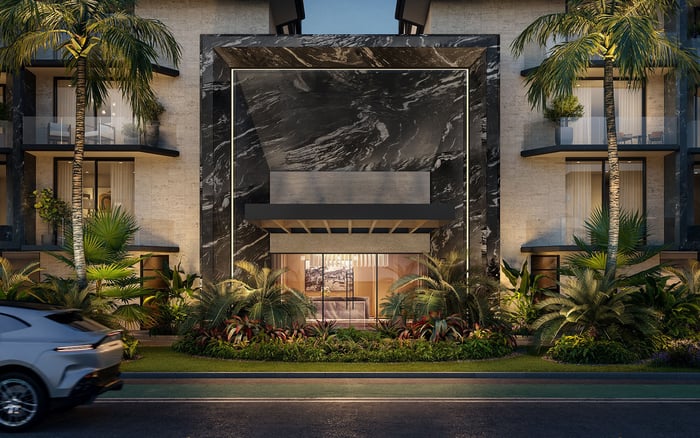
Pagani Residences in North Bay Village is marketed with valet parking, a porte-cochère, 24/7 concierge, a waterfront lobby, and a private marina with boat slips. Its advertised waterfront offering also includes a 240-foot boardwalk. These are advertised features, not proof of delivery, included access, or the terms of any brand agreement.
Bay Harbor Islands also has service-oriented examples. La Baia at 9221 E Bay Harbor Drive, unit 412, is advertised with 24/7 concierge, guest valet, a rooftop pool, wellness facilities, a private marina, and a club lounge. The quoted $2,551 monthly HOA charge applies to that unit; it is not a building-wide or town-wide benchmark.
When considering Continuum Club & Residences North Bay Village, apply the same contractual scrutiny: request service schedules, management terms, and the allocation of mandatory versus optional charges. Do not infer those terms from branding alone.
A marina can be central to the ownership experience, but “private marina” does not establish a particular buyer’s rights. Verify slip availability, eligibility, allocation, recurring charges, and any restrictions affecting the intended vessel. Establish whether access is included, separately purchased, or governed by another agreement.
For a buyer evaluating Onda Bay Harbor with boating in mind, resolve these questions before assigning value to any waterfront-related offering. The same principle applies to valet, wellness access, and guest privileges: value the documented entitlement, not merely the amenity description.
Bay Harbor Islands’ multifamily zoning distinguishes waterfront RM-1 sites from non-waterfront RM-2 sites and sets controls including minimum unit sizes and height limits. Its residential zoning excludes hotels, motels, condo-hotels, and interval-ownership timeshare units from allowable residential uses.
North Bay Village’s framework includes RM-40 medium-density and RM-70 high-density multifamily districts. Its January 2023 RM-70 planning framework provides for 70 units per acre, with exceptions involving transfers of development rights. Neither framework should be treated as a universal development entitlement for every parcel.
More importantly, zoning does not establish owner voting power. It does not tell a buyer when developer control ends, whether a management agreement can be changed, or how shared expenses are allocated.
Review the declaration, voting provisions, current budget, reserves, assessments, board minutes, renovation rules, and service contracts. Ask counsel to identify who can approve changes, the required thresholds, and any contractual limits on those decisions. Owner autonomy must be established at the building level.
Bay Harbor Islands requires vacation rentals to comply with town procedures and applicable state law. Its residential-use exclusions do not establish a blanket vacation-rental ban. Municipal requirements and building-specific rental restrictions require separate review.
For a seasonal owner, confirm rental periods, approval procedures, guest access, and renovation rules against the intended pattern of use. Then make the final comparison in order: all-in cost, documented control, and service value. The stronger purchase is the residence whose obligations and privileges fit the buyer-not the town that wins a single headline metric.
For a tailored comparison of residences and ownership priorities, connect with MILLION.
If branded residences are on your mind — as a home or as an allocation — we would be glad to share what we are seeing, privately.
Begin a quiet conversationBay Harbor Islands had a municipal rate of 3.4583 mills, compared with North Bay Village’s 5.7062 mills. These figures exclude other property-tax components.
No, the 3.9000 mills for Bay Harbor Islands and 7.0000 mills for North Bay Village are proposed rates in this comparison.
The September 6, 2026 listing snapshot showed a $1,800 median, with the middle half between $1,125 and $3,300. It was not a luxury-only sample or an audited budget comparison.
The September 6, 2026 snapshot of 134 listed condominiums showed an $866 median. The middle half ranged from $786 to $1,201.
No, a specific residence’s budget, included services, reserves, and contractual obligations are more relevant than a dated townwide listing snapshot.
No, compare included services, reserves, assessments, and capital needs before interpreting a lower monthly fee as a financial advantage.
No, voting rights, developer control, and the ability to change management depend on building-level documents and applicable requirements, not zoning alone.
The residential-use exclusions discussed here do not establish a blanket ban. Vacation rentals must comply with town procedures and applicable state law, while building restrictions require separate review.
No, buyers should verify availability, allocation, eligibility, charges, and the agreement governing access before assigning value to a slip.
Review the declaration, voting provisions, current budget, reserves, assessments, board minutes, rental and renovation restrictions, and service contracts. Confirm that the resulting costs and rights match the intended use.