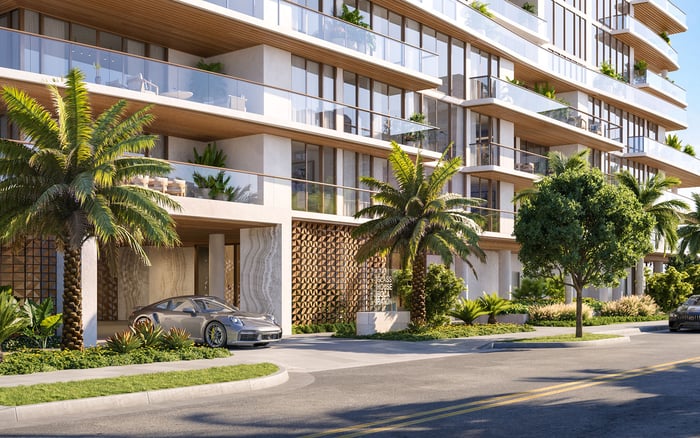
A buyer-focused framework for evaluating discreet security from vehicle arrival through private residential access, including circulation, staffing, technology, governance and emergency resilience.

At an ultra-premium address, the most effective protection is often the least theatrical. It should guide vehicles, residents, guests, deliveries and staff along carefully managed paths without making daily life feel institutional. Buyers evaluating The Residences at Mandarin Oriental Boca Raton should examine that distinction closely before making a reservation.
The relevant question is not simply whether cameras, guards or credentials are planned. Buyers should assess security as a continuous experience, extending from the vehicle approach to the private residence. Because technical specifications and operating protocols may evolve before completion or occupancy, expectations should be confirmed through current offering documents, condominium disclosures and written developer materials.
This is especially important with pre-construction purchases, where a polished presentation may precede final operating details. Branded residences can offer a compelling lifestyle proposition, but branding alone should never be treated as a guarantee of any particular security protocol.
A discreet-security audit begins before the valet opens the door. Study how vehicles are expected to enter the property, where they will pause, how the arrival area will be arranged and what will occur during the valet handoff. Ask who can observe arrivals, how keys and vehicles will be controlled, and what will prevent an unverified person from moving beyond the drop-off zone.
Circulation deserves particular attention. Buyers should determine whether residents and other visitors will have separate arrivals, lobbies or onward routes. Any separation should be operationally clear, allowing residents to understand where public-facing space ends and controlled residential space begins.
The same arrival analysis is useful when comparing other Boca Raton options, including Alina Residences Boca Raton and Glass House Boca Raton. The objective is not to assume equivalent systems, but to apply consistent questions to every property under consideration.
Elevator security is a central due-diligence issue. Request a clear explanation of how credentials are expected to restrict access to residential floors, how visitors will receive authorization and what will happen when a credential is lost, copied or deactivated. Buyers should also ask how unauthorized following into a controlled elevator or corridor is expected to be addressed.
Service movement warrants equal scrutiny. Confirm whether housekeeping, maintenance personnel, vendors and delivery teams are intended to use routes separate from resident corridors and elevators. Then examine where those routes will reconnect with private areas and how access will be recorded, supervised or limited by time and destination.
The analysis should continue to the residence door. Ask how guest approvals, deliveries and service appointments will move through the system, and whether residents will be able to review or revoke permissions. Buyers considering another branded proposition, such as The Residences at Mandarin Oriental, Miami, can apply the same end-to-end test without presuming that two properties will operate identically.
Technology is only one layer. Security also depends on operating procedures, staff judgment and consistent conduct. Privacy-sensitive owners should ask how personnel will be trained to resist social-engineering attempts, including callers or visitors who use familiarity, urgency or partial personal information to seek access or confirmation.
Confidentiality extends beyond the lobby. Buyers should ask whether staff protocols will prohibit casual disclosure of an owner’s presence, travel, guests or routine. Residents with heightened privacy concerns may also wish to discuss safeguards against stalking, travel-pattern exposure and targeted burglary. The goal is disciplined handling of personal information.
Visitor, vendor and delivery procedures should be tested through practical scenarios. Ask what will happen when a guest arrives early, a driver presents an unfamiliar name, a vendor requests access outside an approved window or a delivery cannot be accepted directly. Specific written answers are more useful than broad assurances.
Connected building systems create another line of inquiry. Buyers should ask which systems will be connected, how residential credentials will interact with building technology, who will administer permissions and how access will be removed when staff or vendors change. Cybersecurity should be considered alongside physical access because digital systems may handle identity, occupancy or movement data.
Emergency resilience is equally material. Review the planned approach to backup power, communications continuity and procedures during system outages. Ask how doors, elevators, visitor verification and resident notifications will be handled if primary systems fail. Any response should account for life safety, controlled access and practical egress.
Finally, clarify responsibility. Buyers should understand who will set policy, employ or supervise personnel, maintain technology and respond when a protocol fails. Written allocation is more useful than an assumption based on the name above the entrance.
Before making a reservation, request written confirmation of the planned arrival sequence, access boundaries, elevator-access logic, service circulation, visitor and delivery procedures, surveillance approach, connected-system governance and emergency continuity. Also identify which details are contractual, which remain subject to change and which will ultimately be controlled by the residential association or operator.
A reservation decision should reflect both design intent and operating reality. Discreet security is not a single amenity. It is a chain of physical planning, technology, procedures and human judgment, and its strength depends on how well every link works together.
Does a luxury brand guarantee a specific security protocol? No. Buyers should confirm planned features and procedures in current written materials rather than relying on branding.
Where should a security review begin? Begin at the vehicle approach, then follow the entire route through valet, lobby, elevator, corridor and residence.
Why does the valet handoff matter? It can reveal how vehicles, keys, identities and access beyond the drop-off area are expected to be controlled.
Should residents and other visitors have separate routes? Buyers should determine whether separate arrivals, lobbies or circulation routes are planned and how their boundaries will be enforced.
What should buyers ask about elevators? Ask how credentials will restrict access to residential floors and how guests, lost credentials and unauthorized following will be handled.
How should service personnel reach residences? Confirm whether staff and vendors will use separate circulation and where controlled service routes will reconnect with residential areas.
What does staff discretion involve? It includes protecting occupancy, guest and travel information while resisting social-engineering attempts.
Why is cybersecurity relevant to a condominium? Connected access and building systems may process permissions or movement data, making their governance an important review point.
What emergency questions should be raised? Ask about backup power, communications resilience and procedures for access, notification and egress during outages.
Who may be responsible for residential security? Buyers should obtain written clarity about who will set policy, supervise personnel, maintain systems and respond to failures.
If you'd like a private walkthrough and a curated shortlist, connect with MILLION.
If branded residences are on your mind — as a home or as an allocation — we would be glad to share what we are seeing, privately.
Begin a quiet conversation