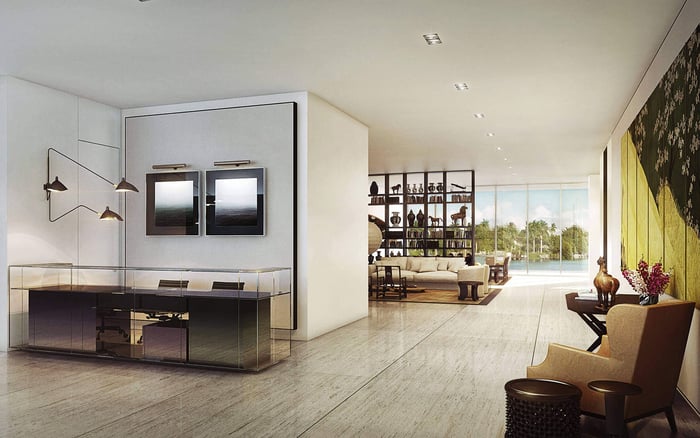
For collectors considering The Perigon Miami Beach, the decisive questions extend beyond views. Morning light, usable walls, controlled handling, climate specifications, emergency power and alteration rights should all be tested before purchase.

The appeal of The Perigon Miami Beach is immediately apparent: a boutique condominium on an Atlantic beachfront parcel in mid-Miami Beach, with direct eastern exposure from its Collins Avenue setting. Sunrise and sweeping coastal panoramas are integral to the experience. For an art collector, however, the most seductive architectural feature can also present the most consequential curatorial constraint.
A residence designed to function as both home and private gallery must be evaluated work by work. Monumental paintings require uninterrupted walls. Works on paper and textiles may be sensitive to strong light. Sculpture demands appropriate circulation and stable placement. A collection that changes frequently may require more flexibility than a static installation. The right residence is therefore not necessarily the largest. It is the plan that best reconciles art, privacy, entertaining and the oceanfront lifestyle.
East-facing residences can receive strong morning sunlight. That light can make the ocean orientation extraordinary, yet collectors should not assume every artwork belongs beside the glazing. Request window-performance information and ask a qualified adviser to assess how daylight moves through the specific residence rather than extrapolating from a rendering or brief showing.
Map proposed placements at different hours. Consider which pieces can tolerate brighter conditions and which should occupy deeper interior zones. Window treatments and specialized glazing strategies may be relevant, but their compatibility with the building and residence must be confirmed. Project-specific UV filtration is not established, so buyers should obtain current technical documentation before relying on the facade as a conservation measure.
This discipline applies across coastal Miami Beach. A collector comparing 57 Ocean Miami Beach should conduct the same artwork-by-artwork light study rather than treat an ocean view as a uniform condition.
Expansive glazing can reduce the continuous wall surface available for large paintings, multi-panel works or salon-style arrangements. Floor-plan review should therefore begin with a marked inventory of solid interior walls, including their width, height, interruptions and relationship to furniture circulation.
Ask where doors, millwork, controls and vents will sit. Determine whether a dining room can accommodate a major canvas without compromising service flow and whether a corridor provides sufficient viewing distance. A generous terrace may enrich daily life, but art near exterior doors requires particular care because of direct coastal exposure and frequent transitions between indoors and outdoors.
Collectors considering reinforced display walls, concealed blocking or customized lighting must verify which alterations condominium rules permit. The same question applies when evaluating design-led alternatives such as Faena House Miami Beach: architecture should be tested against the collection’s dimensions, not admired only in the abstract.
The Perigon’s low-density luxury format may provide a more private environment than a high-density tower-an attractive quality for owners who receive guests among valuable works. Privacy alone, however, is not a complete security plan. Collectors should examine the entire route from vehicle arrival to final installation.
Request current delivery procedures. Determine how specialist art handlers are admitted, where vehicles can wait, which elevator and corridors are used, and whether oversized works can negotiate every turn. A controlled arrival sequence can support discretion, but dimensions, scheduling rules and management approvals remain practical matters to confirm.
Security diligence should be equally precise. Ask which base-building provisions exist, which devices may be added inside the residence, and whether proposed systems satisfy the collector’s insurer. Surveillance specifications, dedicated art storage and insurer-approved security systems are not established. Buyers comparing Shore Club Private Collections Miami Beach should pose the same operational questions rather than infer protection from a property’s luxury positioning.
Art conservation depends on consistency as much as comfort. Obtain HVAC specifications for the selected residence and discuss the collection’s requirements with appropriate conservation and mechanical professionals. Ask how temperature and humidity are monitored, whether supplemental equipment is permitted, where it could be located, and how installation would affect ceilings, walls or service access.
Emergency-power coverage warrants separate attention. Buyers should identify which building and in-residence systems remain operational during an interruption and how long the applicable design is intended to support them. Project-specific humidity tolerances and backup-power coverage should not be assumed without written confirmation.
Condominium documents and alteration rules may ultimately determine whether gallery lighting, reinforced walls, security devices or supplemental climate systems are feasible. Review them before committing to a residence or an art-installation concept. The objective is not to turn a home into a museum. It is to create a calm, technically considered setting in which art and domestic life can coexist.
Before purchase, assemble a single diligence file containing the floor plan, measured wall schedule, window data, HVAC specifications, emergency-power scope, delivery rules and alteration requirements. Add proposed artwork locations and flag any piece requiring unusual access, low light or tighter environmental control.
The final residence decision should balance ocean views and natural light against usable walls, privacy and collection logistics. At The Perigon Miami Beach, that balance defines informed collector living: the panorama remains central, but it does not eclipse the practical architecture of stewardship.
Is The Perigon Miami Beach suitable for an art collector? Its boutique, low-density positioning and oceanfront setting may suit collector living, but suitability depends on the selected floor plan and the collection’s requirements.
Why is eastern exposure important for artwork? Direct eastern exposure can bring strong morning sunlight, making artwork placement and verified window performance important considerations.
Does a larger residence guarantee more display space? No. Expansive glazing and plan interruptions can leave less continuous wall area than the total square footage suggests.
What should buyers measure during floor-plan review? Measure solid wall widths and heights, viewing distances, door clearances, corridor turns, and the locations of vents, controls and millwork.
Can customized gallery lighting be installed? It may be possible, but buyers should verify condominium alteration rules and technical constraints before designing a lighting scheme.
Is project-specific UV filtration confirmed? No. Request current window-performance data and obtain specialist guidance for sensitive works.
What security questions should a collector ask? Ask about arrival control, surveillance provisions, permissions for in-residence devices, handler access and compatibility with insurer requirements.
Are dedicated art-storage rooms documented? Dedicated art storage is not established and should not be assumed without written confirmation.
What climate-control documents matter most? Request HVAC specifications, monitoring capabilities, supplemental-system rules and clear information about emergency-power coverage.
How should terrace access affect art placement? Keep sensitive works away from direct coastal exposure and consider how frequently exterior doors will be opened near proposed displays.
For a tailored shortlist and next-step guidance, connect with MILLION.
If branded residences are on your mind — as a home or as an allocation — we would be glad to share what we are seeing, privately.
Begin a quiet conversation