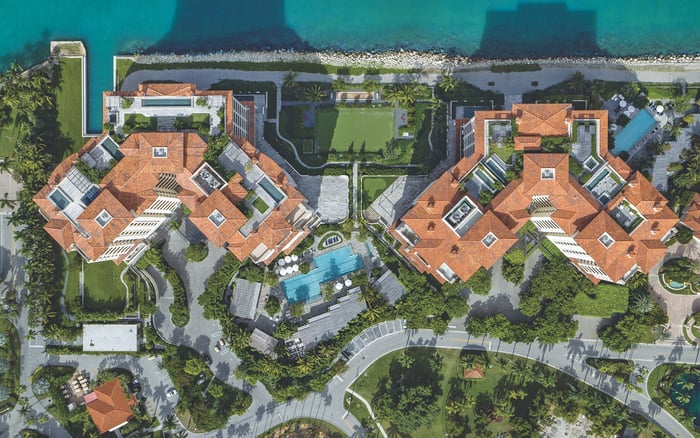
An absentee-owner audit for Palazzo del Sol, separating advertised amenities from the documented storage conditions, inventory controls, access permissions, and household responsibilities that support confident long-term ownership.

A residence should be as thoughtfully managed in its owner's absence as it is prepared for arrival. At Palazzo del Sol, ownership readiness is not simply a question of attentive service. It depends on whether storage, possessions, and access remain under clearly assigned control while the household is elsewhere.
Located at 7000-7095 Fisher Island Drive, the condominium's advertised amenities include private elevator entry, 24-hour front desk reception and security, and a multilingual concierge described as “six-star.” These features establish a service setting, not a complete absentee-owner operating agreement. Readiness begins where the amenity description ends: with written responsibilities, verified permissions, and a response plan.
For a purchaser, this audit belongs alongside the residence inspection and document review. For an existing owner, it should precede the next extended departure. The objective is quiet continuity: no uncertainty about who checks the residence, who may enter, or who responds when conditions change.
Air-conditioned storage spaces are advertised as available for purchase. That distinction matters: storage should not be assumed to accompany a residence, and advertised availability does not establish what can be acquired today.
Request documents identifying the specific space, the nature of the ownership or use right, and any transfer restrictions. Confirm permitted contents, access arrangements, charges, and maintenance responsibility. In a resale purchase, reconcile the seller's description with the documents rather than relying on a storage-room visit alone.
Then examine environmental performance. Ask for temperature and humidity targets, monitoring records, maintenance responsibility, and the procedure for notifying an owner when conditions drift. Determine whether monitoring is continuous, who receives alerts, and what happens if an alert goes unacknowledged.
Air conditioning is not a conservation specification. Before leaving sensitive furnishings, textiles, or collections, obtain an assessment appropriate to the objects and confirm insurance terms for that location. If a buyer is also considering Palazzo della Luna, ask the same document-led storage questions independently; one property's arrangements do not establish another's.
Fur-coat storage is among the advertised offerings, but current operating procedures, environmental specifications, and insurance arrangements require confirmation. It is not evidence of general art-storage suitability.
Likewise, floor-to-ceiling cabinetry for private wine collections should be understood as cabinetry unless refrigeration, humidity control, and monitoring are separately established. Elegant presentation and preservation are different obligations.
For each sensitive category, ask a qualified specialist to define acceptable conditions before assigning a location. Record who may handle the objects, whether packing is required, and where items should move if the space becomes unsuitable. Confirm the insurer's requirements rather than assuming building security or conditioned air resolves coverage questions.
This review need not be elaborate for ordinary household goods. Its purpose is to distinguish possessions that tolerate routine storage from those requiring a documented conservation plan.
A photographed digital inventory is a practical recommendation, not a documented building service. Each entry should carry a unique identifier, a useful description, a precise location, and current condition photographs. Retain valuation and insurance documentation where appropriate, with access limited to authorized people.
Locations should be specific enough for someone unfamiliar with the household to find an item without opening every cabinet. Distinguish the residence, purchased storage, and any specialist off-site location. Avoid a single category called “in storage”; it conceals the very information the inventory should preserve.
Movement control matters just as much. Record what left, who released it, who received it, its destination, and whether return is expected. Assign one person to reconcile those movements against the master inventory. A housekeeper, household manager, or specialist may perform different tasks, but accountability should remain explicit.
Before departure, reconcile the inventory against the physical locations. Before arrival, check outstanding movements and exceptions. Arrival preparation then becomes a controlled handover rather than a search for missing pieces.
Private elevator entry offers a discreet arrival experience, but does not by itself establish programmable or time-limited vendor permissions. Secured elevator, parking, and lobby access should not be mistaken for a detailed household-access protocol either.
Ask management to explain the approval sequence for a home-watch professional, technician, household employee, and emergency contractor. The written arrangement should address identity checks, permitted destinations, key or credential custody, elevator authorization, visit logging, and revocation.
Define which permissions are standing and which require fresh approval. Establish who may authorize entry while the owner is unreachable, what constitutes an emergency, and how the visit is documented afterward. Confirm that former employees and vendors can be removed from every relevant authorization record.
Buyers evaluating The Residences at Six Fisher Island can use this same access checklist in their own review without presuming identical systems or policies. The useful comparison is documented control, not the vocabulary of exclusivity.
Advertised amenities include a waterfront lounge, fitness center, treatment rooms, salon, children's playroom, and private theater. These enrich time in residence. They do not establish responsibility for inspecting an unoccupied interior or reconciling its contents.
Similarly, common-area maintenance coverage does not establish private household oversight. Set out interior inspections, HVAC checks, leak checks, storm preparation, incident escalation, and arrival preparation in a written scope, with responsibility assigned and frequency agreed.
Independent home-watch services are marketed on Fisher Island, but building access, eligibility, and contractual duties must be confirmed. Review insurance, reporting practices, backup staffing, and emergency authority before appointment. A concierge and a home-watch professional may have complementary roles; neither role should be inferred from the other.
The advertised emergency generator serves elevators and life-safety systems. That description does not establish backup power for residence HVAC or storage cooling.
Verify separately whether storage cooling, residence HVAC, sensors, and communications remain operational during an outage. Define who receives a loss-of-power notification, who can inspect safely, and what conditions trigger specialist intervention or relocation of sensitive possessions. The plan should not depend entirely on a monitoring device whose own power or connection may fail.
Before departure, assemble a concise operating file: storage documents, environmental requirements, inventory, access authorizations, service scopes, and emergency contacts. Treat an unresolved responsibility as an open task, not an implied amenity. Ownership readiness means the household can function without relying on the owner's immediate availability.
For a discreet perspective on ownership planning and South Florida residences, explore MILLION.
If branded residences are on your mind — as a home or as an allocation — we would be glad to share what we are seeing, privately.
Begin a quiet conversationAir-conditioned storage spaces are advertised as available for purchase. Confirm the specific residence's storage rights, transfer documents, and current availability separately.
Not on that description alone. Verify temperature and humidity targets, monitoring, outage procedures, and suitability for the particular possessions.
The mention of fur-coat storage does not establish suitability for art. Confirm current specifications, handling procedures, and insurance before placing sensitive objects there.
Floor-to-ceiling wine cabinetry is described, but refrigeration and monitored cellar conditions are not established. Verify those capabilities separately.
Use photographs, unique item identifiers, condition notes, and precise locations. Maintain movement records and name one person responsible for reconciliation.
No. Programmable or time-limited permissions require separate confirmation, along with authorization, identity checks, visit records, and revocation procedures.
The advertised concierge service does not establish an interior inspection obligation. Put home-watch duties, frequency, and escalation procedures into a written agreement.
The advertised generator serves elevators and life-safety systems. Backup power for storage cooling and residence HVAC requires separate verification.
Independent home-watch services are marketed on Fisher Island. Confirm Palazzo del Sol access approval, service eligibility, insurance, and the provider's contractual responsibilities before appointment.
Reconcile the inventory, confirm access permissions, and assign responsibility for inspections, storms, outages, and incident escalation. Keep those instructions and emergency contacts in a concise operating file.