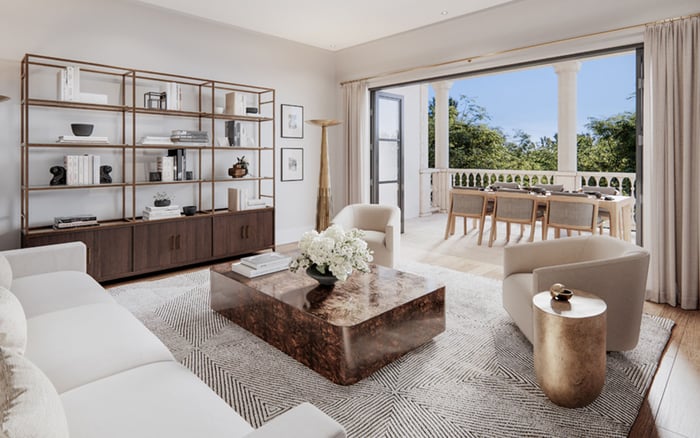
At a design-led residential community, the value of a shared room is measured not only by its appearance, but by whether an owner can reserve and use it as intended. Buyers who entertain should examine access, timing, guest, fee, staffing, and enforcement provisions before treating an amenity as an extension of the home.

For a buyer considering The Village at Coral Gables, the decisive question is not simply how a shared space looks. It is whether the space can be reserved, when it can be used, how many guests may attend, and what obligations accompany a private gathering.
That distinction belongs beside floor plan and finish in a rigorous purchase analysis. General access to a common room does not necessarily confer the right to close it to other residents. Nor does an elegant setting, by itself, establish permission for a seated dinner, business meeting, philanthropic reception, or catered salon.
In any residential community, shared spaces can make scheduling important. The lifestyle promise becomes practical only when the written operating framework aligns with an owner's actual pattern of entertaining.
A buyer should first establish what “access” means. A lounge may be open for informal resident use yet unavailable for exclusive reservation. Another space may allow private use only with advance approval, within a fixed time window, or under management supervision. These are materially different rights.
Request the current policy for each space under consideration, not a generalized amenity description. Identify who may book, whether reservations are confirmed in writing, how far in advance requests can be made, and whether recurring bookings are restricted. Buyers should also ask how competing requests are resolved and whether holidays or high-demand dates follow separate procedures.
This discipline applies across the local market. A buyer evaluating Cora Merrick Park and Ponce Park Coral Gables can pursue the same inquiry without assuming that communities with polished hospitality spaces operate them alike. Design and architecture define atmosphere; operating documents define usability.
Abstract questions rarely reveal enough. Buyers who entertain should model several realistic occasions: a private dinner, an early business presentation, an evening reception, and a weekend family celebration. For each, test the anticipated guest count, preferred day, setup time, event duration, vendor needs, and cleanup period against the applicable rules.
Advance-booking requirements can limit spontaneity. Guest caps may accommodate an intimate dinner while excluding a larger cultural or philanthropic gathering. Closing hours can curtail an evening even when the room itself appears ideal. Event-duration limits may also include setup and breakdown, further reducing the usable hosting window.
The same exercise applies when comparing nearby luxury options, including Four Seasons Residences Coconut Grove. The point is not to presume a policy at any property, but to make reservation mechanics a consistent part of due diligence throughout Coral Gables and the broader South Florida market.
Reservation availability is only one consideration. Private-event fees, refundable deposits, insurance requirements, and cleanup obligations can materially affect the economics of frequent hosting. A modest charge may be immaterial for an occasional celebration yet consequential when the space is intended for regular meetings or dinners.
Seek clarity on staffing, security, maintenance, noise control, and risk management. Determine whether building personnel must be present, whether outside vendors require approval, and whether the owner is responsible for post-event cleaning or damage. The governing documents and current operating policy should set out the framework and its practical application.
This is where buyer's guides must move beyond visual appeal. A beautiful room with costly or restrictive conditions may hold less personal value than a simpler space with predictable, workable access.
Written rules matter, but consistency matters as well. Buyers should ask how reservations are administered, how violations are addressed, and whether policies may be amended. A transparent, consistently enforced system protects both the host and neighboring residents.
Noise controls, security procedures, and guest limits are not merely constraints on entertaining. They help preserve privacy, order, and the quality of shared life. The buyer's task is to determine whether that balance suits the scale and cadence of anticipated events.
When considering other design-conscious communities such as The Well Coconut Grove, apply the same standard: request the rules rather than infer rights from imagery or sales language. Marketing descriptions should never be treated as guarantees of exclusive use or permission for private events.
Before relying on an amenity as an extension of the residence, request the current governing documents, reservation procedures, fee schedule, guest provisions, event hours, insurance terms, and cleanup requirements. Confirm which materials are binding, which are operating policies subject to change, and who has authority to approve an event.
Have counsel review the documents before closing, particularly if regular entertaining is central to the purchase decision. When an answer is material, obtain it in writing from the appropriate developer, association, or property manager. The objective is not to eliminate rules, but to understand precisely what ownership permits.
Does general amenity access include exclusive use? Not necessarily. Buyers should confirm whether a shared space can be privately reserved and under what conditions.
Why do advance-booking periods matter? They determine how spontaneously an owner can organize dinners, meetings, receptions, or other gatherings.
Are guest limits relevant for small events? Yes. Even an intimate salon or business gathering should be tested against the property's current guest provisions.
Can event hours affect a purchase decision? Yes. Closing times and duration limits can determine whether a space suits the owner's preferred hosting schedule.
What costs should a buyer investigate? Review event fees, deposits, insurance requirements, staffing charges, security, and cleanup obligations.
Why ask about setup and breakdown time? Those periods may count toward the reservation window, leaving less time for the event itself.
Should buyers rely on amenity renderings or marketing language? No. Presentation can illustrate a lifestyle, but written rules establish reservation and use rights.
Who should provide the current policies? Buyers should request them from the appropriate developer, association, or property manager.
Can operating rules change after purchase? Policies may be subject to amendment, so buyers should understand the governing authority and review process.
When should counsel review amenity rules? Counsel should review the relevant governing documents and current policies before closing when entertaining is a priority.
If you'd like a private walkthrough and a curated shortlist, connect with MILLION.
If branded residences are on your mind — as a home or as an allocation — we would be glad to share what we are seeing, privately.
Begin a quiet conversation