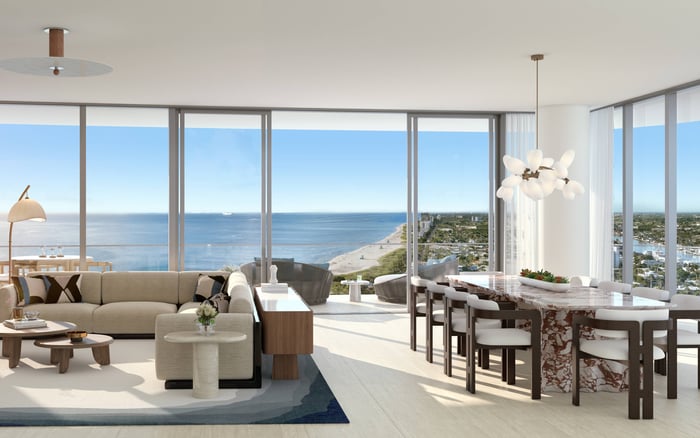
For Westchester sellers moving to Pompano Beach, the decisive luxury is not simply more space. It is a residence whose entrances, bedroom suites, circulation, storage, and operating rules support family, guests, and caregivers without compromising privacy.

For Westchester County households choosing Pompano Beach, the central question is not merely how many bedrooms a property offers. It is whether the home can accommodate overlapping generations, recurring guests, and professional care without eroding anyone's independence.
A large residence can still create daily friction if private areas depend on shared hallways, secondary occupants lack convenient bathroom access, or a caregiver cannot reach the person receiving care efficiently. A useful acquisition brief should therefore focus on how the household will operate, not simply on room counts.
The right floor plan separates private routines while keeping essential care close.
Before touring, buyers should assign a primary purpose to every flexible area. An aging parent may need a quiet bedroom, private bath, minimal level changes, and convenient access to family. An adult child may value a separate entrance and living area. Weekend guests need comfort without permanent storage overtaking the household. An overnight caregiver requires a practical route to the care recipient, along with bathroom access, parking, and secure storage.
Those uses are not interchangeable. A detached structure may suit an independent relative but prove inconvenient for overnight monitoring. A bedroom beside the primary suite may support care yet provide too little acoustic separation for an extended stay. A bonus room can look convincing during a tour while lacking the privacy, bathroom access, or approved use needed for sleeping accommodations.
Buyers should decide which needs are essential and which are optional before comparing properties. That distinction helps prevent an attractive but unsuitable layout from reshaping the household's priorities.
Scale alone does not establish multigenerational suitability. Buyers should map the daily route from the driveway to each bedroom, from sleeping areas to the kitchen, and from interior living spaces to a pool or dock. Every threshold, gate, and shared corridor can either preserve discretion or create friction.
Detached quarters can provide meaningful independence for grandparents, adult children, guests, or live-in staff. Their value depends on whether they are approved for the intended use, conveniently positioned, and practical during poor weather or an emergency. Connected suites may offer faster access while requiring more careful planning for sound, storage, and boundaries between private zones.
The touring process should test real routines. Buyers can consider how groceries arrive, where medications or care supplies would be secured, whether guests cross entertainment areas to reach a bathroom, and how household members move through the property at night.
Pools, docks, gates, patios, and outdoor routes increase the number of transitions requiring examination. Buyers should consider how a parent, guest, or caregiver moves among parking, sleeping quarters, the principal living area, and outdoor spaces.
The review should encompass lighting, surface changes, gates, pool separation, and the relationship between bedroom exits and the water. Accessibility, elevation, flood exposure, and emergency planning deserve added scrutiny when older adults will occupy secondary quarters. The objective is not to diminish the pleasures of coastal living. It is to ensure that the home's most appealing features do not complicate care or create avoidable risk.
Privacy planning also extends outdoors. A secondary suite may feel independent inside but lose that quality if its entrance opens directly onto a frequently used terrace or if access requires crossing the owners' principal entertaining area.
A condominium exchanges the compound model for service, security, and consolidated circulation. In that setting, privacy usually must be created within a single residence through en-suite bedrooms, thoughtful bedroom separation, and sufficient storage for longer stays. Buyers should test whether staff can enter, park, and reach the residence discreetly and whether building rules support the household's intended pattern of use.
A Pompano Beach comparison set may include The Ritz-Carlton Residences® Pompano Beach and Armani Casa Residences Pompano Beach, with attention directed to internal suite placement rather than total bedroom count alone.
The same review can be applied to Ocean 580 Pompano Beach and Waldorf Astoria Residences Pompano Beach. Project selection should follow a review of the applicable condominium documents covering guest occupancy, staff access, parking, and amenity use. Building services may simplify household operations, but they do not replace a privacy plan tailored to the occupants.
“In-law suite,” “bonus area,” “maid's quarters,” and “pool house” are marketing descriptions, not substitutes for legal verification. Buyers should confirm whether a space is permitted for the intended sleeping and living use, whether its plumbing and entrances are authorized, and whether association restrictions affect occupancy.
The physical inspection should be equally exacting. Confirm bathroom access that does not require crossing entertainment areas, storage for personal possessions and care supplies, and parking that does not displace the owners. Evaluate nighttime routes, door widths, level changes, and communication between the care recipient's room and the caregiver's quarters.
If future adaptation is anticipated, buyers should determine whether the layout can support it before purchase rather than assuming a renovation will resolve the issue. Relevant professionals can help assess approvals, physical conditions, association requirements, and the feasibility of proposed changes.
A strong acquisition brief can rank three principles. First, privacy: each long-term occupant should have a bedroom, bathroom, and routine that do not depend on passing through another person's private zone. Second, proximity: care should remain close enough to be practical, especially overnight. Third, adaptability: today's guest suite may become tomorrow's caregiver room or an adult child's longer-term base.
A successful Pompano Beach purchase therefore begins with people, not square footage. Define who stays, how often, for how long, and with what support. Then compare detached quarters, connected suites, and serviced condominiums against the same operating plan. The result should be a residence that feels generous not because every space is shared, but because each person retains an appropriate degree of independence.
For discreet guidance on aligning Pompano Beach property options with your household's privacy and care priorities, connect with MILLION.
If branded residences are on your mind — as a home or as an allocation — we would be glad to share what we are seeing, privately.
Begin a quiet conversationThe layout affects privacy, access, and daily household operations. Buyers should screen for the required configuration from the outset.
Not necessarily. Bathroom access, level changes, privacy, storage, and proximity to family or care support are also important.
Independent access can preserve autonomy for a parent or adult child while reducing traffic through the owner's private living areas.
It may provide useful separation, but buyers should confirm approved sleeping use, weather exposure, nighttime access, and proximity to the care recipient.
They should provide practical bathroom access, parking, secure storage, and a direct route to the care recipient's bedroom.
A condo generally creates guest privacy within one residence, making en-suite bedrooms, bedroom separation, and building-access rules especially important.
Review provisions governing guest residency, staff access, parking, and amenity use before committing to a purchase.
Confirm that it is legally permitted for the intended sleeping and living use, including relevant entrance, plumbing, and occupancy conditions.
Pools, docks, gates, and outdoor routes add transitions that can affect guest convenience, caregiver response, and safety.
Define who will use the secondary space, how often they will stay, how much independence they need, and whether professional care is anticipated.