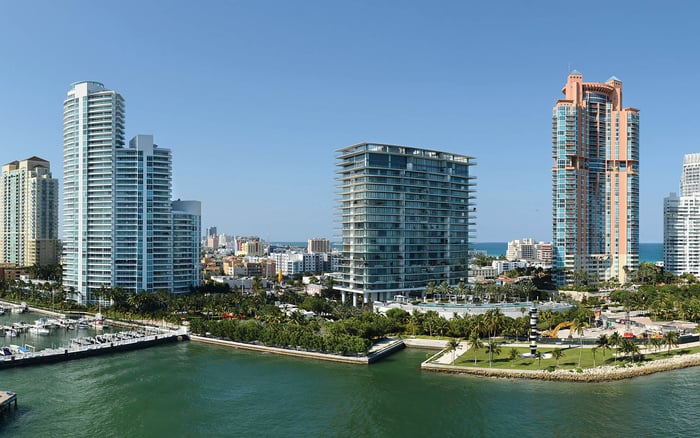
The Perigon’s advertised security and private-entry features address physical privacy, but digital safeguards require separate scrutiny. For second-home buyers, written answers on credentials, access logs, service records and deletion policies belong alongside the offering documents.

For a second-home buyer considering The Perigon Miami Beach, privacy has two dimensions: who can reach the residence, and who can reconstruct the household’s movements. A guarded arrival addresses the first. Policies governing credentials, cameras and service records address the second. Neither substitutes for the other.
Advertised features include 24-hour security, private elevator entry and an extensive residential service program. They merit attention, but do not establish cybersecurity capability. Network architecture, access-event logging and resident-data retention remain unverified in publicly disclosed project details. That is an unresolved diligence question, not evidence that protections are absent.
The buyer’s task is to distinguish advertised features from written operational commitments. This review examines that distinction; it does not assign a cybersecurity rating or claim to test installed systems.
A guardhouse entrance is planned, and a fully walled perimeter is described as part of the security and privacy program. Advertised features also include a private beach deck, gated resident beach access and direct, private elevator entry to each residence. Planned security arrangements cover the lobby and beach entrances, including a beach security officer; delivered staffing is not established.
Together, these features describe a controlled-arrival concept. They do not identify the beach gate’s credential technology, explain elevator authentication or establish floor-access restrictions. A private elevator arrival remains an architectural and circulation feature until its authorization rules are specified.
Buyers should request a written description of each access point and its intended users. Confirm who authorizes visitors, how staff access differs from resident access, and what happens when a credential is lost or a system is unavailable. Verify delivered arrangements against the applicable offering documents: plans, features and amenities are preliminary and subject to change as provided in those documents.
The more useful test is an ordinary week when the owner is away. A housekeeper needs recurring entry, a contractor needs a single visit, and a guest arrives after the household’s departure. Can each permission be separately issued, limited and withdrawn?
Request written rules for time-limited credentials, permitted entrances, elevator access and revocation. Ask whether a homeowner can end one vendor’s permission without replacing everyone else’s credentials, and who confirms that the change has taken effect. None of these capabilities is established for The Perigon in the disclosed details.
Home-management services and in-residence catering are advertised alongside concierge and butler services. For an absentee owner, diligence should also cover who may authorize entry on the owner’s behalf, how that authorization is recorded, and how emergency entry differs from a scheduled appointment.
If Five Park Miami Beach is also on a buyer’s shortlist, apply the same absence scenario there. This is a comparison framework, not a claim about either property’s installed technology.
An access credential and an access log are different things. The Perigon’s disclosed details do not establish which entries are recorded, whether records identify individuals, or who can review or export them. Buyers should not assume that every gate, elevator or visitor interaction generates the same record.
Request a plain-language record inventory. For each controlled entrance, ask whether the system retains a credential identifier, resident or visitor name, timestamp, photograph or attempted-entry result. These are questions for management, not confirmed Perigon data fields. Clarify whether a record identifies a person or merely the credential presented.
Then separate permission to enter from permission to examine records. Which staff roles can search an owner’s history? Can board members obtain it? Are searches and exports themselves audited? What approvals govern disclosure to service vendors or law enforcement?
The objective is accountable access without unnecessarily broad visibility into a household’s routine. More detailed records do not automatically improve privacy; their justification, review permissions and deletion rules must be considered together.
The advertised 24-hour security service does not establish whether building networks are segmented, which access-control vendor is used, how credentials are encrypted or where CCTV footage is stored. Those particulars remain unverified.
Ask for a buyer-appropriate explanation of network isolation and remote administration, rather than sensitive technical diagrams. Ask the developer or manager how resident-facing services are separated from security systems, who can connect remotely, and what controls govern outside maintenance access.
Security testing and incident response deserve equal attention. Request clarity on who commissions testing, who receives findings, who is responsible for remediation and who communicates with residents after an incident. If responsibilities will change between development and association management, ask how that handover will be documented.
A useful answer identifies responsible parties and written obligations. A general assurance of discretion, however sincerely offered, does not resolve operational questions.
The advertised service program includes a dedicated lifestyle concierge, residential butler, pool and beach attendants, in-residence dining, valet and house-car service. The restaurant and speakeasy are described as exclusive to residents and their guests, rather than public hospitality venues. That exclusivity does not, by itself, establish how service-related information is protected.
The operational question is what information these services retain, if any, and whether it can be connected across departments. Disclosed details do not establish retention periods, sharing rules or cross-linking practices for access logs, CCTV and concierge or valet records.
Request a schedule covering access events, camera footage, visitor registrations, vehicle records and concierge requests. Each category should identify its purpose, retention period, authorized viewers, sharing rules and deletion treatment, including backups and exceptions. The privacy policy referenced for website use should not be treated as the building’s operational privacy policy.
A buyer also considering Shore Club Private Collections Miami Beach should seek the same category-by-category answers. No conclusion about that property’s safeguards follows from this comparison.
The Perigon’s disclosed physical privacy features and service offerings warrant consideration. Its digital protections cannot be rated from those features alone. Before relying on them, request three written items from the developer, association and property manager, as applicable: access-control specifications, an operational privacy policy and a resident-data retention schedule.
Read those documents together. A temporary credential needs a clear expiry rule; a searchable log needs review controls; a deletion promise needs an explanation of backups and exceptions. The strongest second-home proposition is not simply convenient entry, but documented control over both access and the information it creates.
For a discreet conversation about your South Florida second-home priorities, connect with MILLION.
If branded residences are on your mind — as a home or as an allocation — we would be glad to share what we are seeing, privately.
Begin a quiet conversationYes, 24-hour security is advertised alongside valet and house-car service. That description does not establish cybersecurity capabilities.
A guardhouse entrance is planned, and a fully walled perimeter is described. Buyers should verify delivered arrangements against the applicable offering documents.
Gated resident beach access is advertised, but its credential technology is not specified in the disclosed details.
No. Direct, private elevator entry is advertised, but elevator authentication and floor-access restrictions remain unspecified.
Network segmentation, access-control vendors, credential encryption and CCTV storage architecture remain unverified. Missing public detail does not establish that safeguards are absent.
Disclosed details do not establish which entries are logged, whether records identify individuals or who can review and export them. Buyers should request a record inventory and permission rules.
Ask how housekeepers, contractors and home-management staff receive time-limited permissions, who authorizes them and how access is revoked. These capabilities are not established for The Perigon.
The referenced privacy policy concerns information collected through website use. It should not be treated as an operational policy for building access, cameras or resident services.
Retention periods, sharing rules and cross-linking practices remain unresolved. Request a schedule covering access logs, CCTV, visitor registrations, vehicle records and concierge requests, including backups.
Request written access-control specifications, an operational privacy policy and a resident-data retention schedule. Seek them from the developer, association and property manager, as applicable.